
Al-Baqara - The Cow
Arabic Name: الْبَقَرَة
Urdu Name: گائے
Type: Madani
Serial Number: 2
Revelation Order: 87
Total Verses: 286
Parah: 1,2,3
Rukus: 40
Sajda: None
Share Verse Art
Arabic
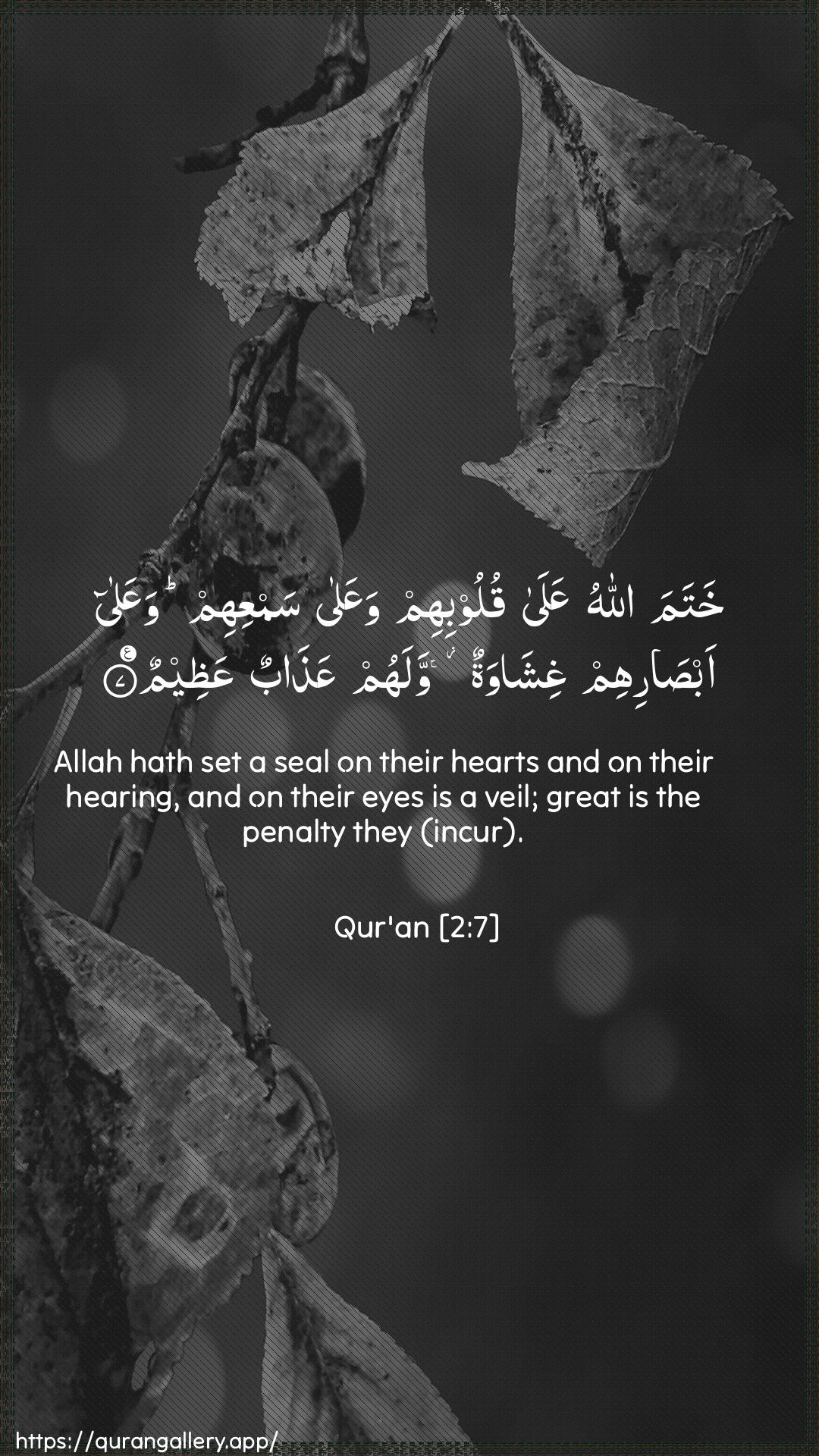
Arabic + English
Arabic (Wide)
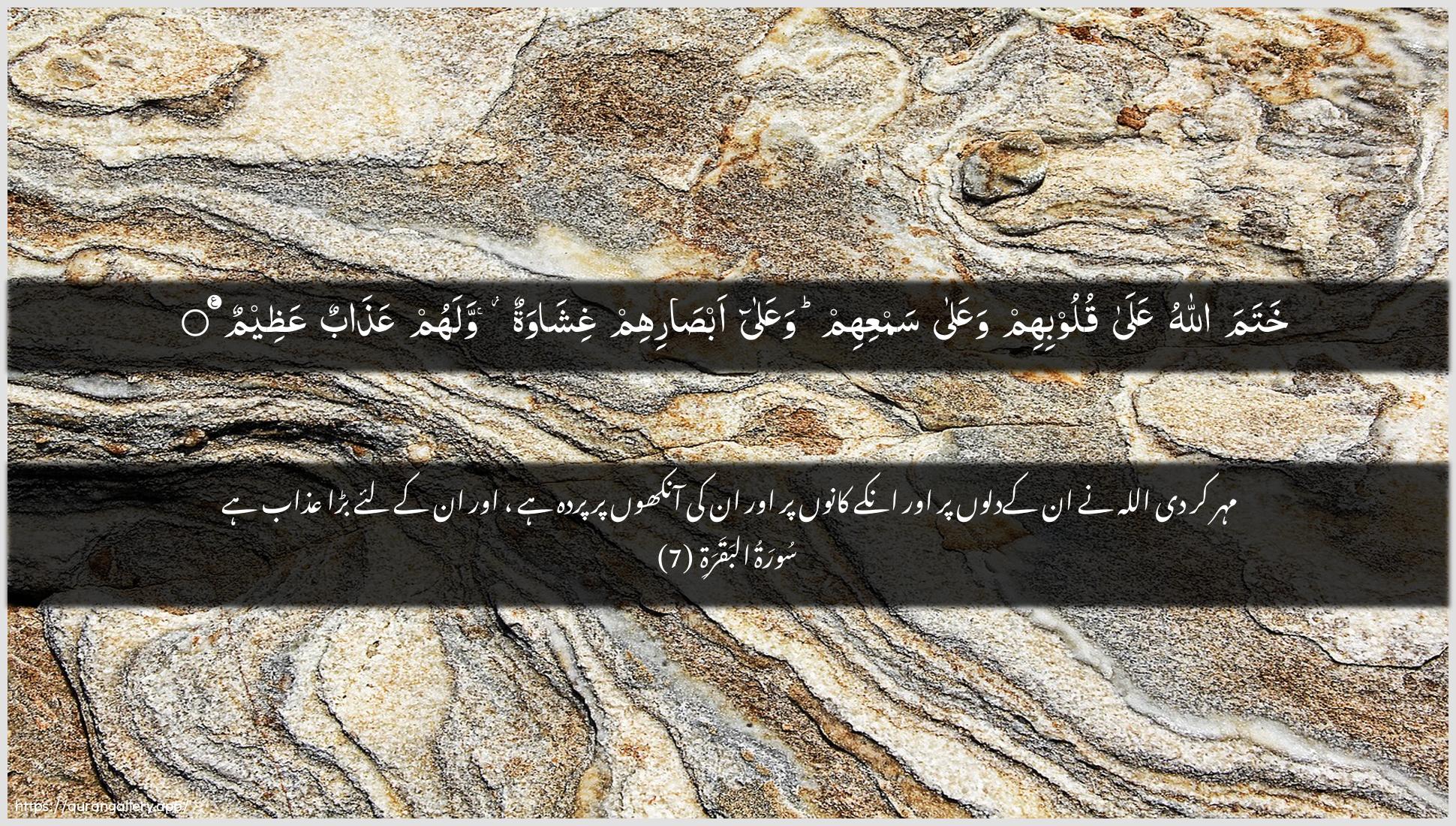
Arabic + Urdu
Free for personal & educational use with attribution
Quick Facts about this Verse
Surah
Al-Baqara
Revealed
Madani
Position
Juz 1,2,3
Explore this Verse
Verse Meaning
According to the classical scholar Al-Tabari, Quran 2:7 describes a divine action, a 'Khatm' or seal, placed upon the hearts and hearing of those who persistently reject faith. This is not an arbitrary act, but a consequence of their own choices. Ibn Kathir elaborates, referencing a hadith that explains how repeated sins create a 'Ran' (stain) on the heart, which, if unrepented, eventually leads to this divine seal. The synthesis of classical tafsirs reveals this is a multi-sensory spiritual state: the heart (the seat of understanding) and hearing are sealed, preventing comprehension and acceptance of guidance, while the eyes are covered by a 'ghishawah' (veil), obstructing the perception of truth. This state is a just recompense for their deliberate turning away from the clear signs, resulting in an inability to access guidance and culminating in a 'great punishment' as a final consequence.
Questions for Reflection
personal
Al-Tabari describes the heart as a vessel for knowledge. Reflect on your own heart: what 'sins' or worldly attachments might be creating 'stains' that prevent the light of the Quran from fully entering? What single, practical step can you take this week to begin polishing your heart?
relational
Ibn Kathir notes that this state prevents them from hearing, comprehending, or understanding guidance. Consider your interactions: when someone offers you sincere advice that challenges your views, is your 'hearing' truly open, or do you immediately become defensive? How can you practice receptive listening as a spiritual discipline?
cosmic
The verse speaks of a 'ghishawah' (veil) over the eyes. Al-Qurtubi connects this to the inability to see the signs of Allah in creation. Step outside and observe one natural phenomenon—a cloud, a tree, an insect. Contemplate how a veiled eye sees only the object, while a seeing eye perceives the power and wisdom of the Creator behind it. What does this teach you about the reality of seeing?
Practical Applications
Practice immediate repentance (Tawbah) after a sin to prevent the spiritual 'stain' (Ran) from accumulating on the heart.
In an age of constant exposure to temptation, developing a habit of quick repentance is a crucial spiritual defense mechanism.
Engage in active listening to the Quran and Islamic reminders, consciously intending to understand and benefit, not just to hear.
Actively listen to Islamic lectures or Quran recitation during commutes instead of passively consuming entertainment.
Cultivate humility (Khushu') by consciously reflecting on the signs of Allah in creation and in your own life.
Keep a gratitude journal, noting daily blessings to foster humility and prevent the spiritual blindness of entitlement.
Hidden Gem
The synthesis of tafsirs reveals a spiritual principle: your outer senses are a reflection of your inner state. The inability to physically perceive the truth (veiled eyes, sealed ears) is the culmination of a heart that has already chosen to close itself. Contemplate this connection: true sight is not of the eyes, but of the heart. How does this change your understanding of what it means to 'see'?
Scroll to see more verses or use the dropdown in the breadcrumb to jump to any verse
Common Questions
1 more question available in the full page