
Al-Baqara - The Cow
Arabic Name: الْبَقَرَة
Urdu Name: گائے
Type: Madani
Serial Number: 2
Revelation Order: 87
Total Verses: 286
Parah: 1,2,3
Rukus: 40
Sajda: None
Share Verse Art

Arabic
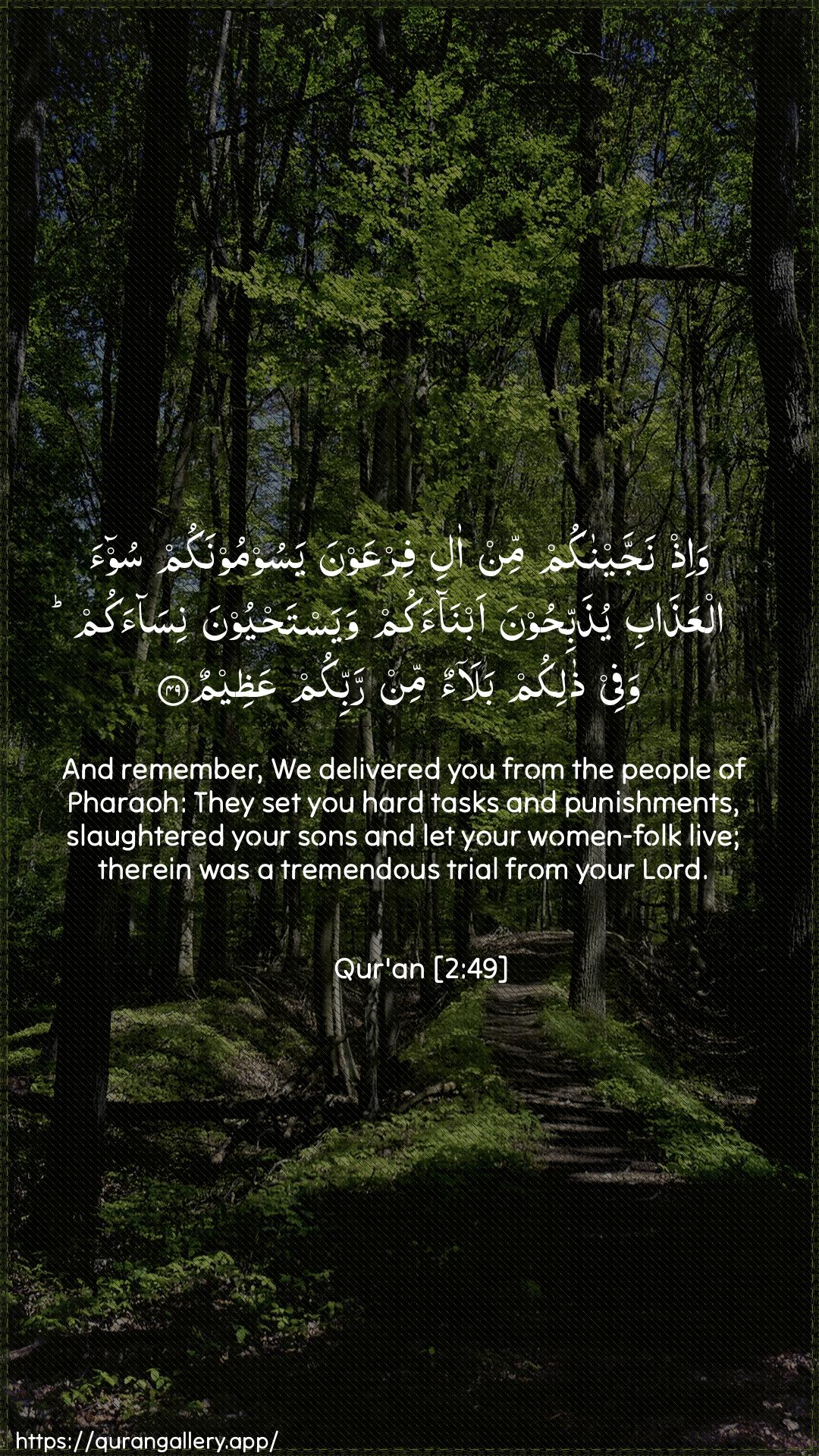
Arabic + English
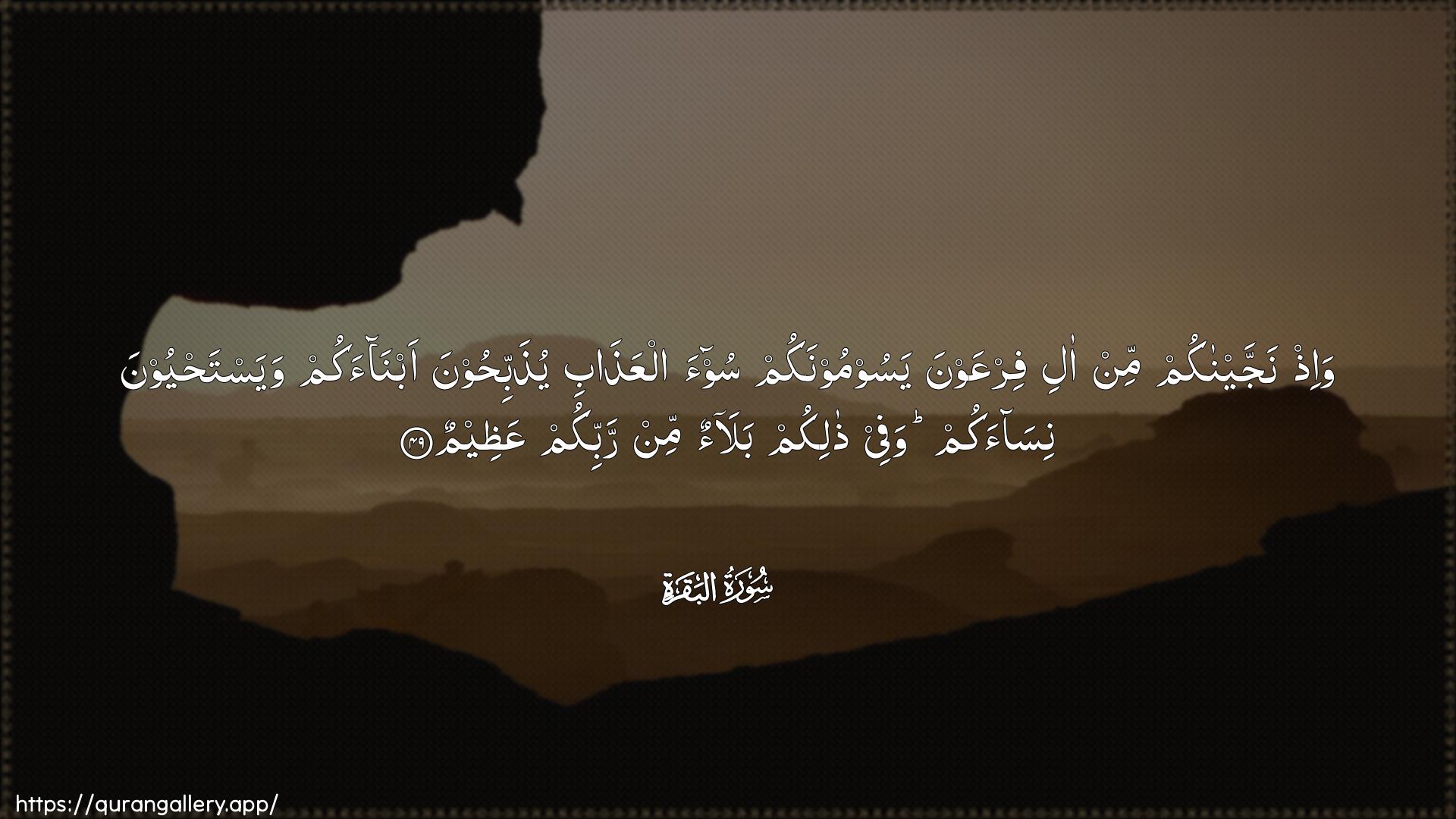
Arabic (Wide)

Arabic + Urdu
Free for personal & educational use with attribution
Quick Facts about this Verse
Surah
Al-Baqara
Revealed
Madani
Position
Juz 1,2,3
Explore this Verse
Verse Meaning
According to the classical exegete Ibn Kathir, verse 2:49 of Surah Al-Baqarah is a powerful reminder from Allah to the Children of Israel, recounting His monumental favor in rescuing them from the tyranny of Pharaoh and his people. This deliverance is detailed as a release from the 'worst of torment' (sū’ al-‘adhāb), which, as Al-Tabari explains, manifested in two horrific acts: the systematic slaughter of their newborn sons and the debasing humiliation of sparing their women for servitude. The synthesis of scholarly interpretations reveals a profound dual meaning in the concluding phrase, 'a great trial (balā’) from your Lord.' Al-Qurtubi and others note that 'balā’ here signifies both the severe test embodied by the persecution itself and, simultaneously, the magnificent blessing and favor embodied by their miraculous salvation. This comprehensive analysis shows that the verse is not merely a historical account but a deep theological lesson: even the greatest calamities are a test of patience, and the deliverance from them is a test of gratitude, both being immense trials from Allah.
Questions for Reflection
Historical Empathy
Ibn Kathir and Al-Tabari narrate that Pharaoh's decree was based on a prophecy that an Israelite boy would end his kingdom. Contemplate the state of a community where every newborn son is a death sentence. How does immersing yourself in their state of fear and helplessness transform your understanding of the phrase 'We saved you' (najjaynākum)? What does true salvation feel like against such a backdrop?
Personal Trials
Al-Qurtubi explains that 'balā'' encompasses both the severe torment and the great deliverance. Reflect on a significant hardship you have faced. Can you identify both the 'torment' aspect (the pain, the struggle) and the 'deliverance' aspect (the lessons learned, the strength gained, the mercy shown)? How does this verse challenge you to see even your deliverance not as an endpoint, but as a new test—a test of gratitude?
Theological Understanding
The verse attributes the torment to 'Pharaoh's people' but the trial ('balā'') to 'your Lord'. Contemplate the divine wisdom in allowing human cruelty to become the instrument of a divine test. How does this distinction shape your understanding of suffering and divine justice? How does it help you reconcile the existence of evil with the reality of an all-powerful, merciful Lord?
Practical Applications
Cultivate communal gratitude by collectively recalling historical hardships and divine interventions in your family or community's history.
During community gatherings or family meetings, share stories of past struggles overcome, explicitly framing them as divine deliverance to build resilience.
When facing personal hardship, reframe it as a 'balā'' (trial) by recalling this verse, understanding it as a test of faith that holds the potential for a great deliverance.
In moments of personal crisis (job loss, illness), consciously label the situation as your 'balā'' and reflect on this verse to find strength and hope for deliverance.
Protect the vulnerable in your society, especially children and women, as a conscious act of showing gratitude for your own safety and deliverance.
Support organizations that protect children and women from exploitation, volunteer at shelters, or advocate for policies that safeguard the vulnerable in your community.
Hidden Gem
The synthesis of scholarly thought reveals a subtle insight: the deliverance itself ('najjaynākum') is part of the 'balā'' (trial). The ultimate test wasn't just enduring the oppression, but how the Israelites would act *after* being saved. Their subsequent history, filled with ingratitude, shows they struggled with the 'test of the blessing' more than the 'test of the torment'. This reframes the entire concept of divine trials.
Scroll to see more verses or use the dropdown in the breadcrumb to jump to any verse