
Al-Baqara - The Cow
Arabic Name: الْبَقَرَة
Urdu Name: گائے
Type: Madani
Serial Number: 2
Revelation Order: 87
Total Verses: 286
Parah: 1,2,3
Rukus: 40
Sajda: None
Share Verse Art

Arabic
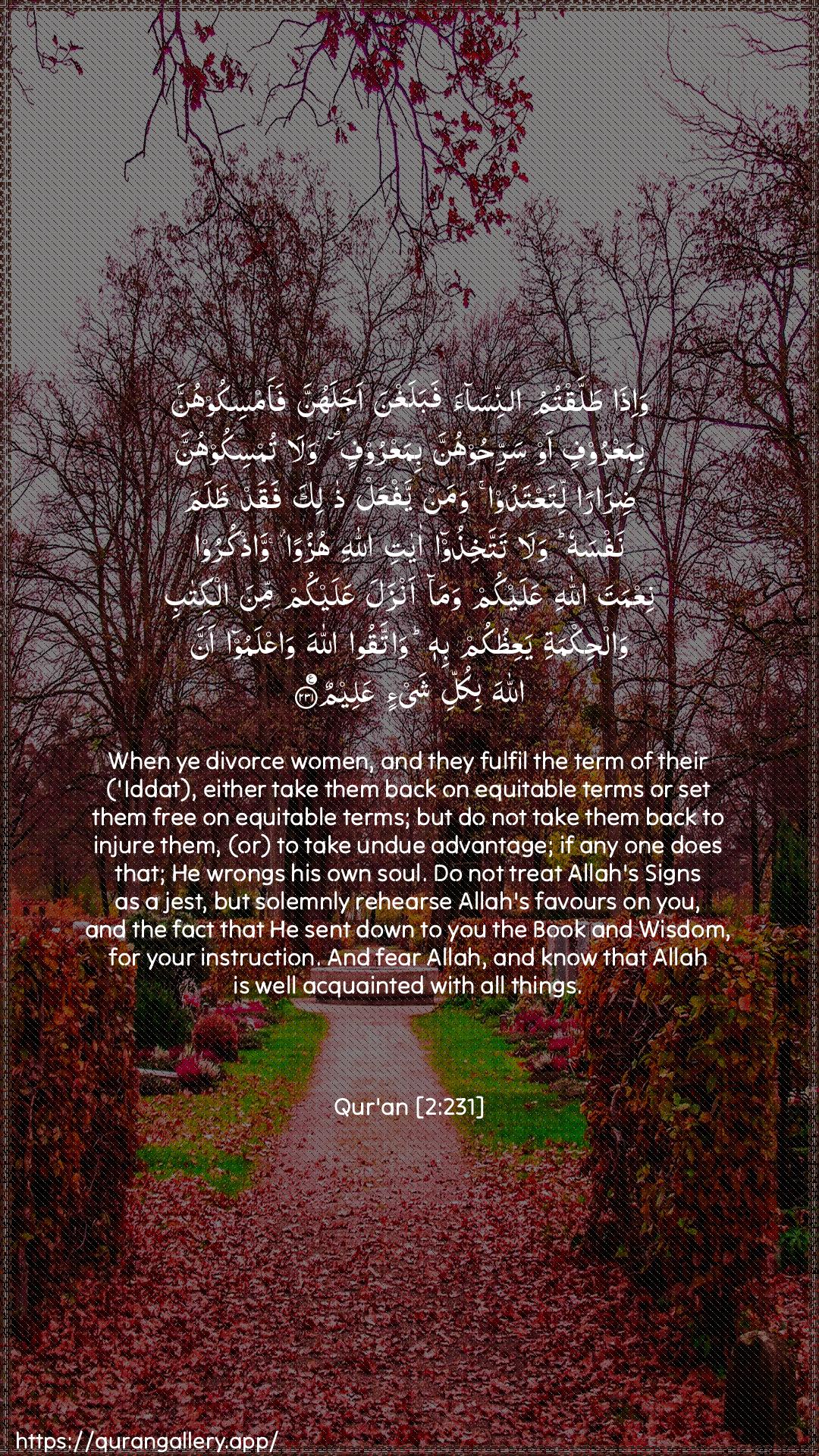
Arabic + English
Arabic (Wide)
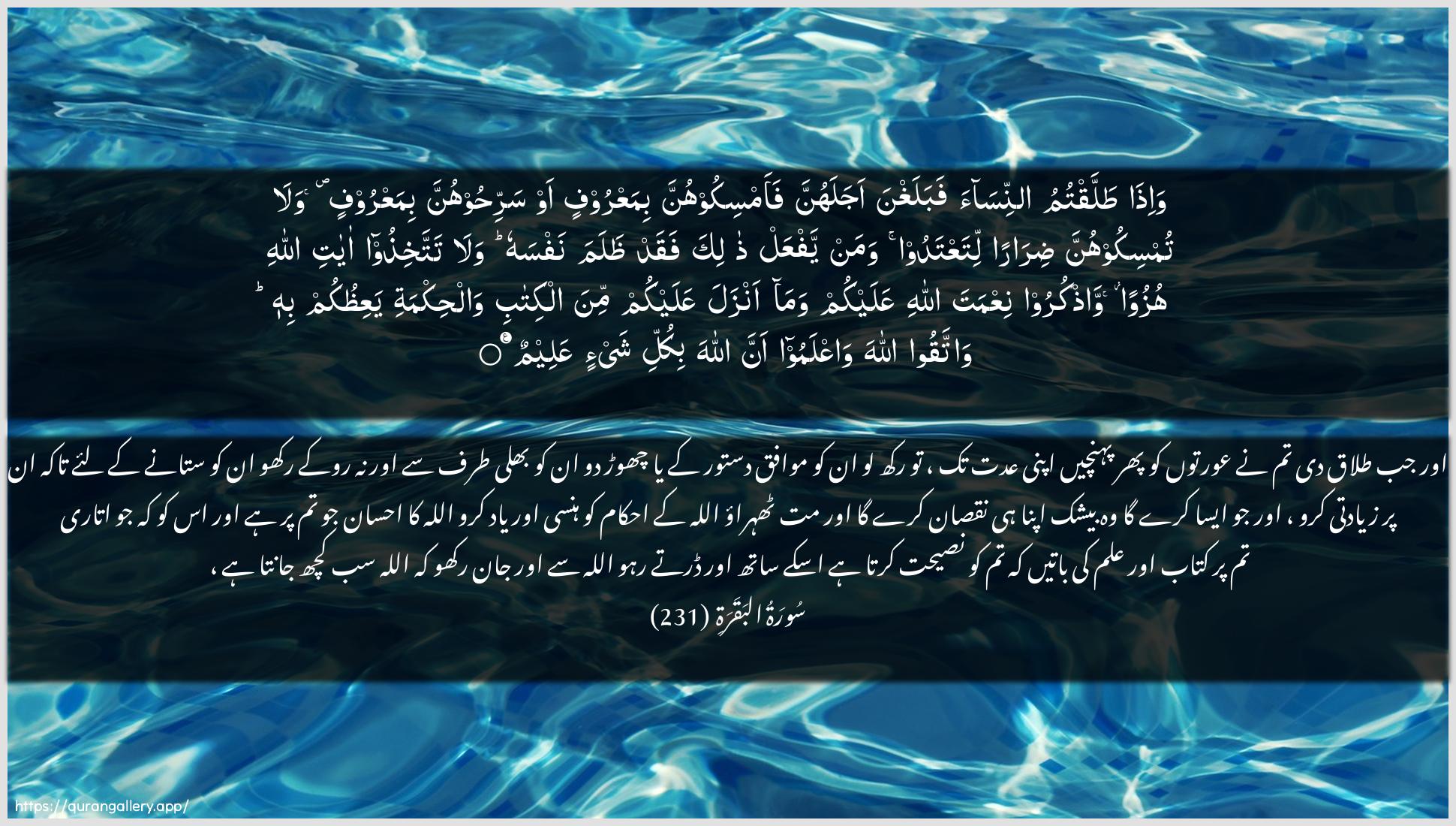
Arabic + Urdu
Free for personal & educational use with attribution
Quick Facts about this Verse
Surah
Al-Baqara
Revealed
Madani
Position
Juz 1,2,3
Explore this Verse
Verse Meaning
According to the great classical exegete Imam Al-Tabari, Quran 2:231 serves as a cornerstone of marital justice in Islam, directly confronting and abolishing a harmful pre-Islamic practice. The verse provides a clear directive for a husband who has issued a revocable divorce: as the wife's waiting period (`iddah`) nears its end, he has a choice between two honorable paths—genuine reconciliation (`imsak bi ma'ruf`) or a dignified separation (`tasrih bi ma'ruf`). A comprehensive synthesis of tafsirs from Ibn Kathir and Al-Qurtubi reveals a profound legal and ethical prohibition against a third, malicious option: retaining the wife not out of love, but for `dirar` (harm), simply to transgress her rights and prolong her suffering. This act of weaponizing the waiting period is condemned as a profound self-inflicted injustice (`zulm`). The verse culminates in a stern warning against treating Allah's sacred ordinances as a mockery (`huzuwan`), a principle underscored by prophetic traditions that confirm the legal validity of divorce or marriage pronounced even in jest, emphasizing the gravity of these commitments.
Questions for Reflection
personal
The verse warns, 'whoever does that has certainly wronged himself.' Drawing on Ibn Kathir's explanation of this self-inflicted harm, contemplate how harboring intentions of 'dirar' (harm) towards another—even when legally permissible—poisons one's own soul, erodes one's `taqwa`, and distances oneself from Allah's mercy.
relational
This verse presents a clear choice: 'retain them in kindness or release them in kindness.' Reflect on how this binary choice eliminates any middle ground for passive aggression, emotional manipulation, or causing distress. How does this principle of clear, kind action apply to ending any relationship or commitment in your life, not just marriage?
theological
The verse commands, 'Do not take the verses of Allah in jest.' Al-Qurtubi links this to the hadith where even divorce in jest is binding. Contemplate the profound sanctity of divine law. Why does Allah command such seriousness? How does a society's health depend on treating sacred commitments—marriage, contracts, promises—with the gravity they deserve?
Practical Applications
Before revoking a divorce, perform an 'intention audit': ask if the desire is for genuine reconciliation or to exert control and prolong the wife's uncertainty.
Applicable in marital counseling or personal reflection to prevent emotional and psychological abuse during separation proceedings.
Treat the words of marriage and divorce with the utmost seriousness, understanding that even statements made in jest have real-world legal and spiritual consequences.
A crucial reminder in an age of casual communication, where sacred matters can be easily trivialized online or in careless conversation.
Hidden Gem
The synthesis of scholarly thought reveals a subtle insight: the command to 'remember Allah's favor upon you' is placed directly after the prohibition of injustice and mockery. This suggests that the ability to be just and respectful of divine law is itself a divine gift (`ni'mah`). Forgetting this gift leads to arrogance and the misuse of the power dynamics inherent in divorce.
Scroll to see more verses or use the dropdown in the breadcrumb to jump to any verse