
Al-Baqara - The Cow
Arabic Name: الْبَقَرَة
Urdu Name: گائے
Type: Madani
Serial Number: 2
Revelation Order: 87
Total Verses: 286
Parah: 1,2,3
Rukus: 40
Sajda: None
Share Verse Art

Arabic
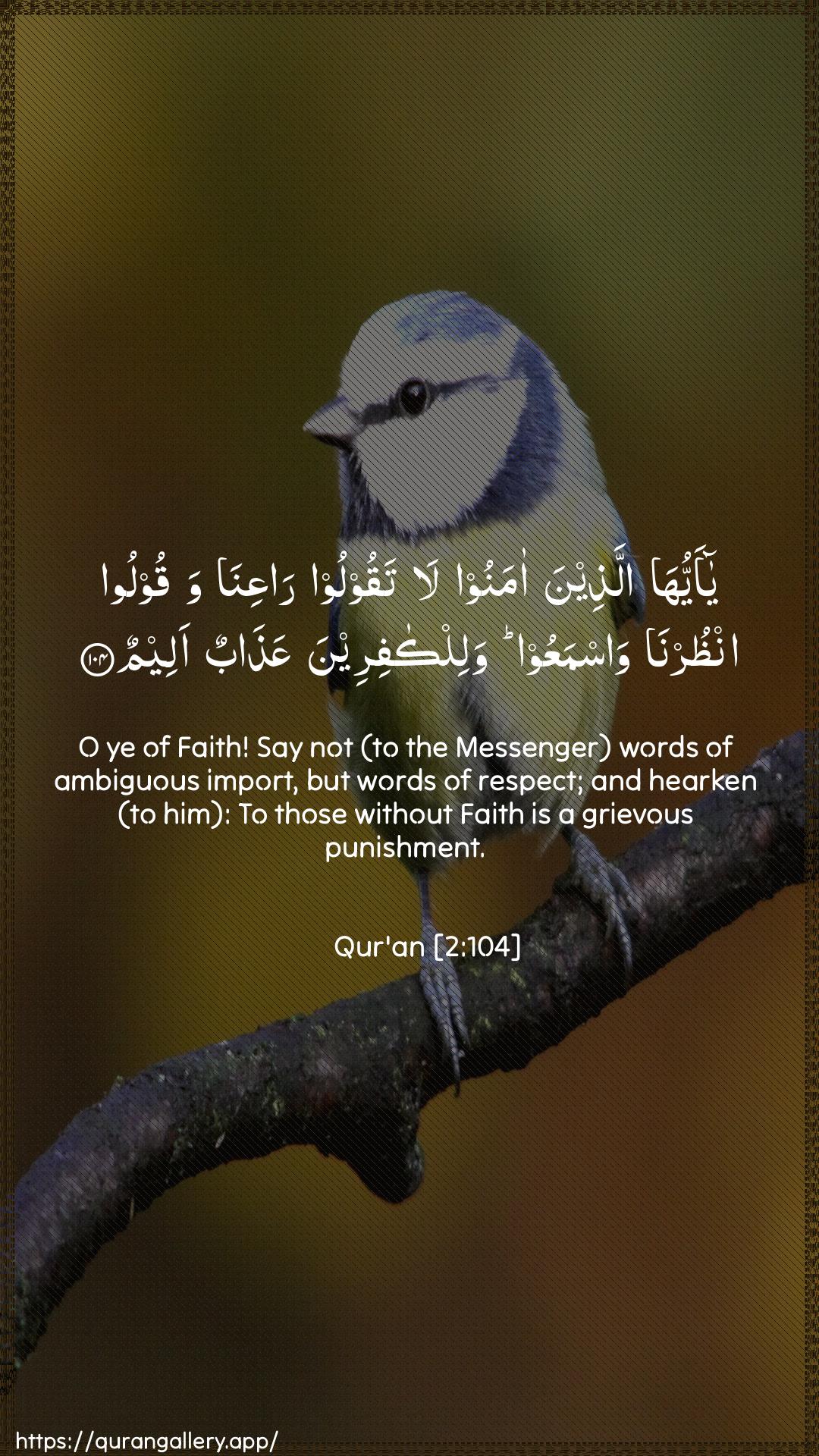
Arabic + English
Arabic (Wide)
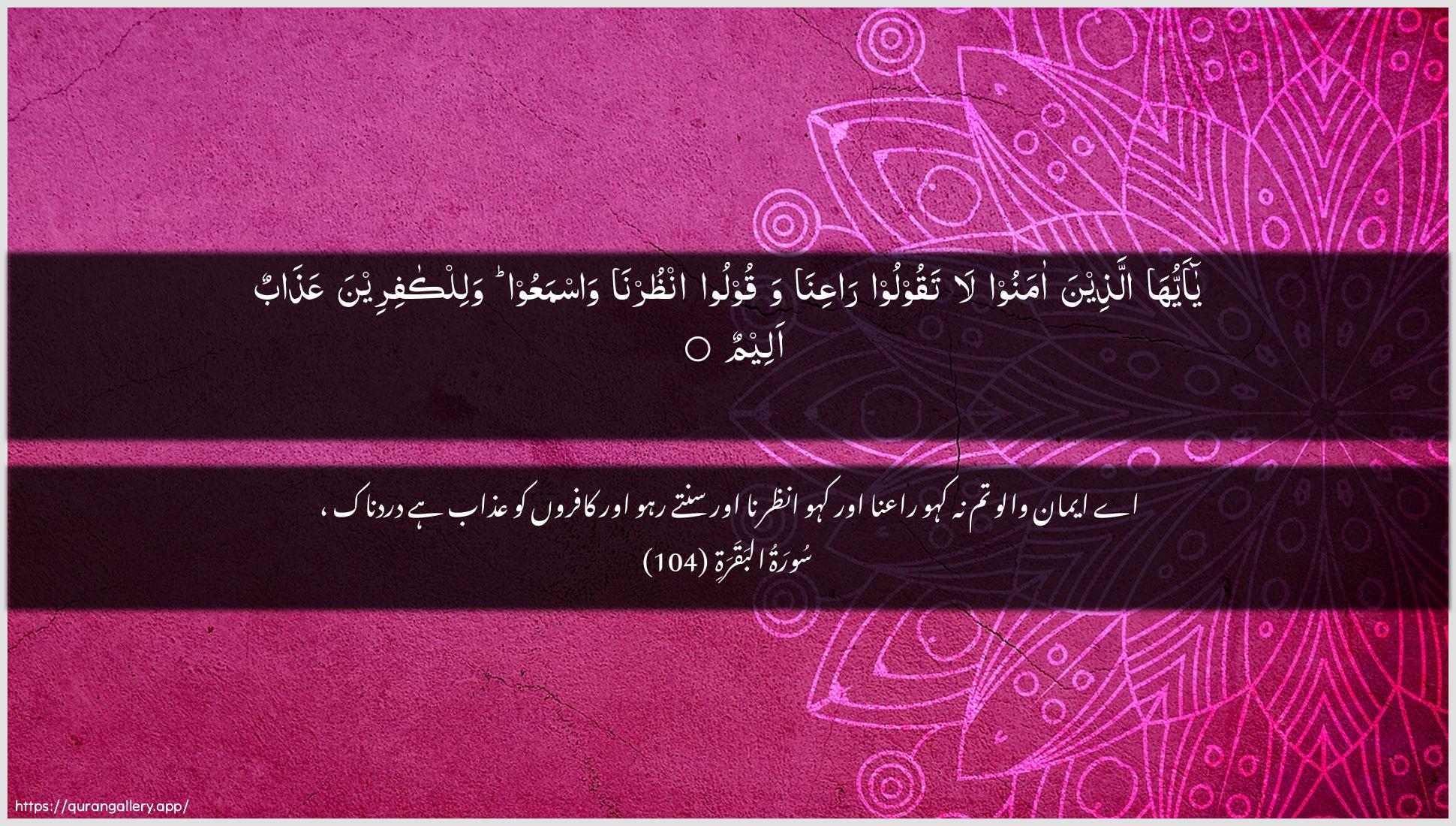
Arabic + Urdu
Free for personal & educational use with attribution
Quick Facts about this Verse
Surah
Al-Baqara
Revealed
Madani
Position
Juz 1,2,3
Explore this Verse
Verse Meaning
According to the classical scholar Ibn Kathir, Quran 2:104 is a foundational lesson in the etiquette of addressing the Prophet Muhammad (ﷺ) and a divine command to prevent the imitation of disbelievers. The verse addresses a subtle yet malicious linguistic trick employed by the Jews of Medina. While believers used the word 'rā'inā' to mean 'attend to us' or 'look upon us', the Jews would twist the pronunciation to imply insult, such as 'our shepherd' or 'the foolish one,' a curse in Hebrew. As Al-Tabari and Qatadah explain, this act was a form of mockery disguised in an apparently innocent word. The synthesis of scholarly opinions reveals a profound principle in Islamic law: 'sadd al-dhara'i' or 'blocking the means to evil.' Allah did not just forbid the insult; He forbade the very word that could be used as a vehicle for it, even when used with a pure intention. This comprehensive analysis shows the verse is not merely about a single word, but about cultivating a community consciousness that prioritizes respect for divine messengers, avoids ambiguity that can be exploited by enemies, and establishes a distinct Muslim identity separate from those who harbor ill will. The command to say 'unẓurnā' ('watch over us') provided a clear, respectful alternative that fulfilled the believers' need without opening the door to mockery.
Questions for Reflection
Personal Accountability
Ibn Kathir emphasizes that the Jews intentionally used ambiguous words to hide their mockery. Reflect on your own speech: are there instances where you use sarcasm, double meanings, or subtle digs that, while not explicitly forbidden, create a negative or confusing environment? How does this verse call for absolute sincerity (ikhlas) not just in intent, but in the very words we choose?
Communal Protection
Al-Qurtubi derives the principle of 'sadd al-dhara'i' (blocking the means to evil) from this verse. Contemplate your role in your community (family, workplace, masjid). What 'rā'inā'-like words or practices exist that, while seemingly harmless, are being exploited or could be exploited to cause division, disrespect, or mockery of your shared values? How does this verse empower you to suggest a better 'unẓurnā'?
Spiritual Identity
Al-Tabari details various narrations about the origin of the word. The final command creates a distinct linguistic practice for believers. Contemplate how the specific words we use as Muslims (e.g., 'Assalamu Alaikum', 'Insha'Allah', 'Masha'Allah') are not just phrases, but markers of a unique identity. How does choosing 'unẓurnā' over 'rā'inā' represent a declaration of allegiance and a conscious separation from the patterns of those who disbelieve?
Practical Applications
Audit your vocabulary for ambiguous words that could be misunderstood or misused, especially when addressing scholars, elders, or leaders.
Applicable in emails, social media comments, and public forums where tone is easily misconstrued and words can be twisted.
Proactively create a glossary of respectful terms for your family, team, or community to replace ambiguous or outdated language.
Crucial for organizations developing communication guidelines, or families aiming to instill respectful speech in children.
Practice the principle of 'Sadd al-Dhara'i' (blocking the means) by identifying and avoiding actions or words that, while permissible, could lead to haram or mockery of Islam.
Relevant to decisions about social media engagement, business partnerships, or friendships that might inadvertently compromise Islamic values.
Hidden Gem
A synthesis of the tafsirs reveals a deeper insight: the command was not just to protect the Prophet, but to train the believers. By making them change their own permissible speech to counter the malice of others, Allah was teaching them that the integrity of the community sometimes requires sacrificing personal convenience for the greater good. It was an exercise in collective spiritual responsibility.
Scroll to see more verses or use the dropdown in the breadcrumb to jump to any verse