
Al-Baqara - The Cow
Arabic Name: الْبَقَرَة
Urdu Name: گائے
Type: Madani
Serial Number: 2
Revelation Order: 87
Total Verses: 286
Parah: 1,2,3
Rukus: 40
Sajda: None
Share Verse Art
Arabic
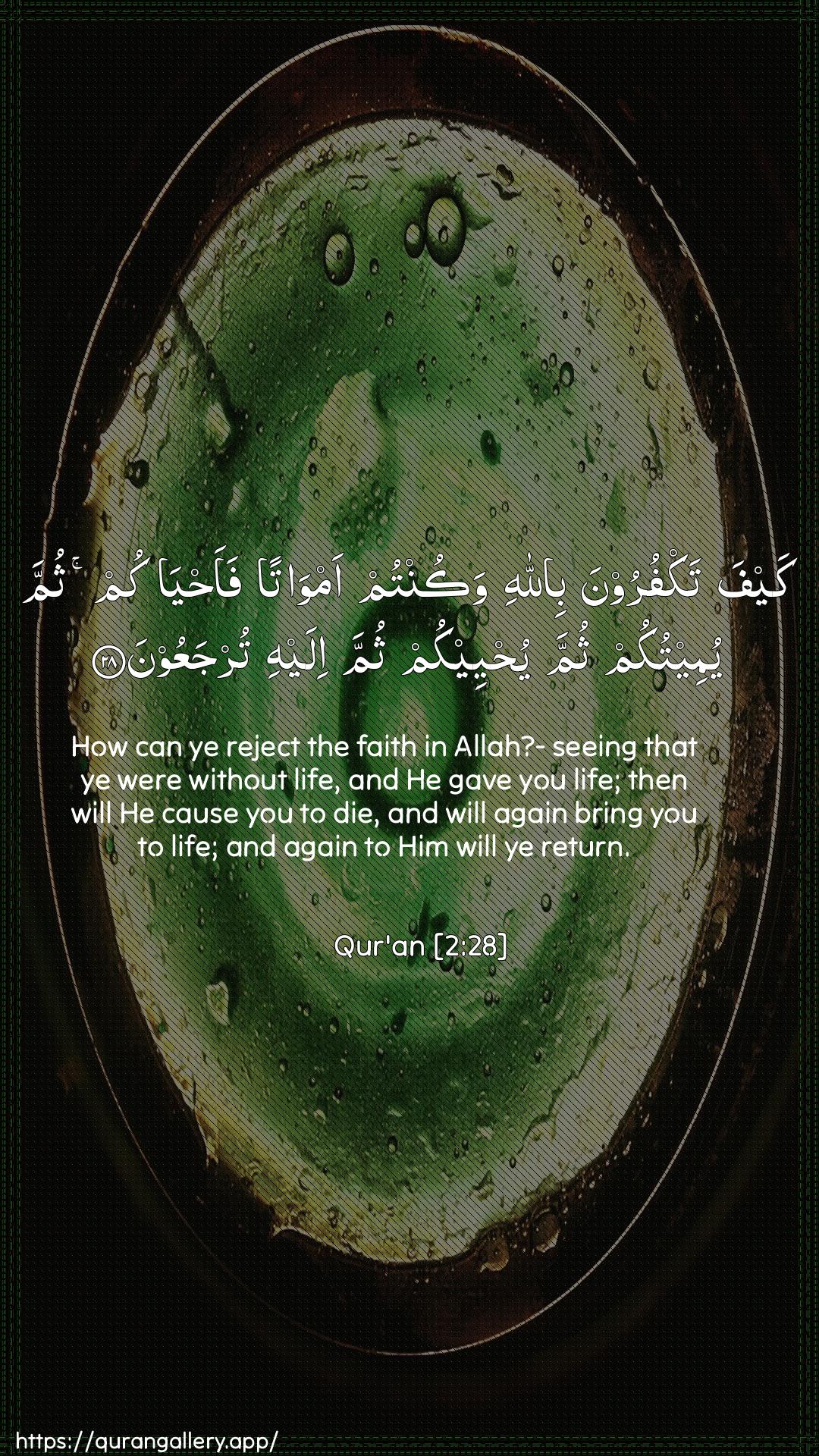
Arabic + English
Arabic (Wide)
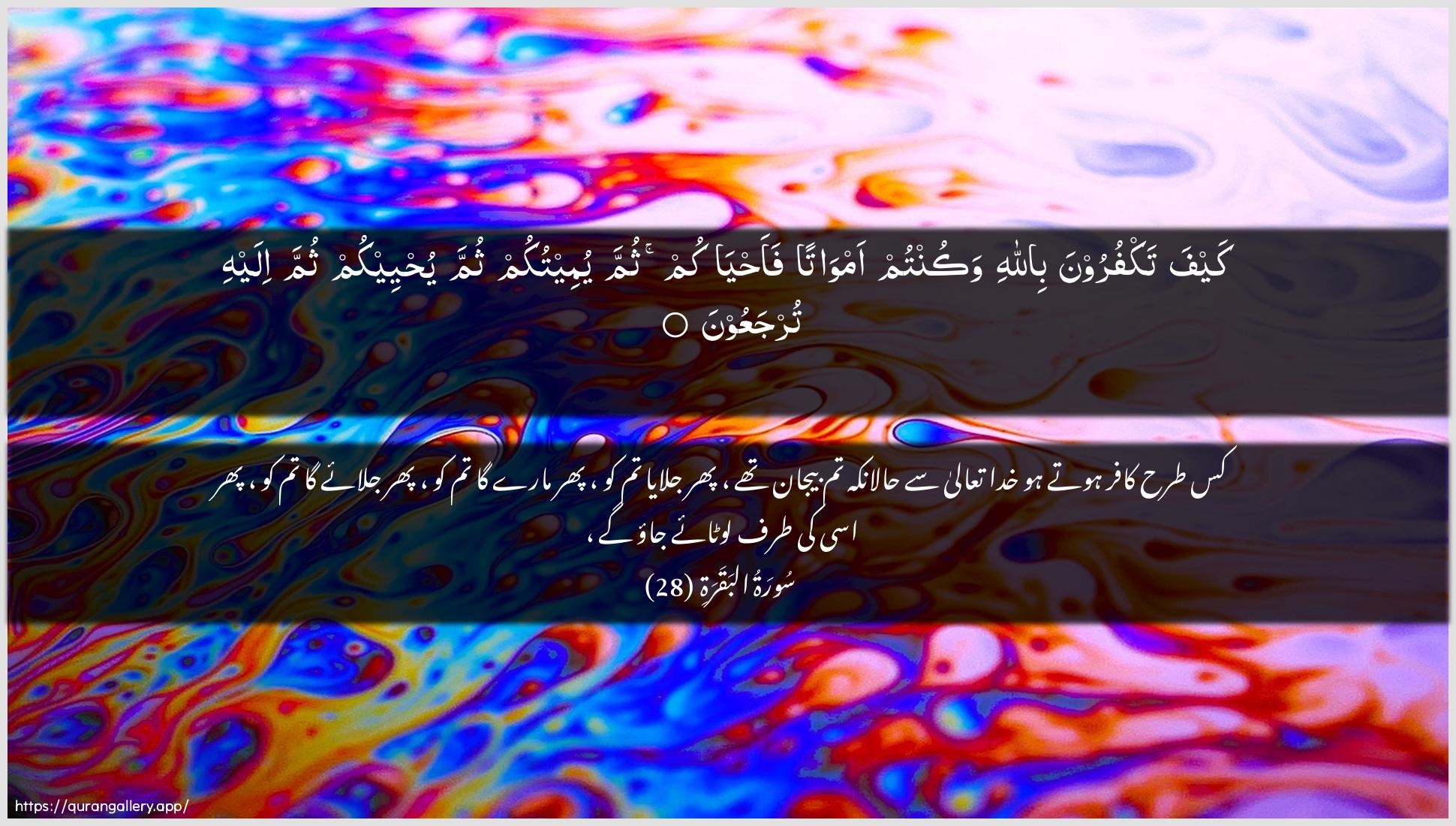
Arabic + Urdu
Free for personal & educational use with attribution
Quick Facts about this Verse
Surah
Al-Baqara
Revealed
Madani
Position
Juz 1,2,3
Explore this Verse
Verse Meaning
According to the classical exegete Ibn Kathir, verse 2:28 of Surah Al-Baqarah presents a powerful and undeniable argument against disbelief by challenging humanity with the reality of its own existence. A comprehensive synthesis of classical tafsirs from authorities like Al-Tabari and Ibn Abbas reveals that the verse's opening, 'and you were lifeless (amwatan),' refers not to a physical death but to the state of non-existence before creation. This initial 'death' is the foundation of the proof. Allah then gave life, will cause the ordained death in this world, and will give life again for the resurrection, culminating in the final return to Him. What emerges from this comprehensive analysis is the revolutionary insight that the verse uses the four-stage cycle of human existence as a self-evident proof of God's absolute power and the reality of the Hereafter. The synthesis of scholarly opinions, particularly from Ibn Masud and Ibn Abbas, confirms that the 'two deaths and two lives' mentioned here are the same as those confessed by the disbelievers in Surah Ghafir (40:11). The first death is non-existence, the first life is this worldly existence, the second death is the end of this life, and the second life is the resurrection. This framework transforms a simple observation into a profound theological argument that requires no external evidence beyond one's own life journey, making the act of disbelief an astonishing rejection of manifest reality.
Questions for Reflection
Existential Contemplation (The First Death)
As Ibn Abbas and Ibn Masud explained, you were 'amwatan'—lifeless, non-existent. Deeply reflect on the state of utter nothingness before your conception. What does your effortless transition from non-existence to conscious existence truly tell you about the nature and power of your Creator?
Personal Contemplation (The Two Lives)
Allah says He 'gave you life,' then 'will cause you to die,' then 'will bring you to life' again. Contemplate your current life as a temporary stage between two greater realities. How does viewing your existence as a middle chapter, rather than the whole book, change the significance of your daily struggles, joys, and ultimate purpose?
Eschatological Contemplation (The Final Return)
The verse concludes, 'then to Him you will be returned.' Having established His power to create you from nothing and cause you to die, the return is presented as the inevitable conclusion. Contemplate the certainty of this meeting. What actions, thoughts, and states of heart are you preparing for this final, guaranteed return?
Practical Applications
Cultivate daily humility by reflecting on your state of non-existence before birth, acknowledging that life is a pure gift from the Creator.
Use this reflection during moments of pride, success, or when feeling self-sufficient to reconnect with your fundamental dependence on Allah.
Use the certainty of the 'second death' as a powerful motivator for righteous actions and sincere repentance.
When faced with a moral dilemma or procrastination in worship, recall this verse to re-align your priorities with the reality of returning to Allah.
Strengthen your belief in the resurrection ('then He will bring you back to life') by observing the cycles of life and death in the world around you.
During walks in nature, gardening, or even observing the changing seasons, consciously connect these natural cycles to the promise of resurrection in this verse.
Hidden Gem
The synthesis of tafsirs reveals a profound spiritual insight: the verse's structure mirrors the process of building faith itself. It begins with a fact you cannot deny ('you were lifeless'), moves to a reality you are currently experiencing ('He gave you life'), proceeds to a future certainty ('He will cause you to die'), and culminates in the unseen reality you are asked to believe in ('He will bring you to life'). It's a divine pedagogy that uses the known to prove the unknown, making faith a logical conclusion of self-reflection.
Scroll to see more verses or use the dropdown in the breadcrumb to jump to any verse
Common Questions
2 more questions available in the full page