
Al-Baqara - The Cow
Arabic Name: الْبَقَرَة
Urdu Name: گائے
Type: Madani
Serial Number: 2
Revelation Order: 87
Total Verses: 286
Parah: 1,2,3
Rukus: 40
Sajda: None
Share Verse Art

Arabic
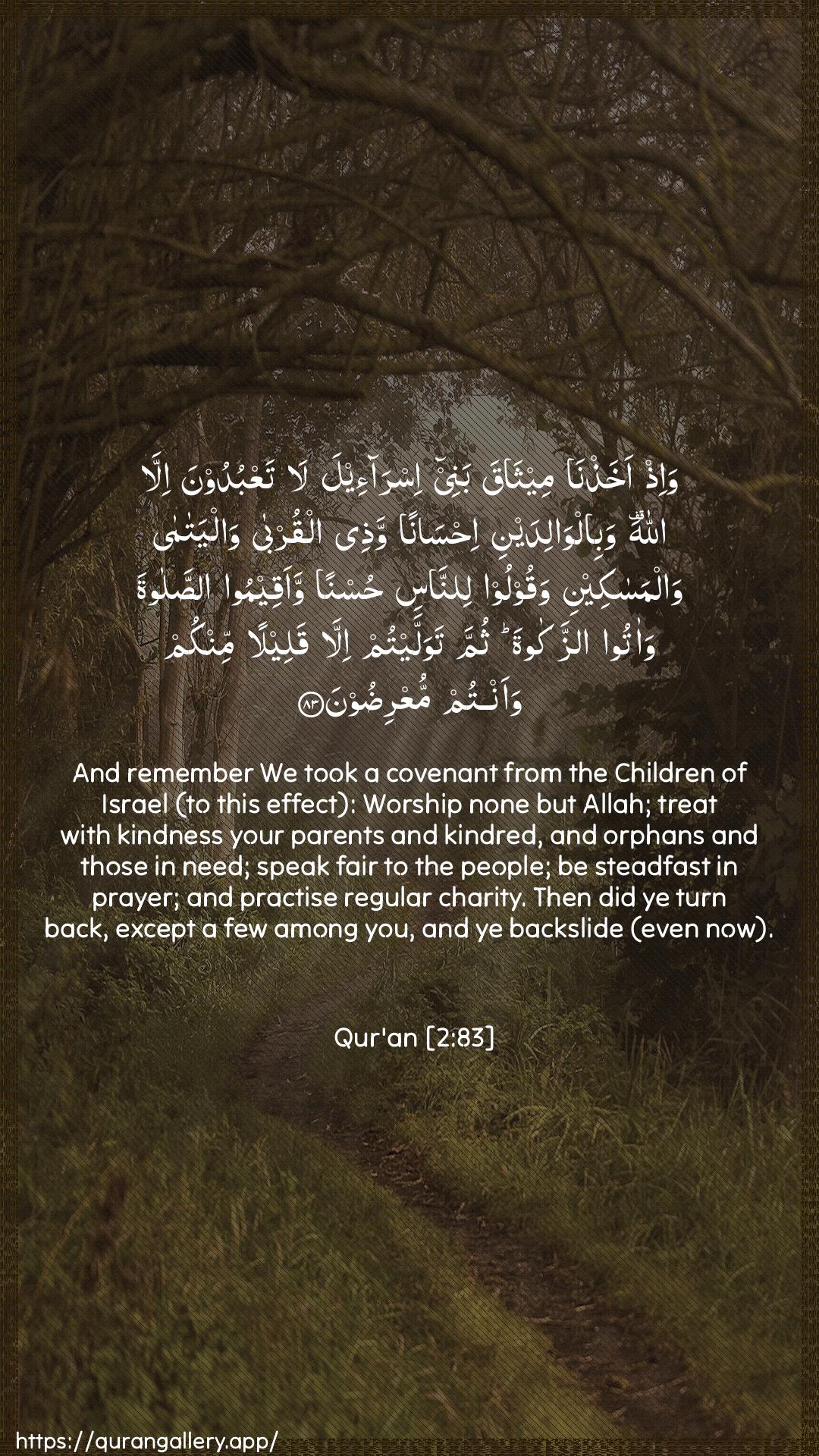
Arabic + English

Arabic (Wide)

Arabic + Urdu
Free for personal & educational use with attribution
Quick Facts about this Verse
Surah
Al-Baqara
Revealed
Madani
Position
Juz 1,2,3
Explore this Verse
Verse Meaning
According to the classical tafsir of Imam Al-Tabari, Quran 2:83 serves as a foundational reminder of the comprehensive covenant (Mithaq) Allah established with the Children of Israel, a pact centered on the twin pillars of theology and social ethics. This verse is not merely a historical account but a universal blueprint for a righteous community. While Ibn Kathir emphasizes that these commandments, starting with the absolute worship of Allah alone (Tawheed), are the essence of every prophet's message, Al-Qurtubi delves into the legal and social implications, highlighting the hierarchy of kindness (Ihsan) that begins with parents and extends to relatives, orphans, and the needy. The synthesis of these scholarly views reveals a profound truth: true faith is inseparable from just and compassionate social conduct. The covenant demands not only vertical submission to God through prayer and charity but also horizontal excellence in human relations, encapsulated in the command to 'speak good to people' (wa qulu lin-nasi husna). This verse thus archives the core principles of divine law—worship, family values, social welfare, and virtuous communication—and chronicles the historical failure of a nation to uphold them, serving as a timeless lesson for all.
Questions for Reflection
Theological Contemplation
Ibn Kathir notes that these commandments form the core of every single prophetic mission. Contemplate the divine wisdom in this consistency. Why are these specific principles—Tawheed, Ihsan to family, social welfare, kind speech, and formal worship—the non-negotiable foundation of humanity's relationship with God across all of history?
Personal Contemplation
Al-Qurtubi discusses 'Ihsan' (excellence) not just as an action but a state of being. Reflect on the hierarchy presented: parents, relatives, orphans, the needy. Is your 'Ihsan' distributed according to this divine priority, or is it directed by personal convenience or social recognition? Where in this chain is your weakest link, and what does this reveal about your inner state?
Communal Contemplation
The verse concludes by stating that most of Bani Israel 'turned away' (tawallaytum) while being 'averse' (mu'ridun). As-Sa'di explains this as a deliberate choice, not an accident. Contemplate the subtle ways our communities today accept the words of the covenant but turn away in practice. What are the modern forms of 'turning away' from these eight principles, and how does our collective aversion manifest?
Practical Applications
Conduct a weekly 'Ihsan Audit,' starting with parents, then relatives, orphans, and the needy in your community to ensure you are fulfilling your social obligations.
Go beyond financial aid; this includes calls, visits, offering assistance with chores for parents, and mentoring an orphan.
Before speaking, consciously filter your words through the principle of 'husna' (goodness), ensuring your speech is beneficial, truthful, and kind, especially in online interactions.
Applicable to social media comments, work emails, family discussions, and customer service interactions.
Pair every act of worship (Salah) with a corresponding act of social good (Zakah/Sadaqah) to maintain the balance taught in the covenant.
After praying, make a small online donation to a charity, text a relative to check in, or contribute to a local food bank.
Hidden Gem
The synthesis of scholarly thought reveals a hidden dynamic: the covenant is not a list of separate rules but an interconnected ecosystem. Ibn Kathir shows the historical result of its breach, while Al-Qurtubi details its legal structure. The gem of contemplation is realizing that a failure in one area (like kind speech) inevitably weakens another (like the quality of prayer), because turning away from one part of the covenant signifies an aversion to the whole. True submission is indivisible.
Scroll to see more verses or use the dropdown in the breadcrumb to jump to any verse