
Hud - Hud
Arabic Name: هُوْد
Urdu Name: حود
Type: Makki
Serial Number: 11
Revelation Order: 52
Total Verses: 123
Parah: 12,11
Rukus: 10
Sajda: None
Share Verse Art

Arabic
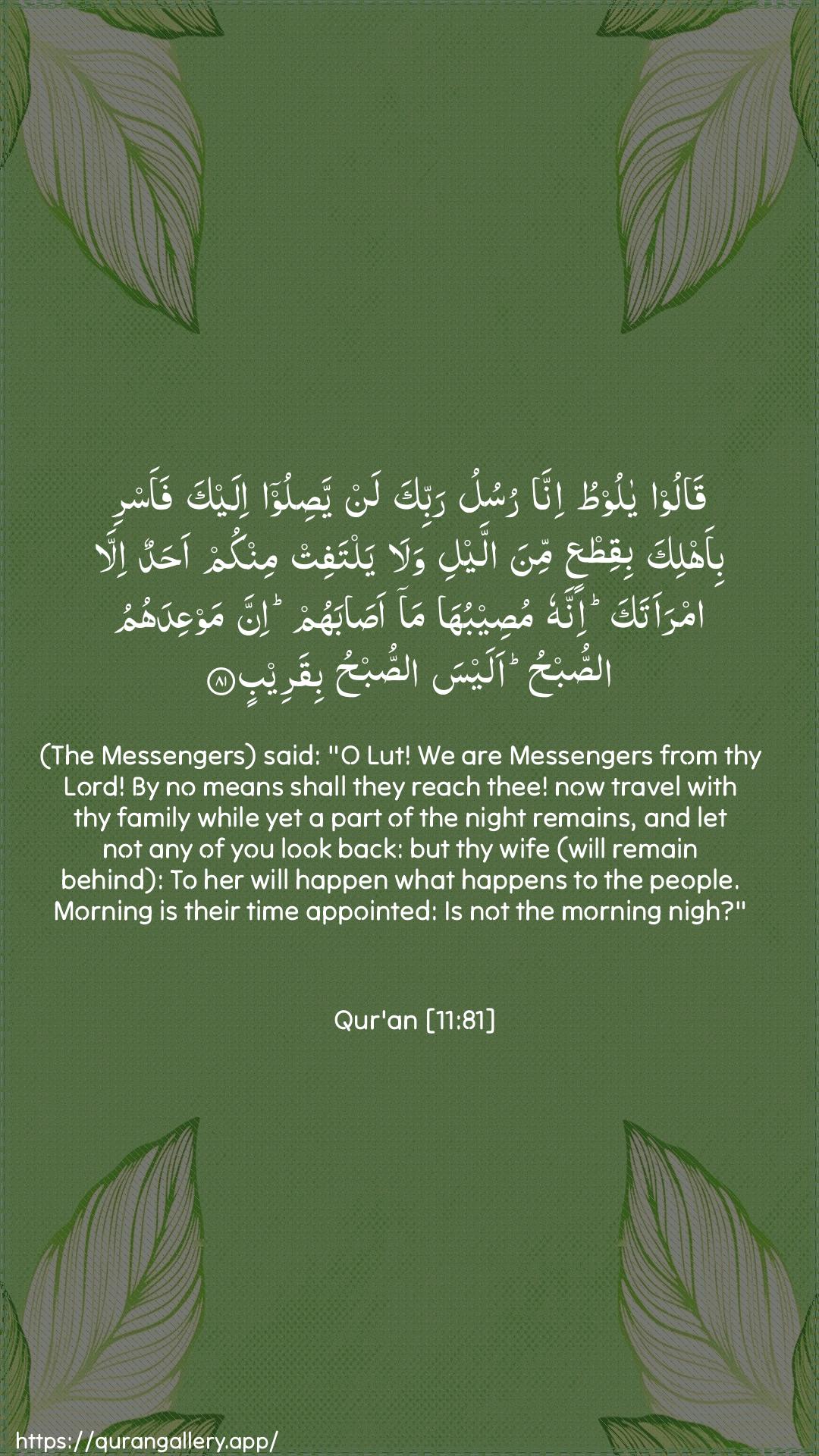
Arabic + English

Arabic (Wide)
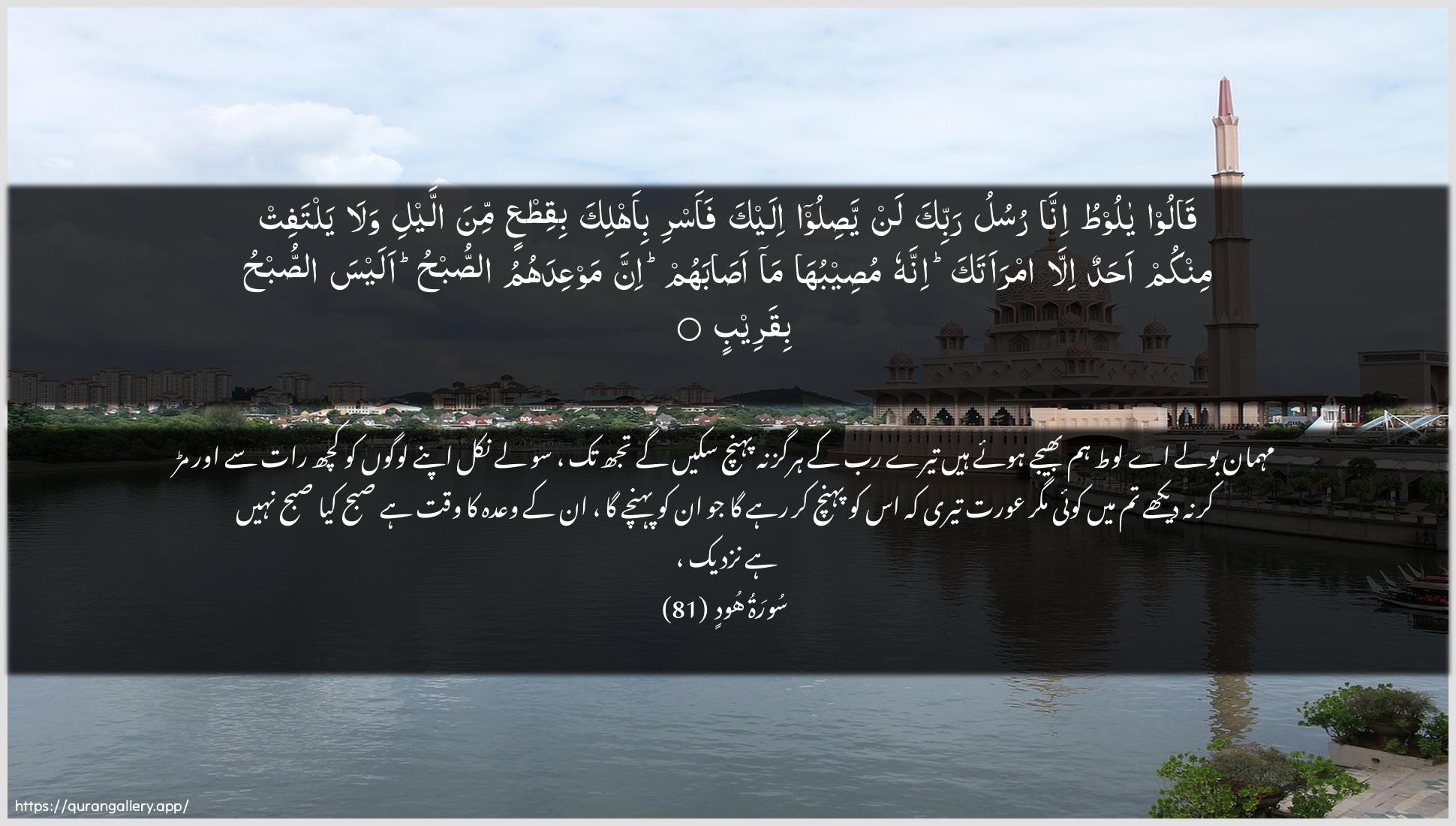
Arabic + Urdu
Free for personal & educational use with attribution
Quick Facts about this Verse
Surah
Hud
Revealed
Makki
Position
Juz 12,11
Explore this Verse
Verse Meaning
According to a comprehensive synthesis of classical tafsirs, Quran 11:81 marks the dramatic turning point in the story of Prophet Lut, shifting from profound distress to divine reassurance. Ibn Kathir explains that at the peak of his helplessness, the angelic guests revealed their true identity as messengers of Allah, guaranteeing Lut's protection. Al-Tabari provides extensive detail on the divine command for Lut to flee with his believing family in the darkness of night, emphasizing the strict instruction, 'let not any of you look back.' The fate of Lut's wife is a central point of scholarly discussion, with Al-Qurtubi analyzing the grammatical nuances to determine whether she was left behind from the start or perished for looking back; in either case, her allegiance to her disbelieving people sealed her doom. The verse concludes with a powerful and imminent promise of justice: 'Indeed, their appointed time is the morning. Is not the morning near?' This rhetorical question served to comfort Lut's desire for immediate retribution, assuring him that divine justice was swift and certain.
Questions for Reflection
The Shift from Despair to Hope
Lut had just declared his powerlessness in verse 80. Reflect on the immediate and absolute certainty in the angels' reply: 'They will never reach you.' How does this dramatic shift, as detailed by Ibn Kathir, teach us about the nature of Allah's intervention when a believer reaches their breaking point?
The Wisdom in Divine Timing
The tafsirs mention Lut's desire for immediate punishment, but the angels state, 'Their appointed time is the morning.' Contemplate the wisdom behind Allah's chosen timeline. What does the rhetorical question 'Is not the morning near?' reveal about the difference between human perception of urgency and divine wisdom?
The Meaning of 'Looking Back'
Scholars like Al-Qurtubi explain that the command 'let not any of you look back' was to ensure a complete break. What does 'looking back' symbolize in a spiritual sense? Reflect on the attachments—to people, places, or sins—that Allah may be commanding you to leave behind without a second glance for your own salvation.
Practical Applications
Cultivate patience in Allah's timing during personal trials, remembering that when Lut desired immediate help, the angels replied, 'Is not the morning near?'
Applicable during career uncertainty, health challenges, or any period of prolonged difficulty where one might feel impatient for a resolution.
Practice decisive severance from negative environments or relationships by adhering to the principle of 'do not look back.'
Useful when leaving a toxic job, ending a harmful friendship, or overcoming an addiction, where looking back can trigger a relapse.
Recognize that spiritual salvation is based on individual belief and allegiance, not just family ties, as exemplified by the fate of Lut's wife.
A crucial reminder in family dynamics where one person's piety might be assumed to cover for others, encouraging individual spiritual responsibility.
Hidden Gem
The synthesis of various narrations in Al-Tabari's tafsir reveals that before the angels acted, Lut had to bear witness three times to the evil of his people. This suggests that divine intervention often follows the complete exhaustion of human effort and testimony. Contemplate how this pattern requires believers to fulfill their duty of speaking truth, even when it seems hopeless, as a precondition for divine victory.
Scroll to see more verses or use the dropdown in the breadcrumb to jump to any verse
Common Questions
2 more questions available in the full page