
Hud - Hud
Arabic Name: هُوْد
Urdu Name: حود
Type: Makki
Serial Number: 11
Revelation Order: 52
Total Verses: 123
Parah: 12,11
Rukus: 10
Sajda: None
Share Verse Art
Arabic
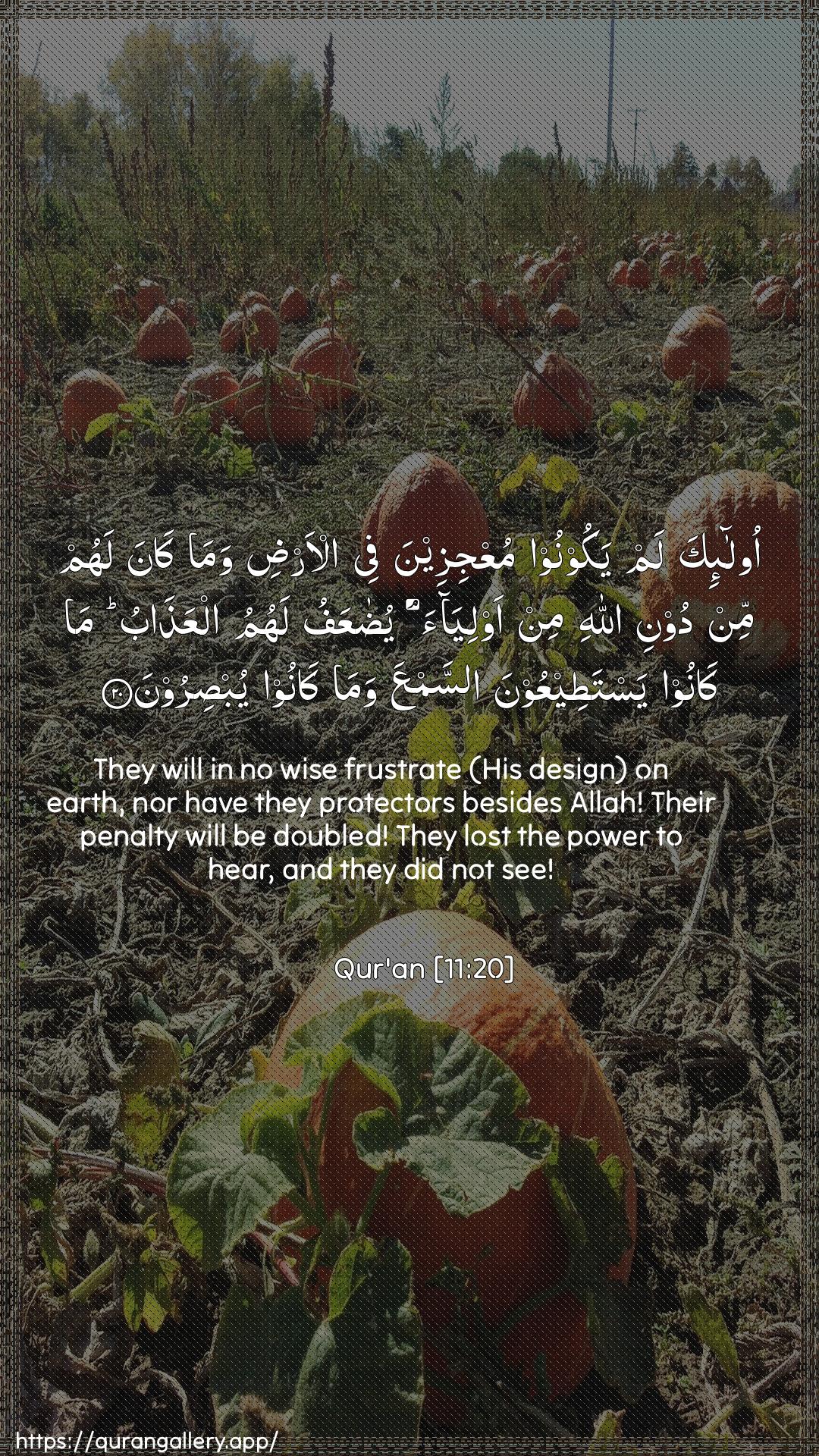
Arabic + English
Arabic (Wide)
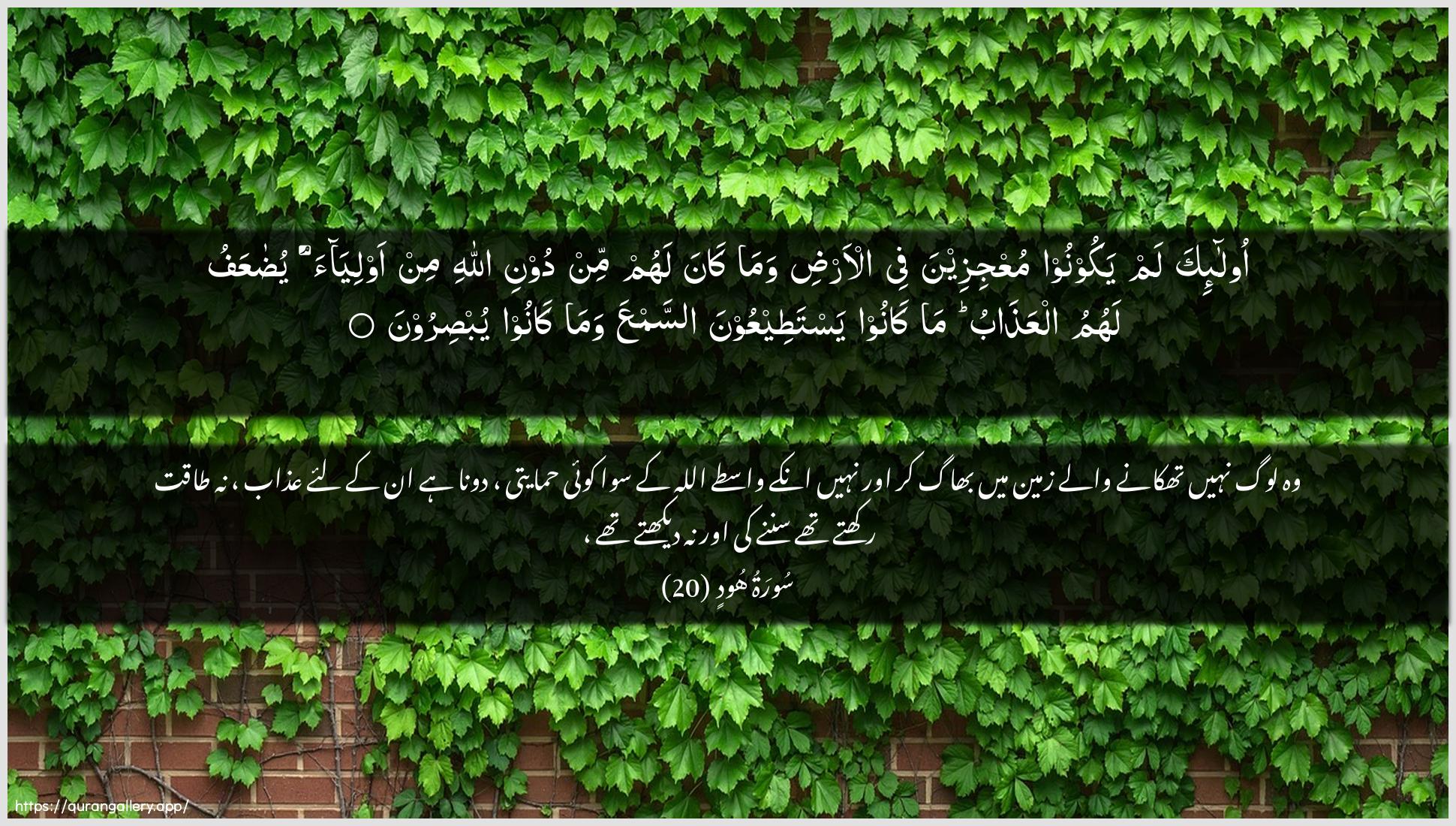
Arabic + Urdu
Free for personal & educational use with attribution
Quick Facts about this Verse
Surah
Hud
Revealed
Makki
Position
Juz 12,11
Explore this Verse
Verse Meaning
According to the comprehensive tafsir of classical scholars like Al-Tabari and Ibn Kathir, Quran 11:20 delivers a powerful verdict on the ultimate state of those who reject divine truth. It establishes three core realities: their absolute inability to escape Allah's power (`لم يكونوا معجزين في الأرض`), their complete abandonment by any would-be protectors (`وما كان لهم من دون الله من أولياء`), and the intensification of their punishment (`يضاعف لهم العذاب`). The most profound insight, synthesized from multiple scholarly analyses, is the reason for this doubled punishment. It is not arbitrary but a direct consequence of their own choices. The verse concludes, `ما كانوا يستطيعون السمع وما كانوا يبصرون`—'They were unable to hear, and they did not see.' As Al-Tabari and Qurtubi clarify, this is not a physical disability but a spiritual one they inflicted upon themselves. Through their persistent aversion and arrogance, they reached a state where their hearts and minds could no longer process or benefit from the truth, rendering their God-given faculties of hearing and sight useless for guidance. This self-imposed spiritual blindness and deafness is the crime for which their punishment is compounded, as they were their own primary agents of misguidance.
Questions for Reflection
Textual Contemplation
The verse shifts from an external reality ('they cannot escape in the earth') to an internal one ('they were unable to hear'). Contemplate how Allah connects the inescapable physical reality of His dominion with the self-imposed spiritual prison of a closed heart. What does this teach you about the relationship between the outer world and the inner state?
Personal Transformation
Al-Qurtubi and other scholars explain that their 'inability' was due to intense aversion and hatred for the truth. Where in my life might I be physically hearing advice but spiritually 'unable to listen' due to pride, desire, or prejudice against the source? What small aversion today could lead to a major spiritual blind spot tomorrow?
Relational Wisdom
Ibn Kathir and Sa'di note the punishment is doubled for their own misguidance and for misleading others. Reflect on your influence. In my words and actions, am I a source of guidance that opens people's spiritual senses, or do my deeds and doubts contribute, even subtly, to the spiritual deafness of those around me?
Practical Applications
Conduct a 'Spiritual Sense' Audit: Consciously reflect on whether you are truly listening to guidance or merely hearing words, a practice derived from Al-Tabari's analysis of their inability to hear beneficially.
Apply this when listening to a khutbah, reading the Quran, or receiving sincere advice from a friend or family member.
Practice Radical Reliance: In moments of distress, consciously identify and reject any perceived 'protector' (awliya) other than Allah, whether it be wealth, status, or connections.
Utilize this during financial uncertainty, career challenges, or when tempted to rely on worldly means over divine help.
Understand the Compounding Nature of Aversion: Recognize that ignoring small truths can lead to a state where one 'cannot' perceive larger truths, as illustrated by the 'doubled punishment'.
Reflect on this when feeling dismissive of a religious reminder, a pang of conscience, or a piece of advice that challenges the ego.
Hidden Gem
The synthesis of tafsirs reveals a chilling spiritual principle: the punishment is not just for the crime of disbelief, but for the destruction of God-given faculties. They were given the tools for salvation—hearing and sight—and they broke them through misuse. This transforms the contemplation from merely pitying their state to valuing and safeguarding our own spiritual senses as a sacred trust (amanah) from Allah.
Scroll to see more verses or use the dropdown in the breadcrumb to jump to any verse
Common Questions
2 more questions available in the full page