
Yunus - Jonas
Arabic Name: يُوْنـُس
Urdu Name: یونس
Type: Makki
Serial Number: 10
Revelation Order: 51
Total Verses: 109
Parah: 11
Rukus: 11
Sajda: None
Share Verse Art
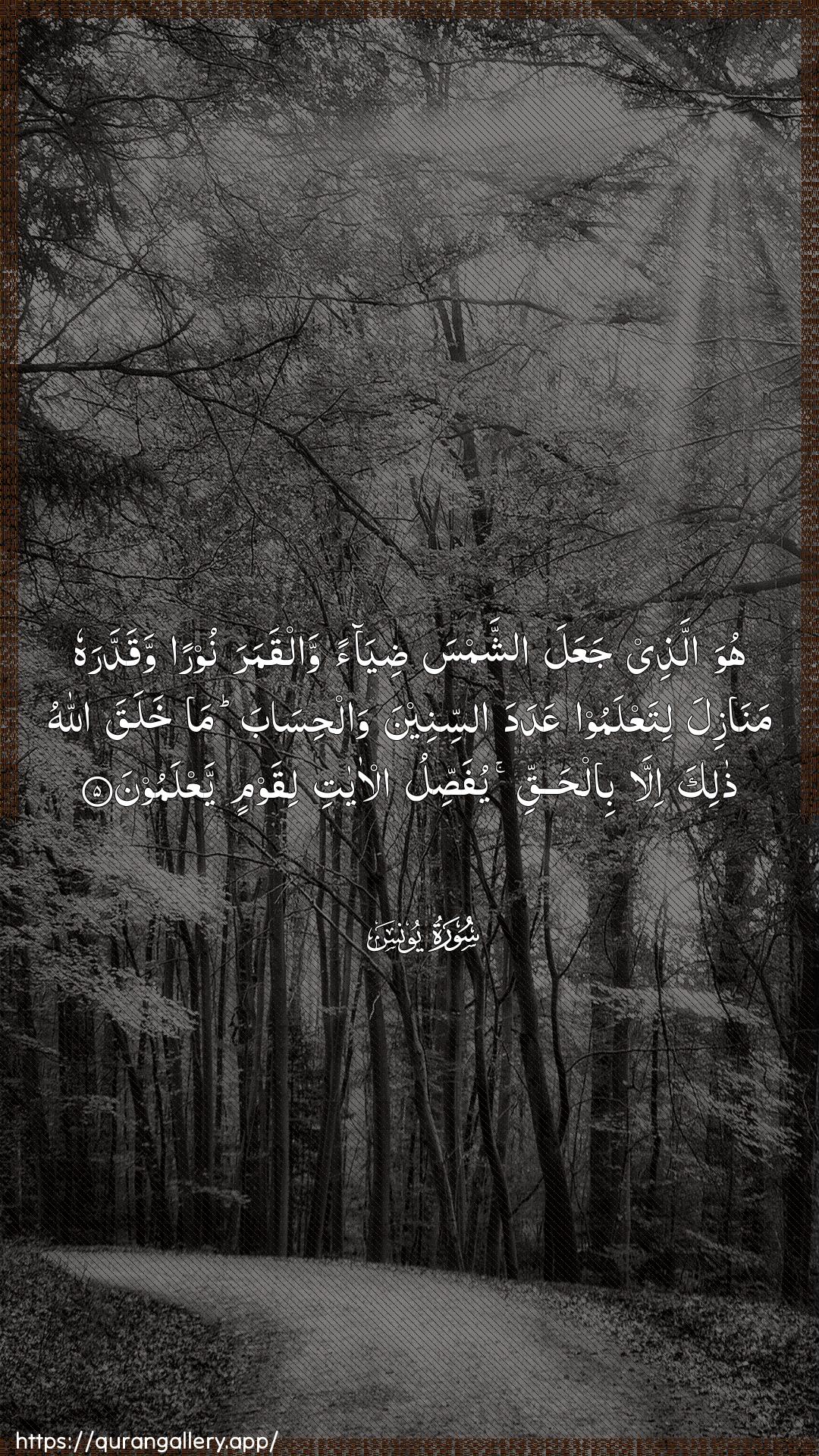
Arabic
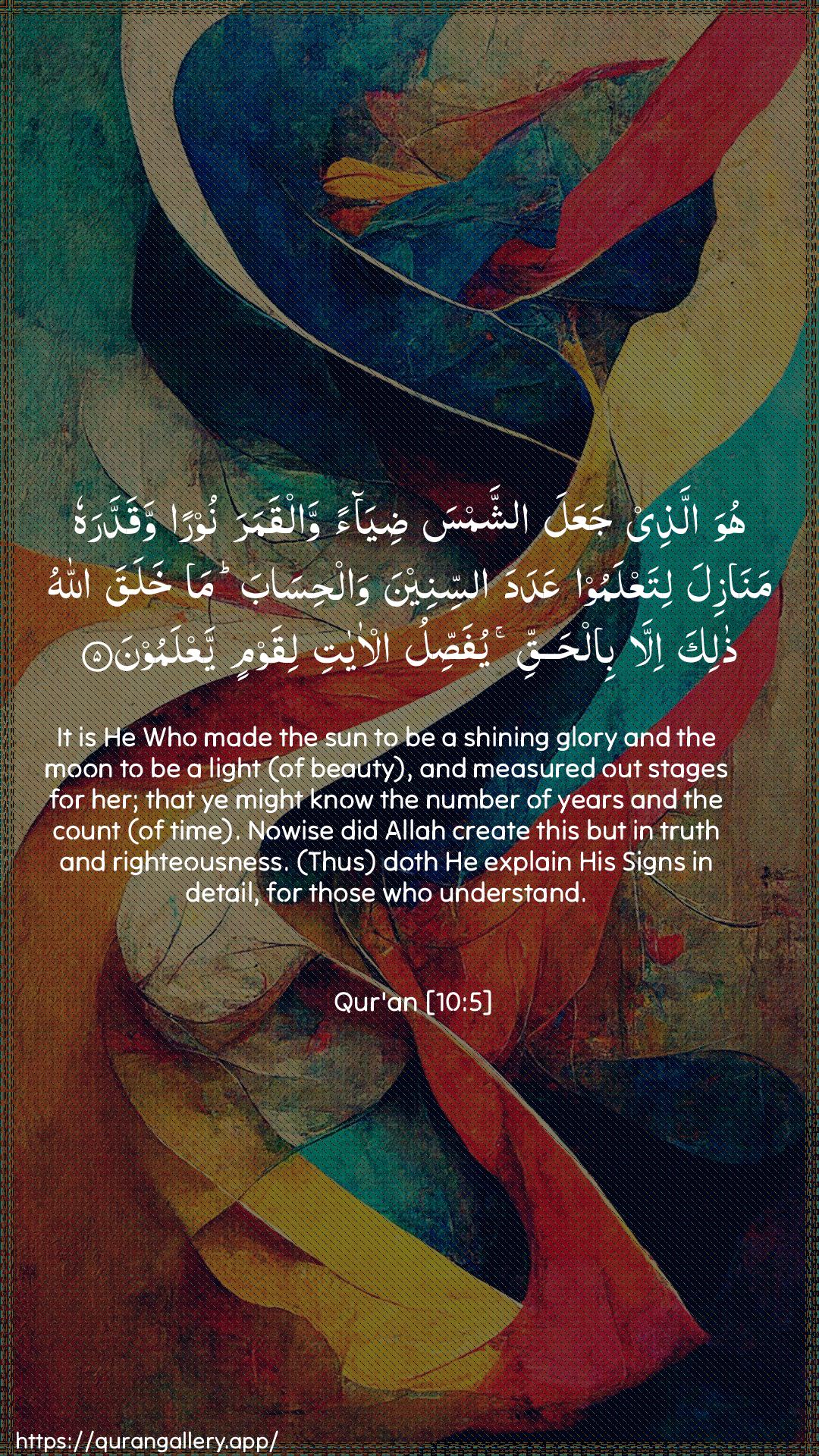
Arabic + English
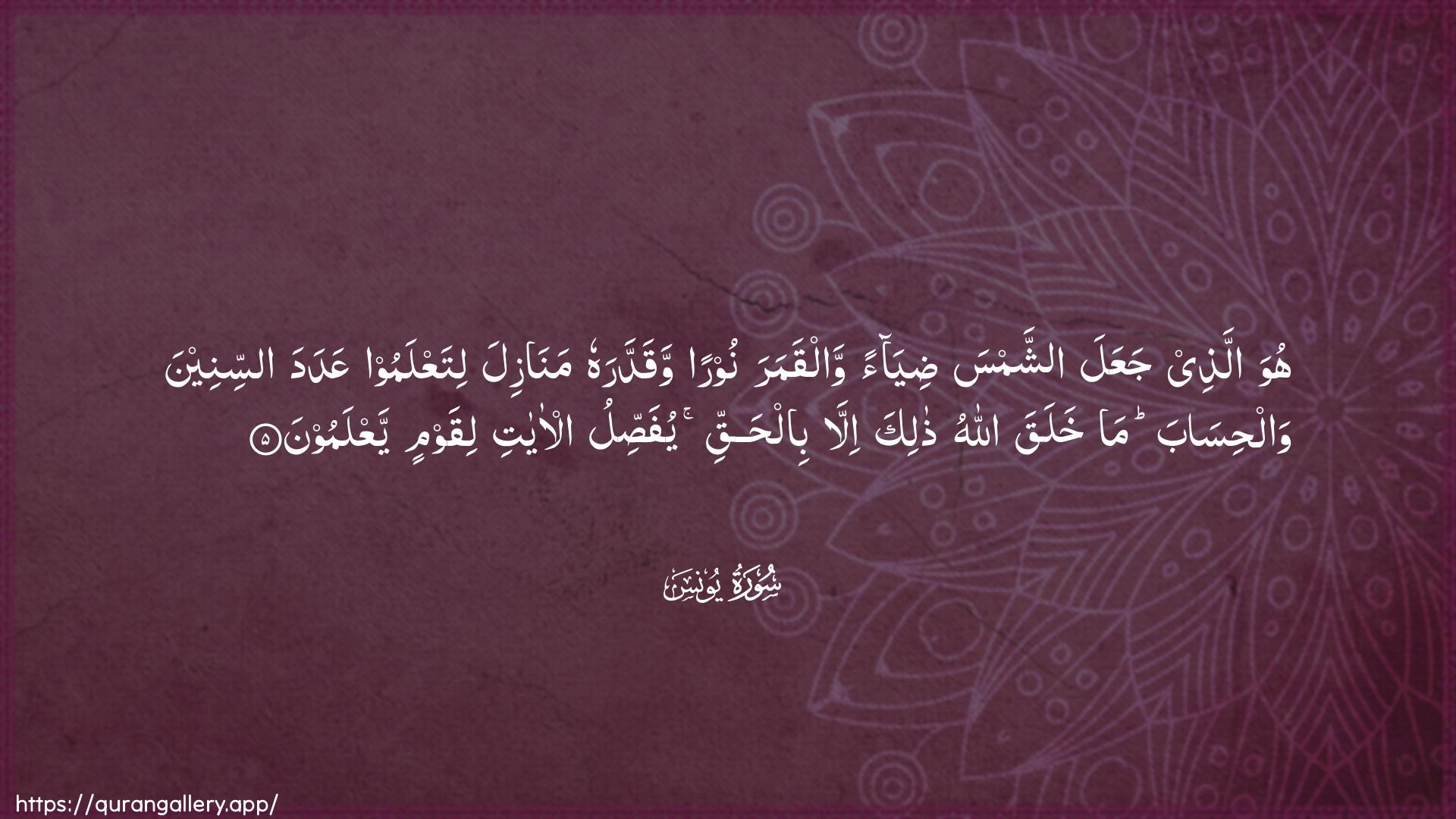
Arabic (Wide)
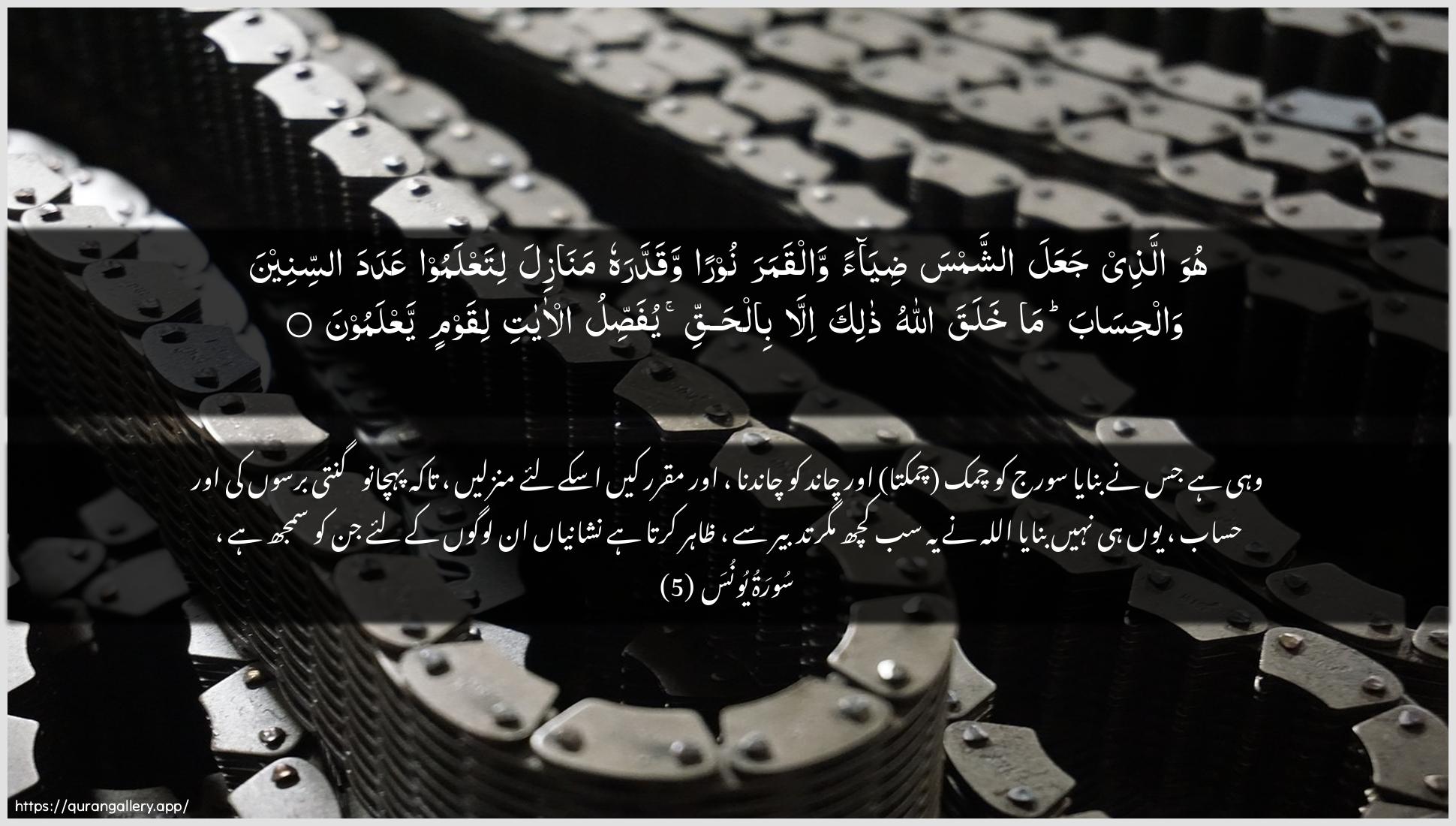
Arabic + Urdu
Free for personal & educational use with attribution
Quick Facts about this Verse
Surah
Yunus
Revealed
Makki
Position
Juz 11
Explore this Verse
Verse Meaning
According to the classical scholar Ibn Kathir, verse 10:5 of Surah Yunus details the celestial signs indicative of Allah's perfect power, distinguishing between the sun's inherent, brilliant splendor ('diya') and the moon's gentle, reflected light ('nur'). A comprehensive review of tafsirs, including those by Al-Tabari and Al-Qurtubi, reveals a profound linguistic and scientific precision; 'diya' implies a source of light and heat, whereas 'nur' is light that illuminates without burning. This distinction, highlighted by modern commentators like Dr. Israr Ahmad, remarkably aligns with the scientific understanding of the sun producing its own energy through fusion while the moon merely reflects it. The verse then states the ultimate purpose of this design: Allah 'determined for it stages'—specifically the lunar phases—so that humanity 'may learn the number of the years, and the calculation.' This celestial clock is not a product of chance; Allah affirms, 'He has not created all this but for a rightful purpose,' a testament to a universe imbued with order and wisdom. As Al-Wasit explains, this system facilitates both worldly affairs and religious observances like Ramadan and Hajj. Ultimately, the verse concludes that these clear signs are fully comprehensible 'for a people who know,' inviting contemplation and understanding.
Questions for Reflection
Linguistic & Scientific Contemplation
The verse uses two distinct words: 'diya' (a source of splendor, like a lamp) for the sun and 'nur' (light) for the moon. Reflect on how this precise choice, made 1400 years ago, perfectly aligns with our modern scientific understanding. How does this precision strengthen your conviction in the Quran's divine origin?
Personal Accountability (Hisab)
Allah states He designed this system for us to know 'the number of years and the calculation (al-hisab)'. The word 'hisab' also means accountability. How can you use the passing of each lunar month not just to count time, but as a personal deadline to take account of your deeds and spiritual progress before your final 'Hisab'?
Contemplation of Purpose (Al-Haqq)
The verse concludes, 'Allah has not created all this except in truth (bil-haqq)'. This means nothing is random or purposeless. Look at the perfect, unwavering orbits of the sun and moon. How does this cosmic certainty and purpose inspire you to seek and live by a higher purpose in your own life, which can often feel chaotic?
Practical Applications
Use the lunar calendar to mark spiritual milestones like Ramadan and Hajj, consciously connecting your worship to the divine rhythm established by Allah.
Beyond just following a calendar, actively observe the new moon each month to re-center your spiritual goals and prepare for significant Islamic dates.
Cultivate gratitude by reflecting on the perfect balance between the sun's powerful 'diya' (splendor) for life and energy, and the moon's gentle 'nur' (light) for guidance and tranquility at night.
During a busy day, take a moment to feel the sun's warmth and acknowledge it as a provision. At night, observe the moon and reflect on the peace it brings as a sign of divine balance.
Hidden Gem
The synthesis of tafsirs reveals a subtle spiritual hierarchy. The sun ('diya') is a direct, powerful sign that is impossible to ignore, representing the undeniable proofs of Allah's existence. The moon ('nur') requires more observation; its phases change, and it grows gradually, representing the subtle, reflective faith that grows and matures in a believer's heart over time through contemplation.
Scroll to see more verses or use the dropdown in the breadcrumb to jump to any verse
Common Questions
2 more questions available in the full page