
Al-Baqara - The Cow
Arabic Name: الْبَقَرَة
Urdu Name: گائے
Type: Madani
Serial Number: 2
Revelation Order: 87
Total Verses: 286
Parah: 1,2,3
Rukus: 40
Sajda: None
Share Verse Art
Arabic
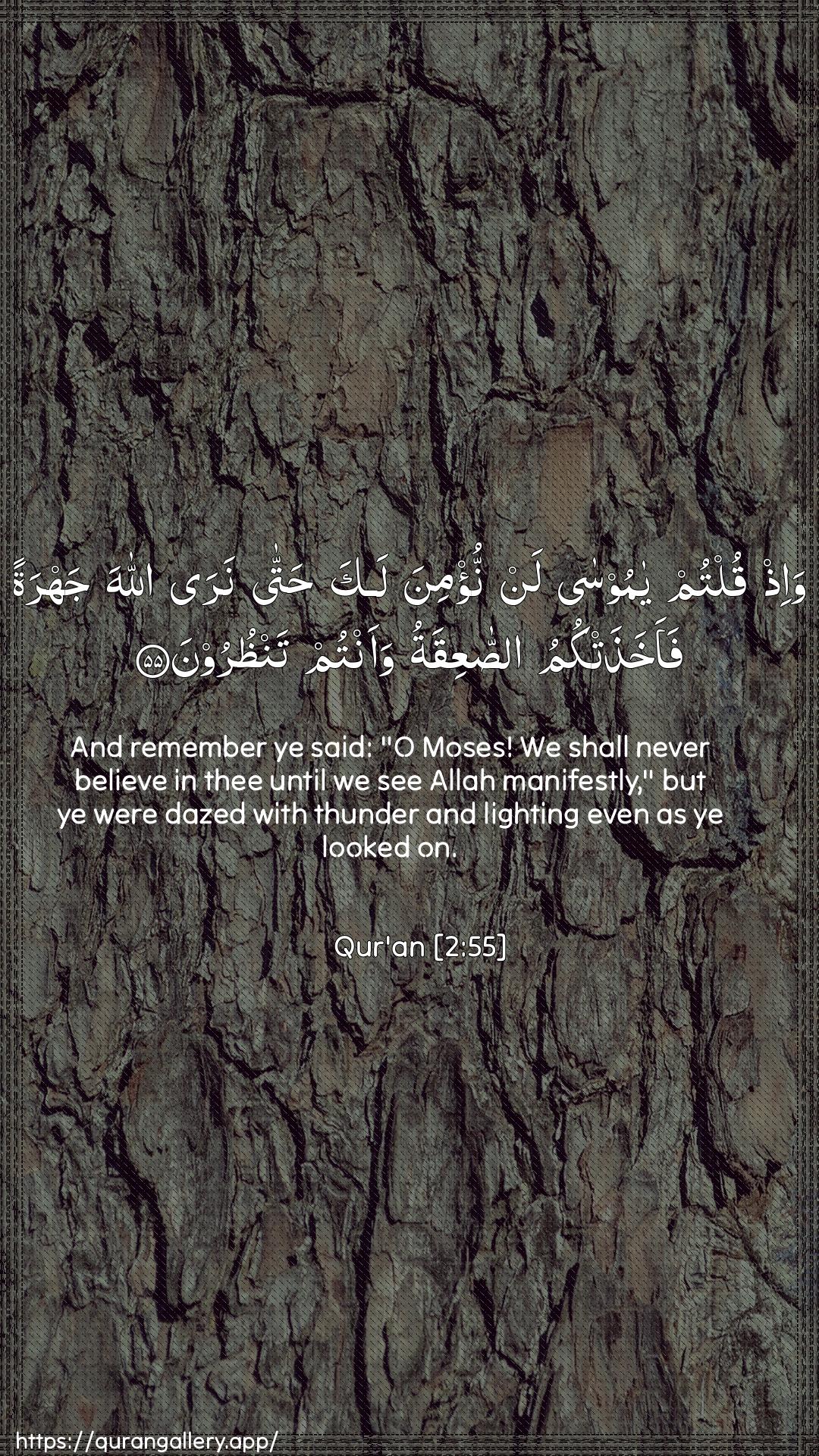
Arabic + English
Arabic (Wide)
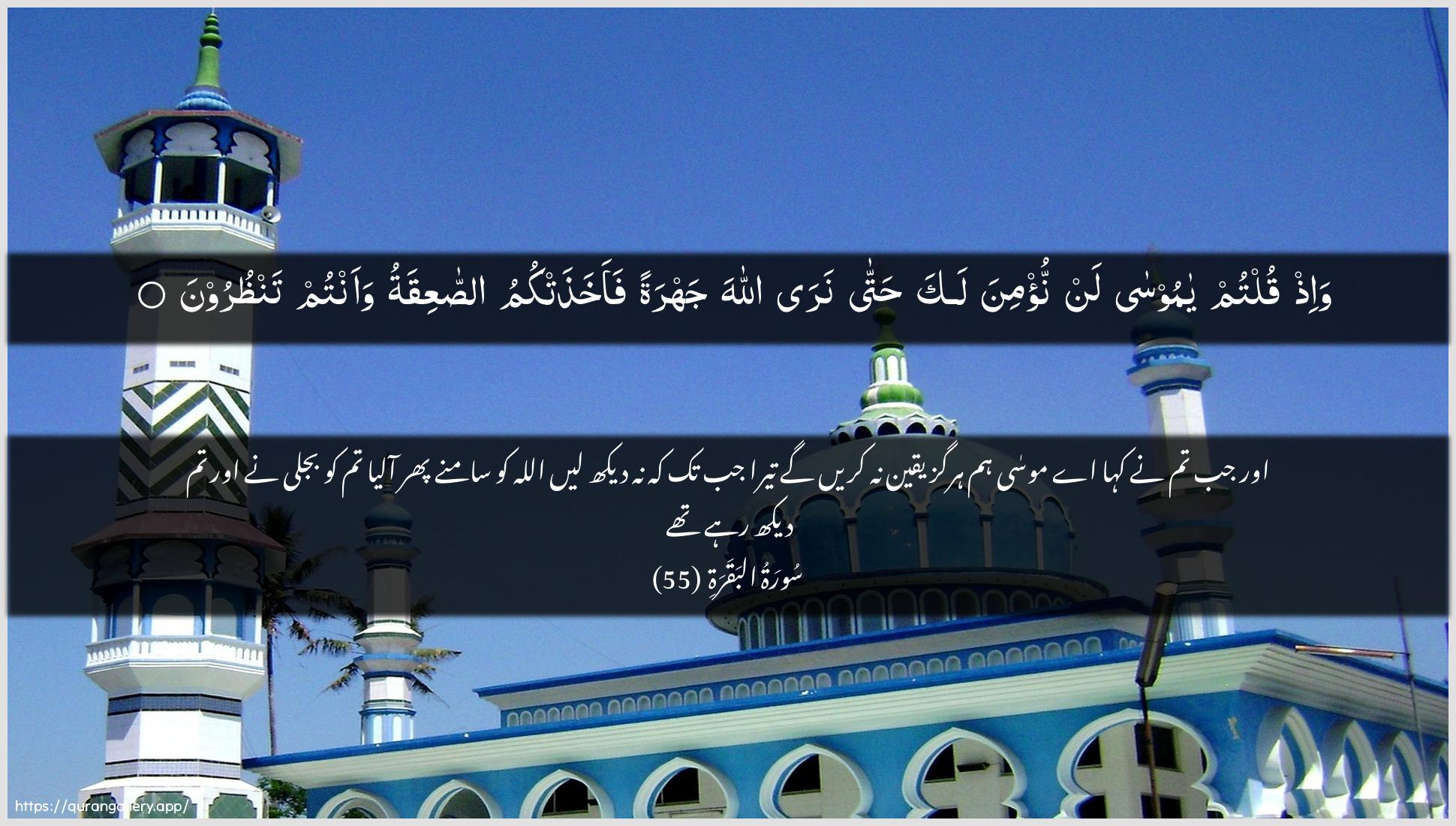
Arabic + Urdu
Free for personal & educational use with attribution
Quick Facts about this Verse
Surah
Al-Baqara
Revealed
Madani
Position
Juz 1,2,3
Explore this Verse
Verse Meaning
According to the great exegete Ibn Kathir, verse 2:55 captures a moment of extreme audacity from the Children of Israel, specifically the seventy elders chosen by Prophet Musa to accompany him to Mount Sinai. Their demand, 'We will never believe you until we see Allah openly (jahratan),' was a flagrant rejection of faith in the unseen. Al-Tabari provides a profound linguistic analysis of 'jahratan,' explaining it means to see something unveiled, without any barrier, a demand that transgressed the fundamental relationship between the Creator and the created. This was not a humble request but a condition for belief, challenging the authority of their own Prophet. The divine response was swift and decisive: 'the thunderbolt (As-Sa'iqah) seized you while you were looking on.' Scholars like As-Sa'di describe this as a punishment for their injustice and insolence. The synthesis of tafsirs reveals this was not an isolated incident but part of a pattern of rebellion. The WOW factor emerges from the direct consequence: they were struck dead, a terrifying event they witnessed happening to one another, only to be resurrected by Allah in the next verse, showcasing both His severe justice and His boundless mercy.
Questions for Reflection
Personal (The Nature of My Certainty)
The seventy elders made their faith conditional on sensory experience. Contemplate your own heart: on what is your faith truly built? Is it anchored in submission to the unseen and trust in revelation, as Al-Tabari emphasizes is necessary? Or do you find yourself secretly setting conditions, waiting for a worldly sign or proof before you fully commit to a command of Allah or His Messenger (ﷺ)?
Relational (Etiquette with Divine Knowledge)
They addressed their Prophet, 'O Musa, we will not believe you...' This demonstrates a profound lack of 'adab' (etiquette). Reflect on how you interact with the sources of divine knowledge—the Quran, the Sunnah, and the scholars. Do you approach them with the humility of a student seeking guidance, or with the skepticism of a critic demanding to be convinced? How can you cultivate the humility that, as Ibn Kathir's narrative implies, was so starkly absent on the mount?
Theological (The Veil of Majesty)
Al-Tabari's linguistic analysis of 'jahratan' implies a desire to tear away the veil between the created and the Creator. Contemplate the divine wisdom in this veil. Why is faith in the 'ghayb' (unseen) a more profound and meaningful test than belief after seeing? How does the existence of this veil necessitate mercy, trust, and intellect in ways that open sight would not?
Practical Applications
Cultivate 'Adab' (Etiquette) in Supplication and Inquiry: Frame spiritual questions with humility, not as challenges. Avoid demanding signs from Allah as a precondition for faith or practice.
When debating religious matters online or in person, approach with sincerity and respect, not with a desire to 'win' or disprove.
Strengthen Faith in the 'Ghayb' (Unseen): Actively practice believing in Allah, His angels, and the Hereafter without demanding physical proof. Make this a conscious part of your daily reflection.
In a hyper-scientific and skeptical age, consciously reaffirming belief in what is beyond empirical verification is a crucial spiritual exercise.
Trust the Messengers: When authentic knowledge comes from the Prophet (ﷺ) and is transmitted by reliable scholars, accept it without demanding a personal miracle or direct revelation.
Instead of doubting established hadith or scholarly consensus, seek to understand the methodology and chain of transmission with trust and respect.
Hidden Gem
The synthesis reveals a profound insight: the punishment (thunderbolt) was a direct manifestation of what they asked for. They demanded to experience Allah directly, unveiled ('jahratan'), unable to comprehend that His majesty is scorching. In a way, they *did* get an unveiled experience of God's power, but their created forms could not withstand it. The contemplation here is that Allah's 'veil' is not a barrier to keep us out, but a mercy to protect us.
Scroll to see more verses or use the dropdown in the breadcrumb to jump to any verse