
Yusuf - Joseph
Arabic Name: يُوْسُف
Urdu Name: یوسف
Type: Makki
Serial Number: 12
Revelation Order: 53
Total Verses: 111
Parah: 12,13
Rukus: 12
Sajda: None
Related Hadith
"The saying of Abdullah ibn Mas'ud: 'The most insightful of people were three: the 'Aziz of Egypt concerning Yusuf, the daughter of Shu'ayb concerning Musa, and Abu Bakr concerning 'Umar.'"
This provides an authoritative early understanding of the 'Aziz's wisdom and insight in recognizing Yusuf's potential, framing his actions as exceptionally wise.
Share Verse Art

Arabic

Arabic + English
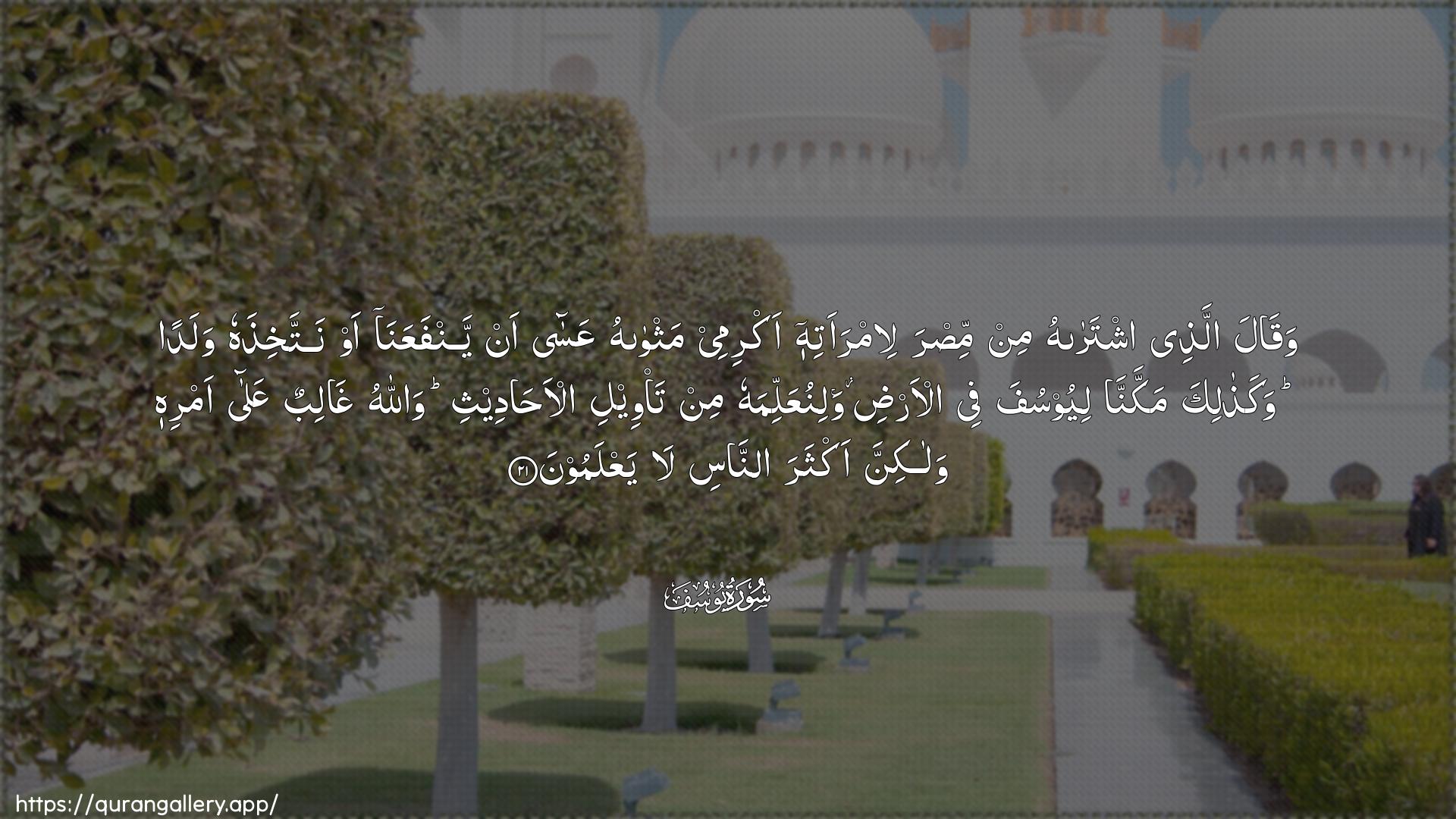
Arabic (Wide)
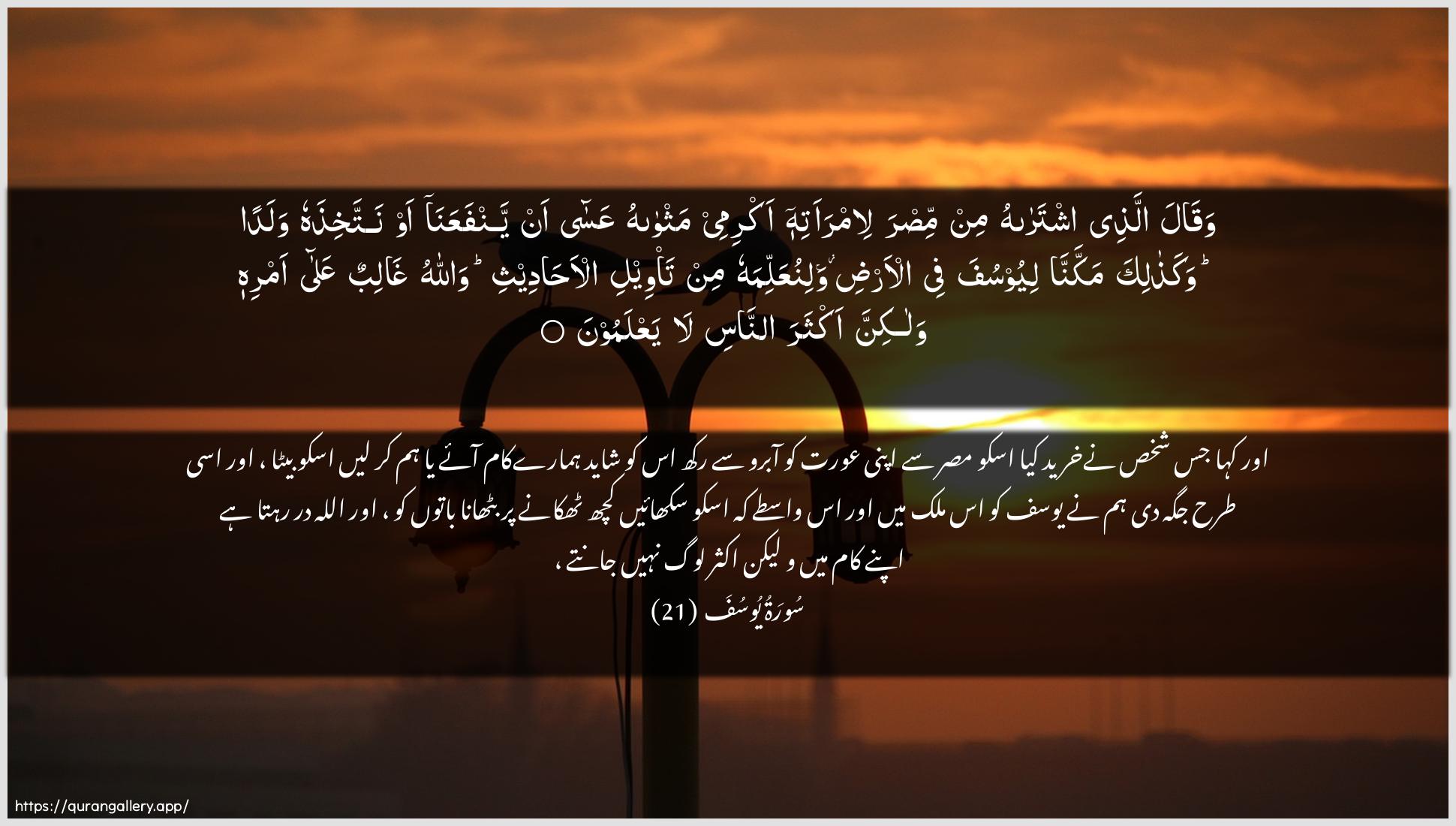
Arabic + Urdu
Free for personal & educational use with attribution
Quick Facts about this Verse
Surah
Yusuf
Revealed
Makki
Position
Juz 12,13
Explore this Verse
Verse Meaning
A comprehensive review of classical tafsirs on Quran 12:21 reveals a pivotal moment where divine providence overtly redirects human events. According to Ibn Kathir, this verse exemplifies Allah's subtle kindness (lutf), as He orchestrated for Yusuf to be purchased by the 'Aziz (chief minister) of Egypt, who recognized his potential. Al-Tabari provides historical context, identifying the buyer as 'Itfir ibn Ruhaib' and his wife as 'Ra'il' or 'Zulaikha.' The synthesis of these scholarly accounts shows that what appeared to be a transaction of slavery was, in fact, the first step in Yusuf's divinely-ordained empowerment (`Makanna li Yusuf fil ard`). This act established him in the land, not as a slave, but as a future leader, destined to be taught the interpretation of events, demonstrating the verse's profound conclusion: 'Allah is predominant over His affair, but most people do not know.'
Questions for Reflection
Textual Contemplation
The verse states, 'And thus We established Yusuf in the land' (Wa kadhalika makanna li Yusuf fil ard). As Al-Tabari explains, the mechanism for this 'establishment' was the very act of him being sold. Contemplate this paradox: how can an event of utter disempowerment be the primary tool for empowerment? Reflect on the specific Arabic word 'makanna' (We established/empowered) and how it redefines the meaning of loss and gain.
Personal Transformation
The 'Aziz of Egypt, upon seeing Yusuf, immediately instructed his wife, 'Make his dwelling honorable' (Akrimi mathwahu). Al-Qurtubi highlights this as an example of profound insight or 'firasah.' Reflect on your own initial reactions to new people or situations that enter your life. Do you honor the potential blessing within them, or do you judge them by their outward, perhaps lowly, appearance? How can you cultivate this 'firasah' to better recognize the hidden good Allah sends your way?
Cosmic Perspective
The verse concludes, 'And Allah is predominant over His affair, but most of the people do not know.' Ibn Kathir notes this applies to all of creation. Contemplate a situation in your life or in the world where human plans failed or went astray. How does this verse's conclusion reframe that event, not as chaos or failure, but as a perfect manifestation of an unseen, prevailing divine will? What does it mean to be among the few who 'know' this reality?
Practical Applications
Cultivate spiritual insight (Firasah) by actively looking for the hidden good and potential in people and challenging situations, just as the 'Aziz of Egypt did with Yusuf.
Apply this in professional settings when mentoring a junior colleague, in family life when dealing with a difficult relative, or when assessing a new opportunity that seems challenging at first.
When facing a personal or professional setback, consciously reframe it as the potential first step of Allah's plan for your 'Tamkin' (empowerment) in a new area.
Use this mindset when experiencing a job loss, a business failure, a relocation, or any major life transition that seems like a step backward.
In moments of high anxiety and uncertainty, reduce the need for personal control by meditating on the phrase 'Wallahu ghalibun 'ala amrihi' (And Allah is predominant over His affair).
Recite and reflect on this during financial instability, health crises, global turmoil, or when waiting for the outcome of an important decision.
Hidden Gem
The synthesis of tafsirs reveals a profound spiritual dynamic: the 'Aziz acted on his personal 'firasah' (insight), but his insight was itself a part of Allah's 'amr' (affair/plan). He thought he was making a wise personal decision, but he was merely an instrument in a divine strategy he could not comprehend. This transforms the verse into a contemplation on how our best intuitions and wisest choices are themselves threads in Allah's magnificent tapestry.
Scroll to see more verses or use the dropdown in the breadcrumb to jump to any verse
Common Questions
2 more questions available in the full page