
Yunus - Jonas
Arabic Name: يُوْنـُس
Urdu Name: یونس
Type: Makki
Serial Number: 10
Revelation Order: 51
Total Verses: 109
Parah: 11
Rukus: 11
Sajda: None
Share Verse Art
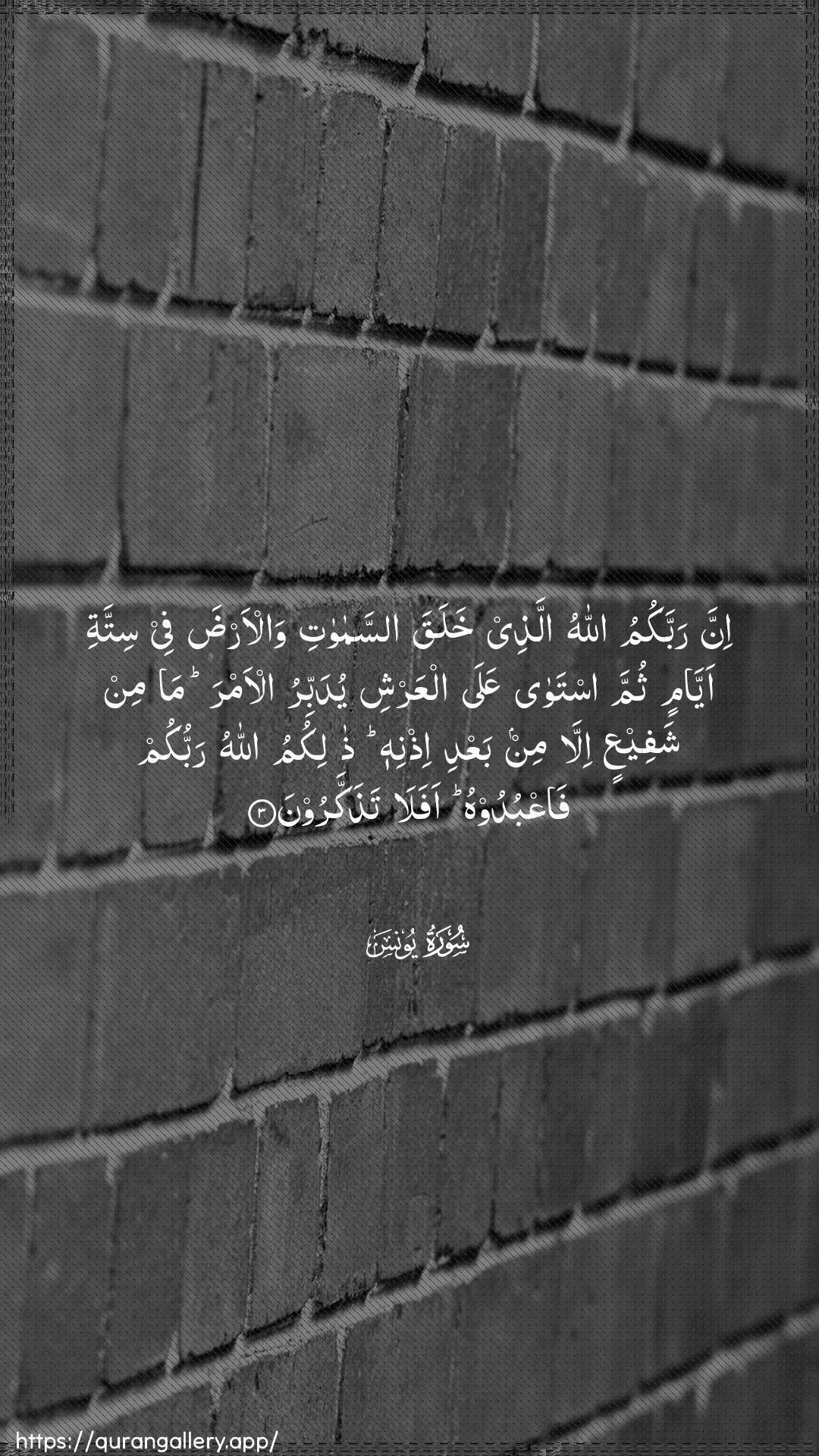
Arabic
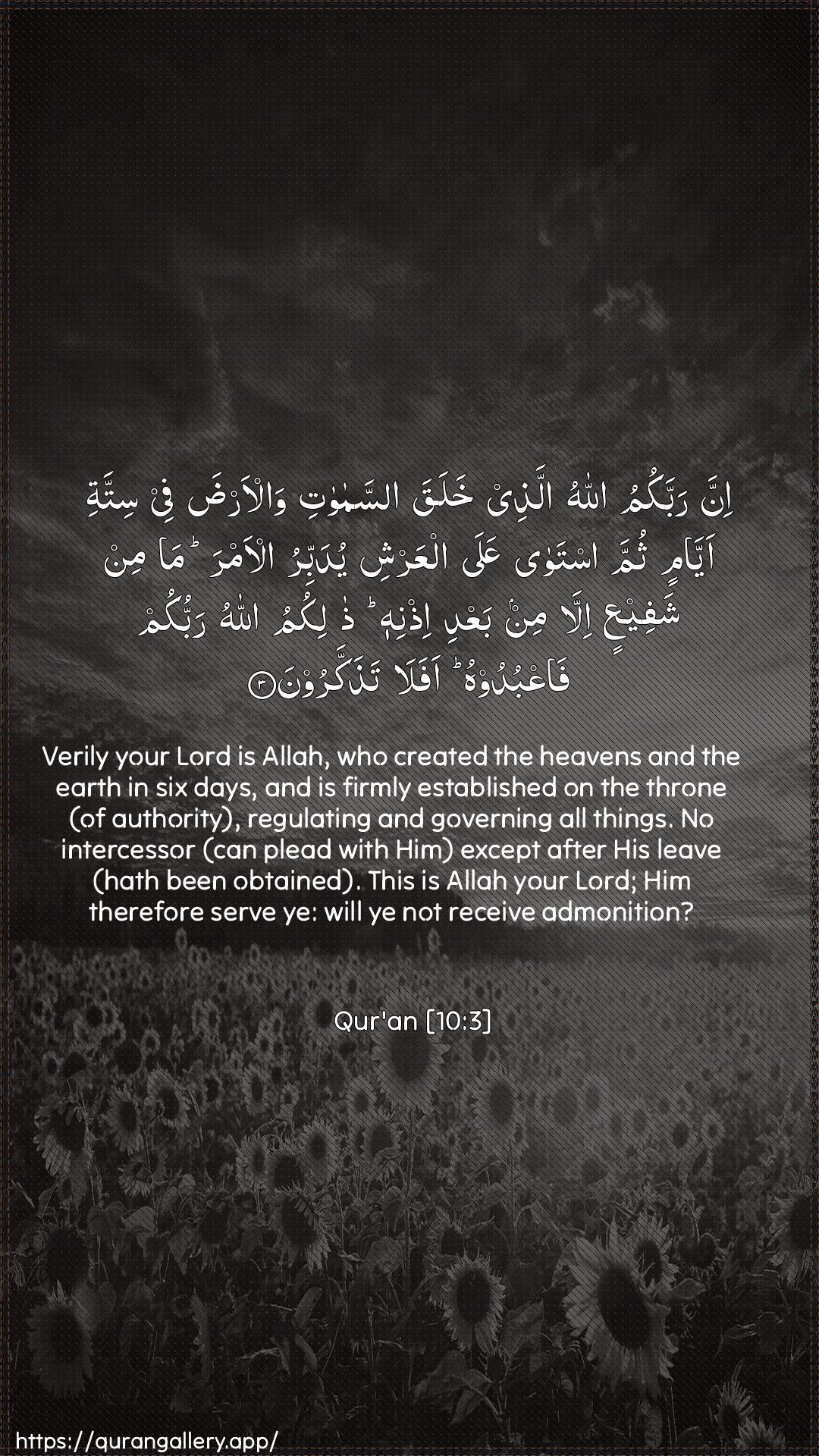
Arabic + English
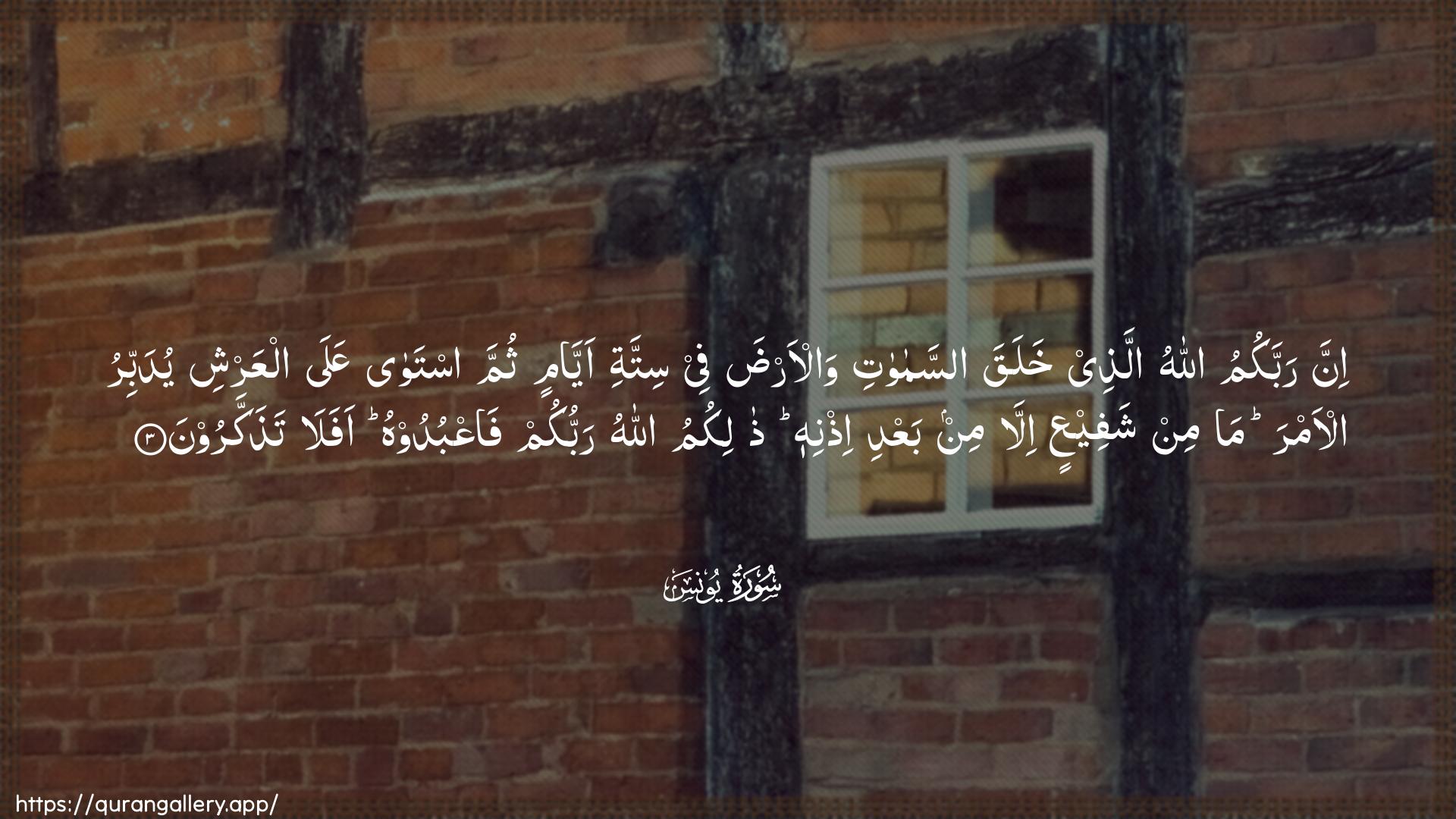
Arabic (Wide)
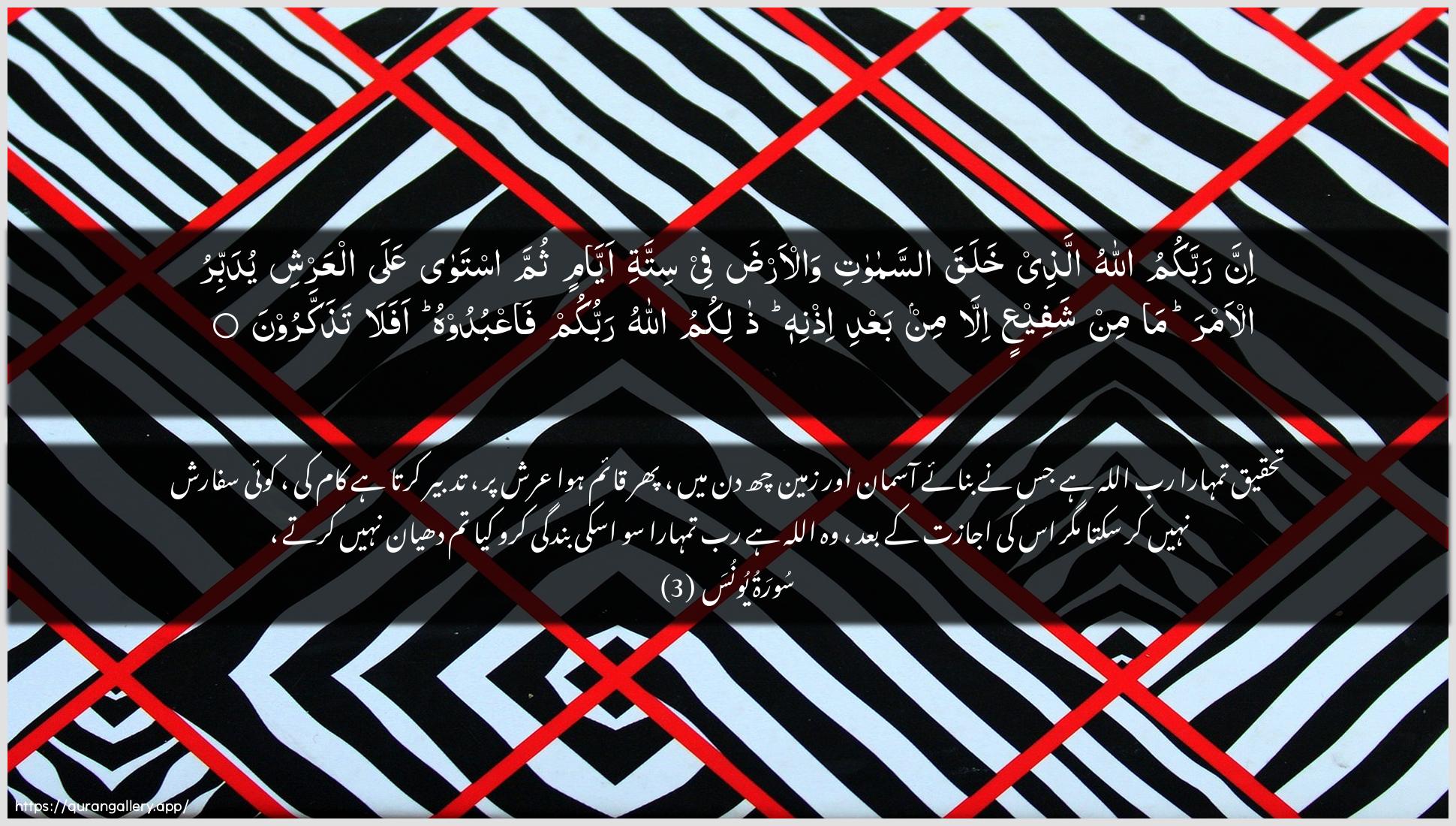
Arabic + Urdu
Free for personal & educational use with attribution
Quick Facts about this Verse
Surah
Yunus
Revealed
Makki
Position
Juz 11
Explore this Verse
Verse Meaning
According to the classical scholar Imam Al-Tabari, verse 10:3 of Surah Yunus serves as a comprehensive declaration of Allah's exclusive right to worship by establishing His absolute authority as Creator and Governor of the universe. A synthesis of classical tafsirs reveals this verse constructs a powerful theological argument: it begins with Allah's creative power (creating the heavens and earth in six days), asserts His sovereign authority ('Istawa 'ala al-Arsh' - He established Himself over the Throne), describes His continuous governance ('yudabbir al-amr' - He manages the affair), and finally dismantles the core tenet of polytheism by stating that no intercession can occur without His permission. Ibn Kathir emphasizes that this final point directly refutes the claims of the polytheists who worshipped idols believing they would intercede for them. The verse culminates in a logical conclusion: since this is your Lord—the sole Creator, Sustainer, and ultimate authority—then He alone is worthy of worship ('fa'buduh'). This structured proof establishes the foundation of Tawheed al-Rububiyyah (Oneness of Lordship) as the undeniable evidence for Tawheed al-Uluhiyyah (Oneness of Worship), calling humanity to reflect ('afala tadhakkarun') on this self-evident truth.
Questions for Reflection
Cosmic and Theological Contemplation
The verse states Allah 'manages the affair' (yudabbir al-amr). As explained by Mujahid (narrated by Al-Tabari), this is a continuous, solitary act. Contemplate one complex system in your life or the world (e.g., the economy, an ecosystem, your own body). How does realizing that a single, all-knowing Being is perfectly managing every variable within it, without flaw or fatigue, reshape your understanding of order, chaos, and divine control?
Personal Reliance and Worship
The verse pivots from cosmic statements to a direct command: 'That is Allah, your Lord, so worship Him.' Why does the Quran present the facts of creation, sovereignty, and management as the prerequisite for the command to worship? How does truly internalizing His role as the sole 'Mudabbir' (manager) of all affairs affect the quality and sincerity of your own 'Ibadah (worship)?
Refuting Hidden Shirk
Ibn Kathir notes the verse's statement on intercession is a direct rebuttal to the polytheists. In our lives, we may not worship idols, but we might place ultimate hope in people, systems, or our own plans. Reflect on one area of your life where you feel anxious. What 'intercessor' are you subconsciously relying on? How does the phrase 'except after His permission' reorient your heart's ultimate hope back to Allah alone?
Practical Applications
Cultivate Awe and Humility by Reflecting on the Six Days of Creation
When feeling overwhelmed by personal problems, take a moment to look at the sky or a natural landscape, consciously connecting it to the power described in this verse to recalibrate your perspective.
Purify Your Hopes by Internalizing that All Intercession Requires His Permission
In moments of seeking help or favor from others (e.g., a job interview, a loan application, a medical consultation), consciously remind yourself that their ability to help is entirely dependent on Allah's permission, thus keeping your ultimate hope in Him.
Hidden Gem
A synthesis of the commentaries reveals a profound spiritual insight: the verse is structured to cure ghaflah (heedlessness). It starts with the grandest, most undeniable realities (heavens and earth) to capture the distracted mind, then moves to the subtle but absolute nature of His authority (the Throne, His management), and culminates in a direct, personal call to remembrance ('afala tadhakkarun' - 'Will you not then remember?'). The entire verse is a divine tool for bringing the human heart from a state of forgetfulness to one of mindful submission.
Scroll to see more verses or use the dropdown in the breadcrumb to jump to any verse
Common Questions
2 more questions available in the full page