
Yunus - Jonas
Arabic Name: يُوْنـُس
Urdu Name: یونس
Type: Makki
Serial Number: 10
Revelation Order: 51
Total Verses: 109
Parah: 11
Rukus: 11
Sajda: None
Related Hadith
"O My servants, I have forbidden injustice for Myself and made it forbidden amongst you... So he who finds good, let him praise Allah, and he who finds other than that, let him blame no one but himself."
Provides the ultimate prophetic explanation for the verse, confirming that blame for negative outcomes lies with the self.
Share Verse Art
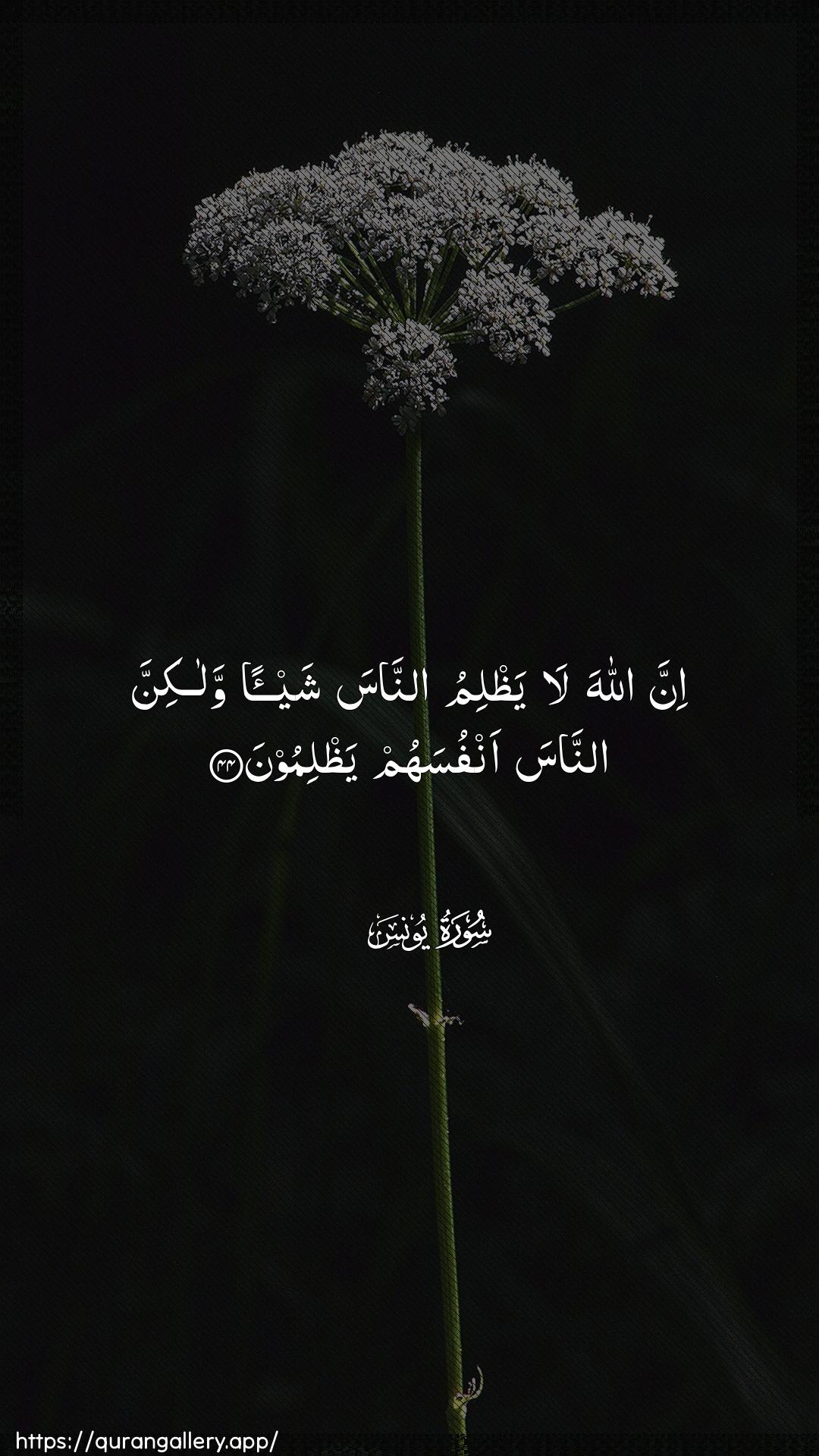
Arabic
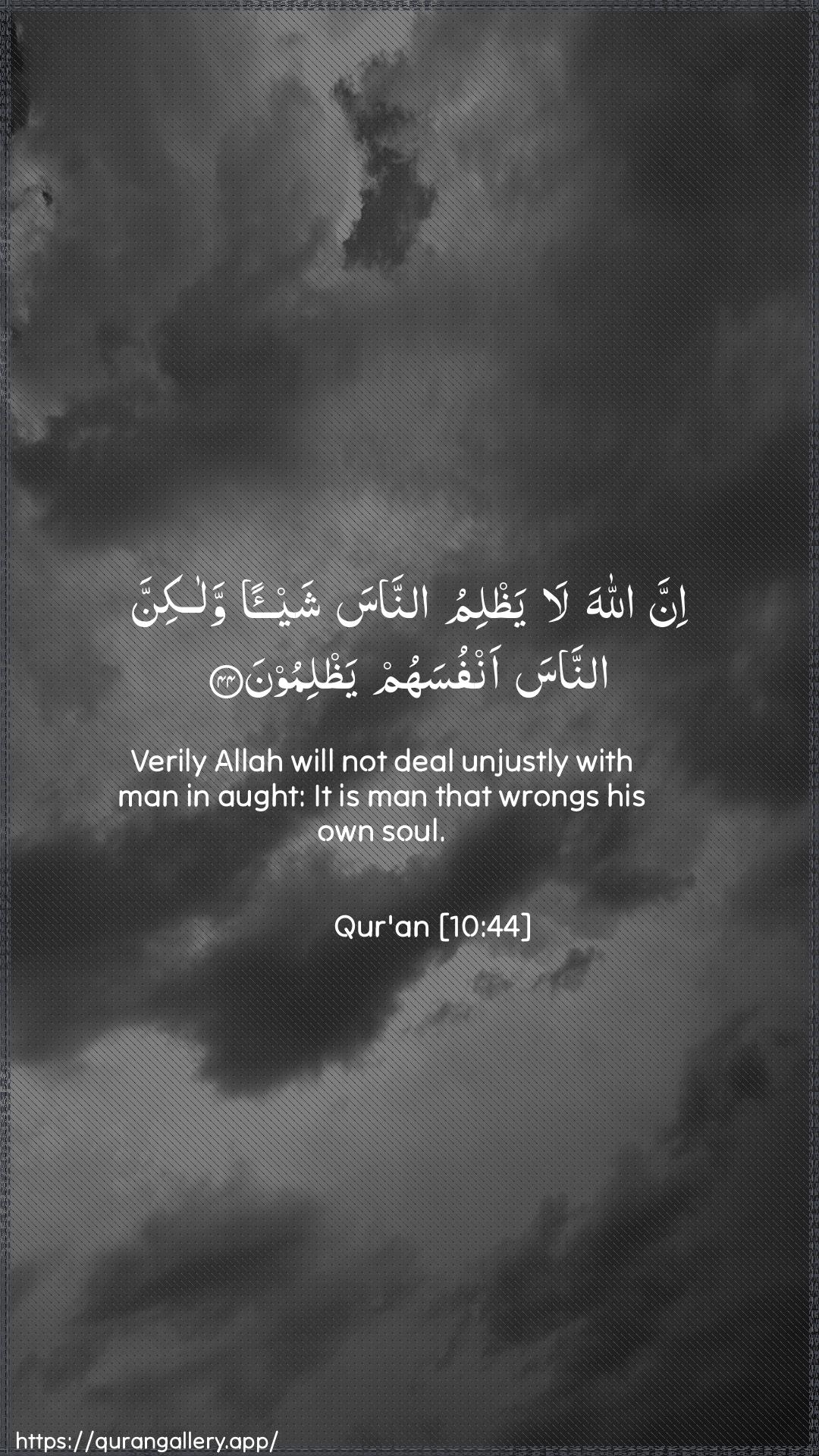
Arabic + English

Arabic (Wide)
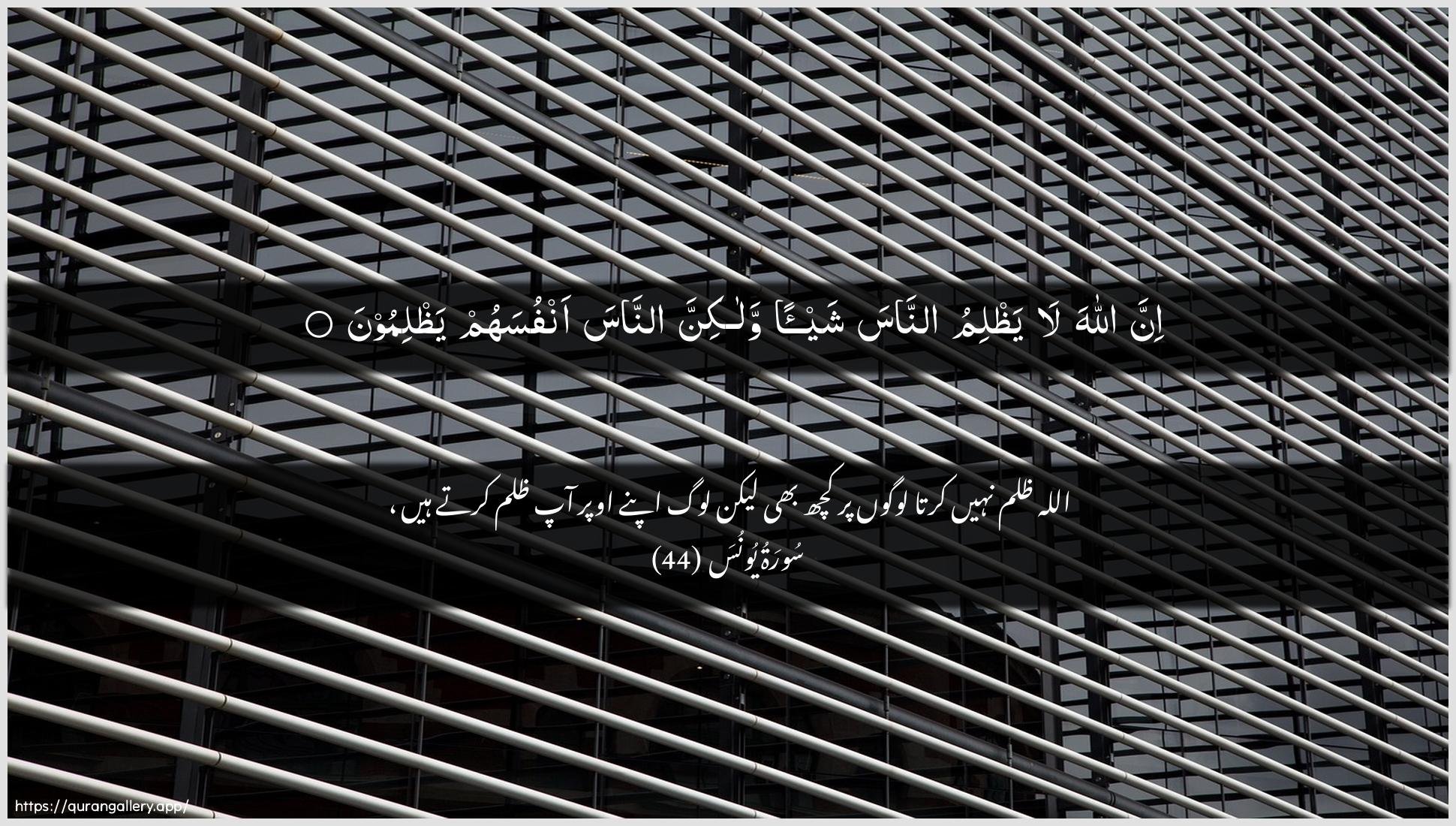
Arabic + Urdu
Free for personal & educational use with attribution
Quick Facts about this Verse
Surah
Yunus
Revealed
Makki
Position
Juz 11
Explore this Verse
Verse Meaning
According to the classical scholar Ibn Kathir, verse 10:44 of Surah Yunus is a foundational statement on divine justice, powerfully supported by a Hadith Qudsi where Allah declares, 'O My servants, I have forbidden injustice for Myself and made it forbidden amongst you.' This establishes that Allah's nature is fundamentally just. Al-Tabari explains that any punishment or withholding of guidance from people is a direct consequence of their own disbelief and disobedience, not an arbitrary act from God. The verse synthesizes this by stating that the mechanism for spiritual ruin lies within humanity itself. As Al-Qurtubi notes, even within the complexities of divine decree (qadr), Allah's actions are perfect and just, as He is the sovereign acting within His own dominion. Therefore, the 'injustice' is the act of people wronging their own souls by rejecting the clear signs and faculties—like reason, sight, and hearing—that Allah has provided for their guidance.
Questions for Reflection
Personal Contemplation
As-Sa'di states people wrong themselves by rejecting truth when it comes. Reflect on a time a truth or piece of good advice was presented to you, but your pride or desire caused you to reject it. What was the internal and external cost of that self-inflicted injustice?
Relational Contemplation
Al-Tabari explains that our actions 'earn' Allah's response. Contemplate a key relationship in your life. In what ways might your own actions—words, assumptions, or neglect—be the root of any 'injustice' or difficulty you feel you are experiencing in that relationship?
Spiritual Contemplation
Ibn Kathir cites the Hadith 'I have forbidden injustice for Myself.' Meditate on the absolute, unwavering justice of Allah. How does fully internalizing this reality liberate you from feelings of resentment or spiritual despair, placing the power to change squarely back in your hands?
Practical Applications
Conduct a daily audit of God-given faculties: 'Have I used my sight, hearing, and intellect today to seek truth or to indulge in heedlessness?'
In an age of digital distraction, consciously choosing to use technology for learning and reflection rather than mindless scrolling is a direct application of this principle.
When facing hardship, consciously reframe the narrative from 'Why is this happening to me?' to 'What is my share of responsibility, and how can I rectify it?'
Applicable in career setbacks, relationship difficulties, or personal failures, encouraging a mindset of growth and accountability over blame.
Hidden Gem
The synthesis of tafsirs reveals that 'wronging the self' is not a single act, but a process of de-sensitization. The Urdu tafsirs highlight neglecting God-given faculties. As-Sa'di points to rejecting truth. Al-Tabari notes earning consequences. Together, they show that self-injustice is the slow process of ignoring our innate tools for guidance, which leads to an inability to recognize truth, culminating in actions that bring about our own ruin. It's a chain reaction that begins with simple neglect.
Scroll to see more verses or use the dropdown in the breadcrumb to jump to any verse
Common Questions
1 more question available in the full page