
Al-Baqara - The Cow
Arabic Name: الْبَقَرَة
Urdu Name: گائے
Type: Madani
Serial Number: 2
Revelation Order: 87
Total Verses: 286
Parah: 1,2,3
Rukus: 40
Sajda: None
Share Verse Art

Arabic
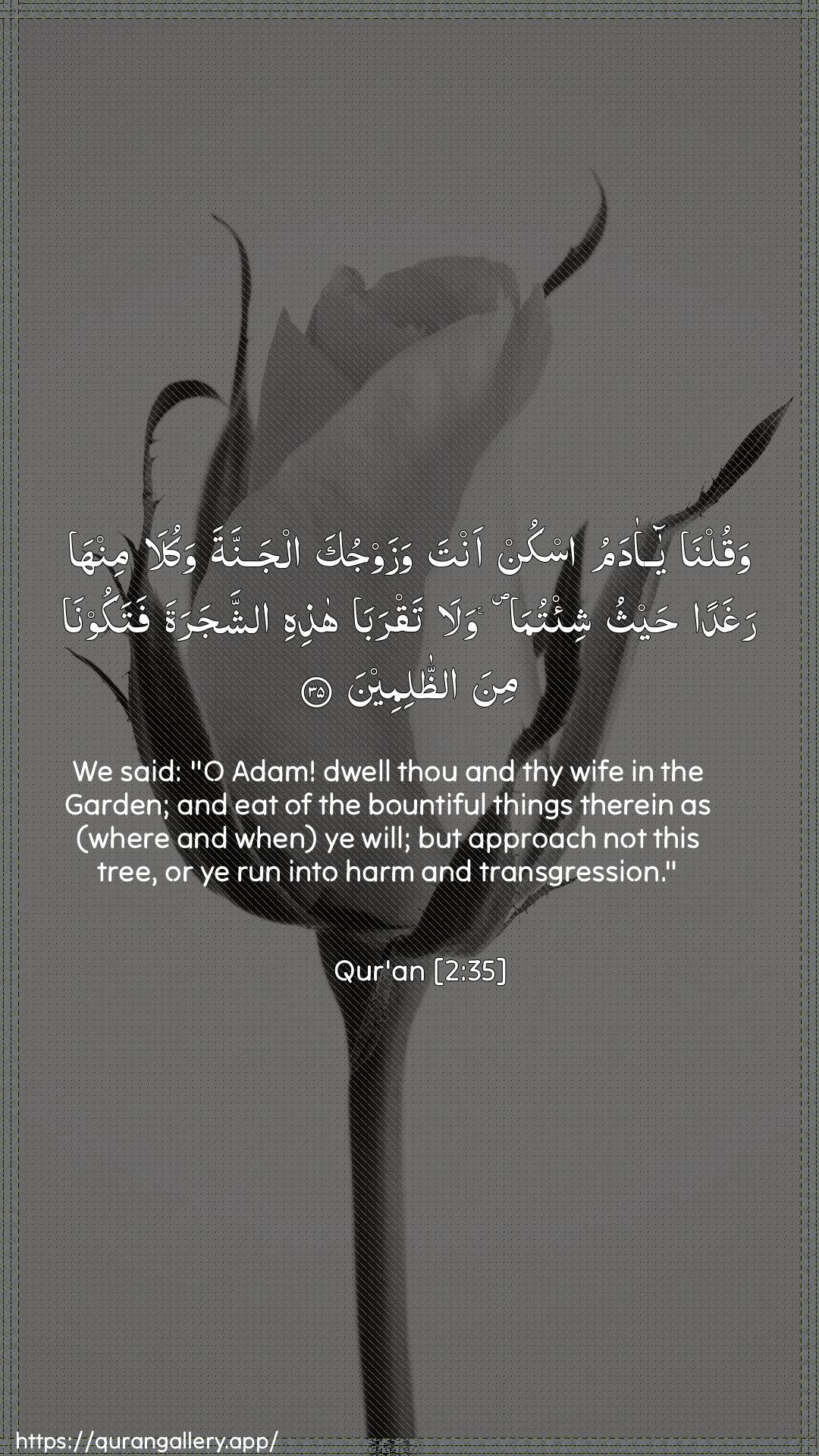
Arabic + English
Arabic (Wide)
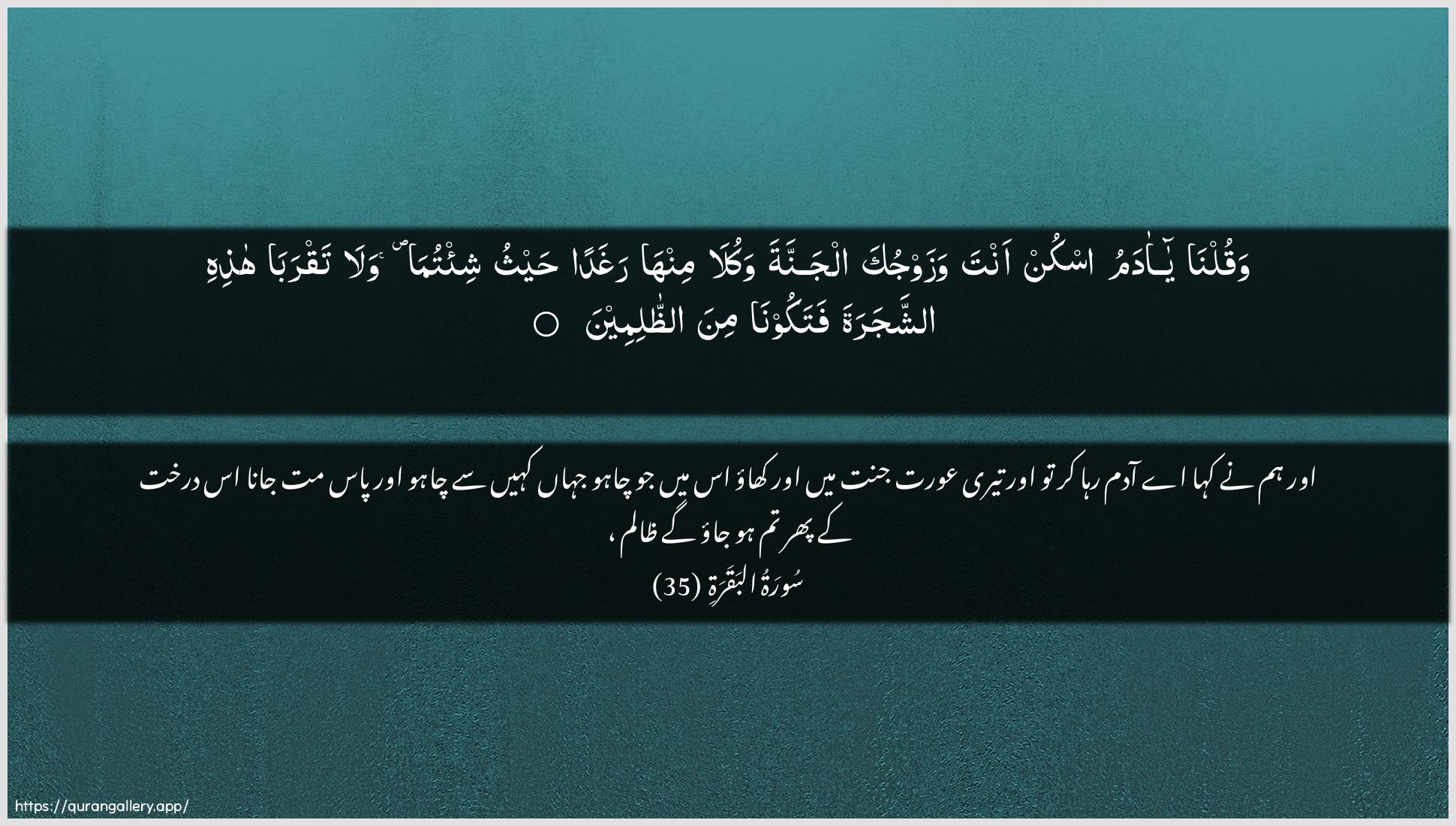
Arabic + Urdu
Free for personal & educational use with attribution
Quick Facts about this Verse
Surah
Al-Baqara
Revealed
Madani
Position
Juz 1,2,3
Explore this Verse
Verse Meaning
According to the classical tafsir of Imam Al-Tabari, Quran 2:35 marks a pivotal moment of divine honor and the first test for humanity. After the angels' prostration, Allah bestowed upon Adam and his wife, Hawwa (Eve), the privilege of residing in Jannah (the Garden), granting them abundant, blissful sustenance ('raghadan'). This synthesis of scholarly opinion, including insights from Ibn Kathir and Al-Qurtubi, reveals a profound truth: the command was not merely about a tree, but a foundational lesson in obedience, boundaries, and the nature of free will. The prohibition, "do not approach this tree," was a test of their commitment. While scholars like Ibn Abbas and others debated the tree's specific type—be it a vine, fig, or wheat stalk—Imam Al-Tabari concludes that its exact identity is unknowable and irrelevant to the core lesson. The true 'hidden gem' from this cross-tafsir analysis is that the prohibition was designed to teach humanity that true freedom lies not in limitless consumption, but in adherence to divine limits, and that transgressing these limits defines one as a 'Zalim' (wrongdoer), not just against God, but against one's own soul.
Questions for Reflection
Textual Contemplation
Allah says, 'eat... abundantly (raghadan) where you will,' but then gives a single prohibition. Al-Tabari notes the contrast between boundless permission and a specific limit. Contemplate the linguistic balance here. How does understanding the vastness of Allah's permission change your perception of His prohibitions? Does it feel like restriction, or a loving act of protection within an ocean of blessings?
Personal Transformation
The verse ends with '...lest you be among the wrongdoers (al-Zalimin).' Al-Qurtubi explains that this 'wrongdoing' is primarily against oneself. Identify a personal 'forbidden tree'—a habit or desire you know is harmful. Reflect on how approaching it is an act of self-injustice, depriving your soul of peace and closeness to Allah, rather than just breaking an external rule.
Relational Wisdom
The command was given to Adam and Hawwa together: 'Dwell,' 'eat,' 'do not approach,' 'lest you both be.' Ibn Kathir points out this shared accountability from the very beginning. Contemplate how your key relationships either help you stay away from your 'forbidden trees' or draw you closer to them. How can you and your spouse, family, or close friends become mutual guardians of each other's spiritual boundaries?
Practical Applications
Identify and respect the 'forbidden trees' in your own life—the clear prohibitions (haram) in your finances, relationships, and consumption.
Navigating temptations in a hyper-consumerist society, from interest-based loans to unethical entertainment.
Cultivate gratitude for the vastness of what is permitted (halal) rather than focusing on the few things that are forbidden.
Counteracting feelings of religious restriction by actively enjoying the vast halal options in food, work, and leisure.
Recognize that true partnership, like that of Adam and Hawwa, involves mutual support in obeying Allah's commands.
Spouses, friends, or family members reminding each other of Islamic principles and helping each other avoid transgression.
Hidden Gem
A spiritual insight derived from synthesizing the tafsirs is that Paradise (Jannah) for Adam was a state of being where his needs were met ('eat... abundantly') as long as he maintained a conscious relationship with one divine boundary. This suggests that our own inner peace and 'paradise on earth' is not found in having everything, but in being content with Allah's vast blessings while consciously honoring His few sacred limits.
Scroll to see more verses or use the dropdown in the breadcrumb to jump to any verse
Common Questions
1 more question available in the full page