
Al-Baqara - The Cow
Arabic Name: الْبَقَرَة
Urdu Name: گائے
Type: Madani
Serial Number: 2
Revelation Order: 87
Total Verses: 286
Parah: 1,2,3
Rukus: 40
Sajda: None
Share Verse Art

Arabic

Arabic + English
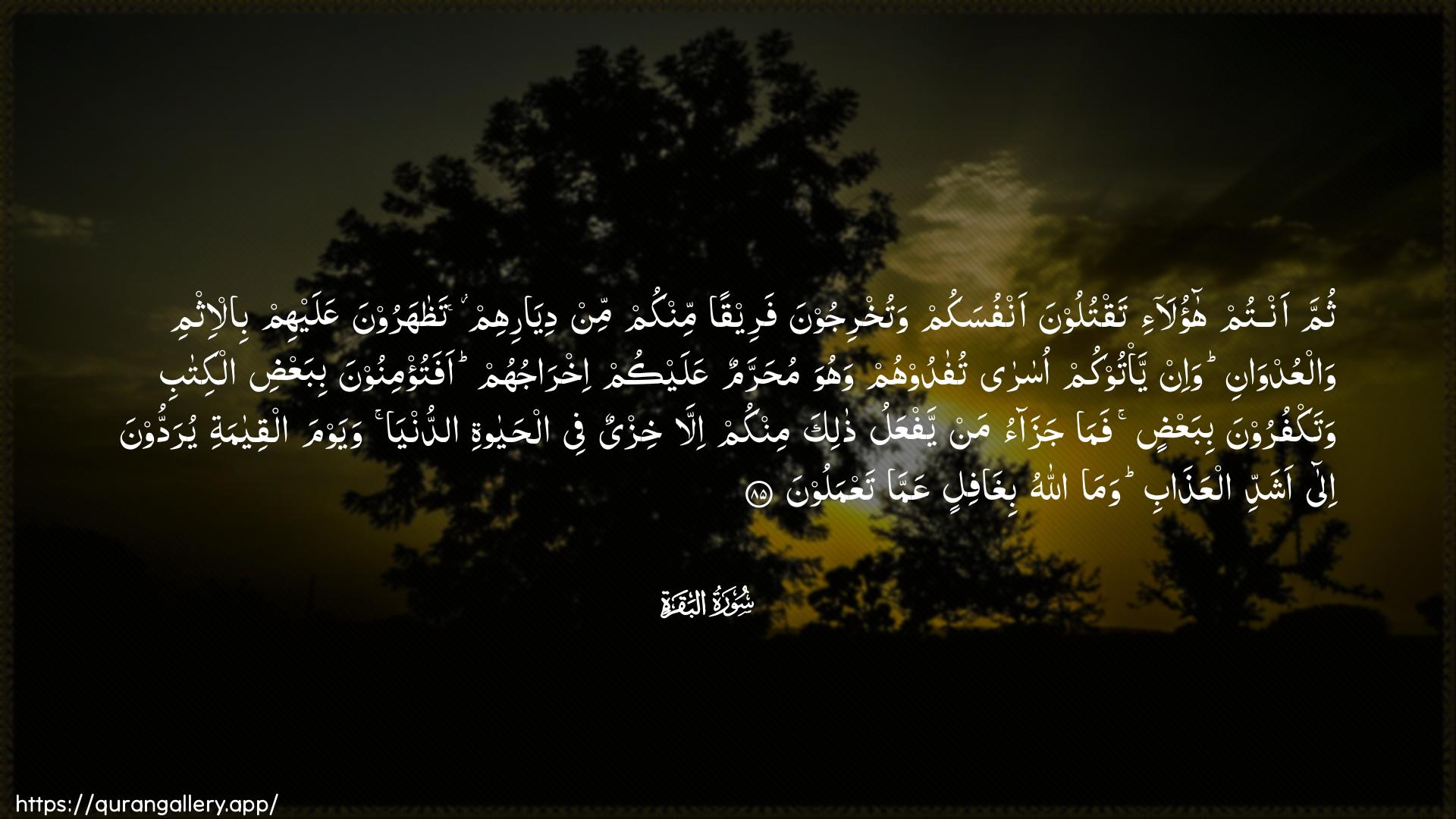
Arabic (Wide)
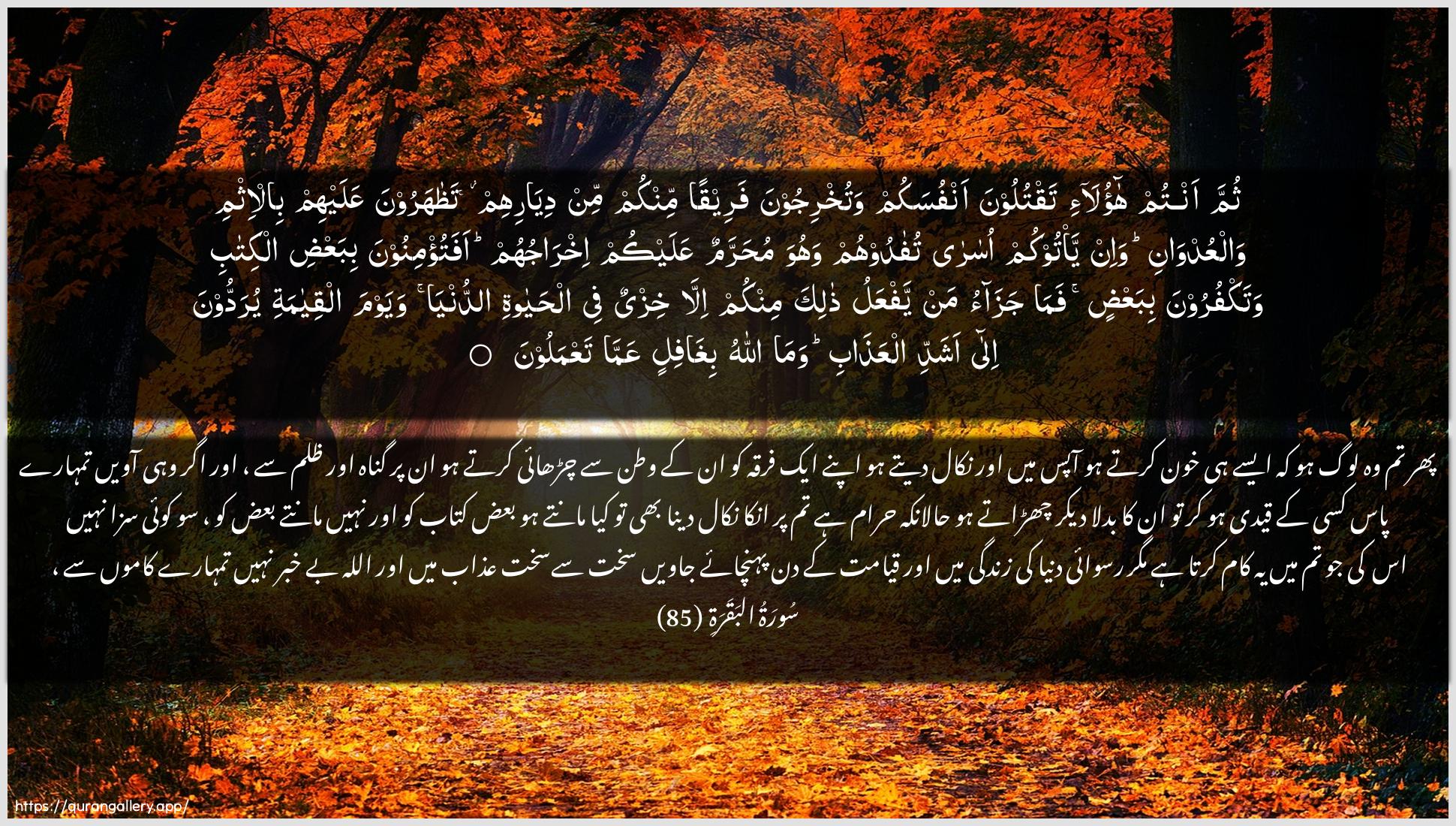
Arabic + Urdu
Free for personal & educational use with attribution
Quick Facts about this Verse
Surah
Al-Baqara
Revealed
Madani
Position
Juz 1,2,3
Explore this Verse
Verse Meaning
According to the classical tafsir of Ibn Kathir, verse 2:85 of Surah Al-Baqarah serves as a severe rebuke to the Jewish tribes of Medina (Banu Qurayza, Banu Nadir, and Banu Qaynuqa) for their flagrant violation of the covenant they made with God. As Al-Tabari details, these tribes had allied themselves with the warring pagan Arab tribes of Aws and Khazraj. In these conflicts, they would kill their fellow Jews and expel them from their homes—actions explicitly forbidden in the Torah. Paradoxically, as noted by As-Sa'di, when their Jewish brethren were taken captive by their pagan allies, they would raise funds to ransom them, citing the Torah's command to do so. This selective obedience, this 'believing in some parts of the Book and rejecting others,' is the crux of the verse. The synthesis of these scholarly accounts reveals a profound hypocrisy: they upheld the law when it was convenient or brought them social credit (ransoming captives) but abandoned it when political alliances and worldly gains were at stake (killing and expelling their own). This verse establishes a universal principle that true faith demands complete submission to divine law, not a fragmented, self-serving application. The punishment for such hypocrisy is severe: disgrace in this world and the harshest torment in the Hereafter.
Questions for Reflection
Personal Integrity
Reflect on your own life and identify an area where you find it easy to follow an Islamic command and another where you consistently struggle or make exceptions. Considering the warning in this verse, how does this inconsistency affect the sincerity and wholeness of your faith, and what practical steps can you take to bridge this gap?
Communal Responsibility
The Jewish tribes prioritized their alliances with pagan clans over the lives of their fellow Jews. In what modern contexts do we see Muslims prioritizing national, political, or financial alliances over the well-being and sanctity of the global Muslim community? How does this verse challenge our modern allegiances?
Theological Consistency
The verse warns of 'disgrace in this worldly life' as a direct consequence of partial faith. Contemplate the state of the Muslim Ummah today. In what ways can our collective state of weakness and disunity be seen as a reflection of our collective picking and choosing of Islamic commands, as detailed by the scholars?
Practical Applications
Conduct a personal audit of your religious practices to identify any areas where you might be 'picking and choosing' which commands to follow.
In an era of secular pressures, consciously uphold Islamic principles in finance, social interactions, and ethics, even when it's counter-cultural.
Prioritize the sanctity of community bonds over worldly alliances and personal gain, refusing to harm a fellow believer for a material advantage.
Avoid backbiting a Muslim colleague for a promotion or engaging in business practices that harm other members of the community.
When you fulfill a religious duty, reflect on whether you are neglecting another related command, striving for consistency in obedience.
One who is diligent in prayer (Salah) should also be honest in business dealings, recognizing both are commands from the same divine source.
Hidden Gem
The deepest gem lies in understanding the psychology of hypocrisy revealed here. The tribes were not openly rejecting the Torah; they were using one part of it (ransoming) to justify their violation of another (killing/expelling). This shows that the most dangerous form of disbelief is not outright rejection, but a self-deceiving reinterpretation of religion to suit one's own desires and political needs. It is a faith that has the form of obedience but lacks the substance of submission.
Scroll to see more verses or use the dropdown in the breadcrumb to jump to any verse