
Al-Baqara - The Cow
Arabic Name: الْبَقَرَة
Urdu Name: گائے
Type: Madani
Serial Number: 2
Revelation Order: 87
Total Verses: 286
Parah: 1,2,3
Rukus: 40
Sajda: None
Share Verse Art
Arabic
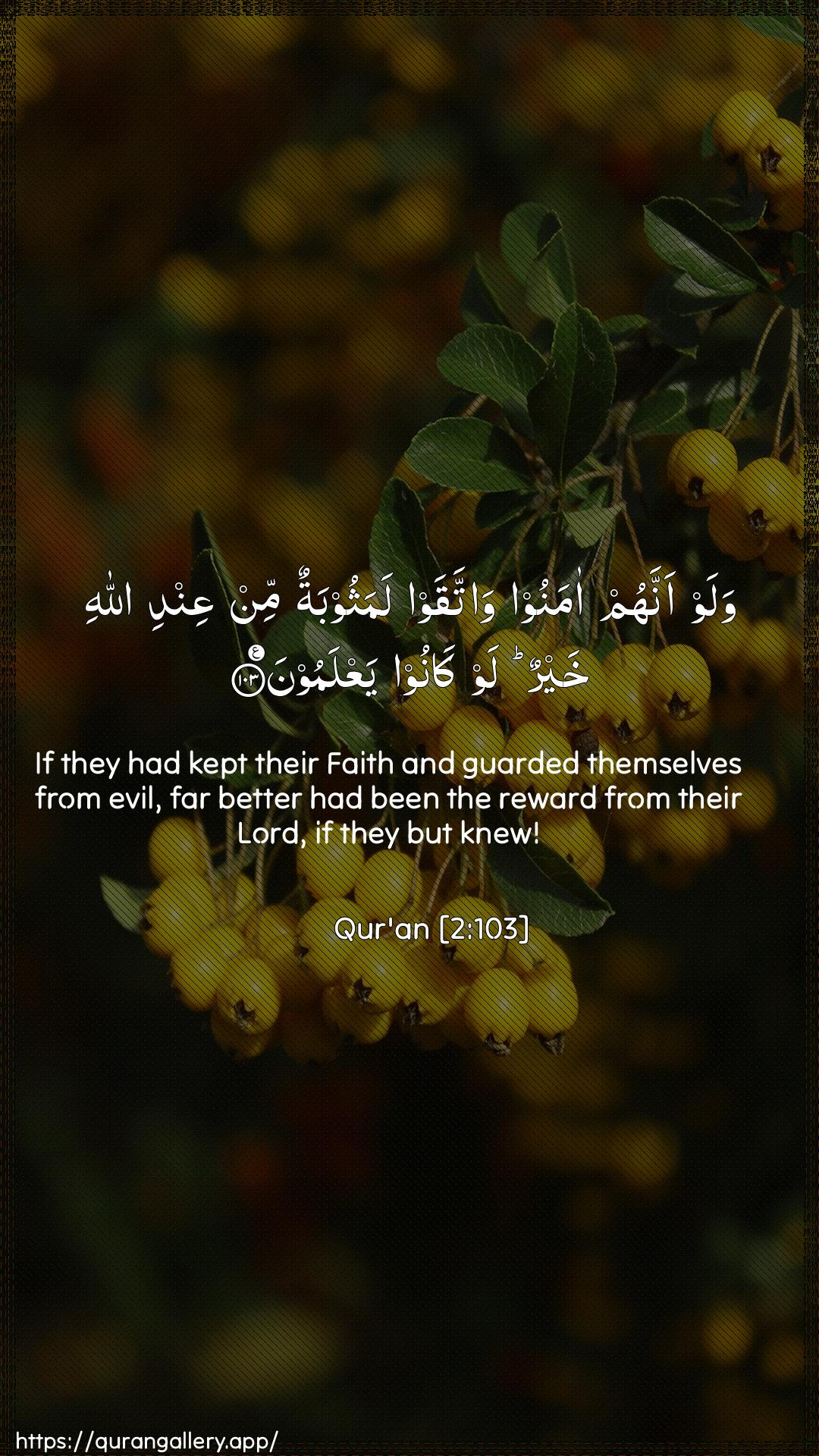
Arabic + English
Arabic (Wide)
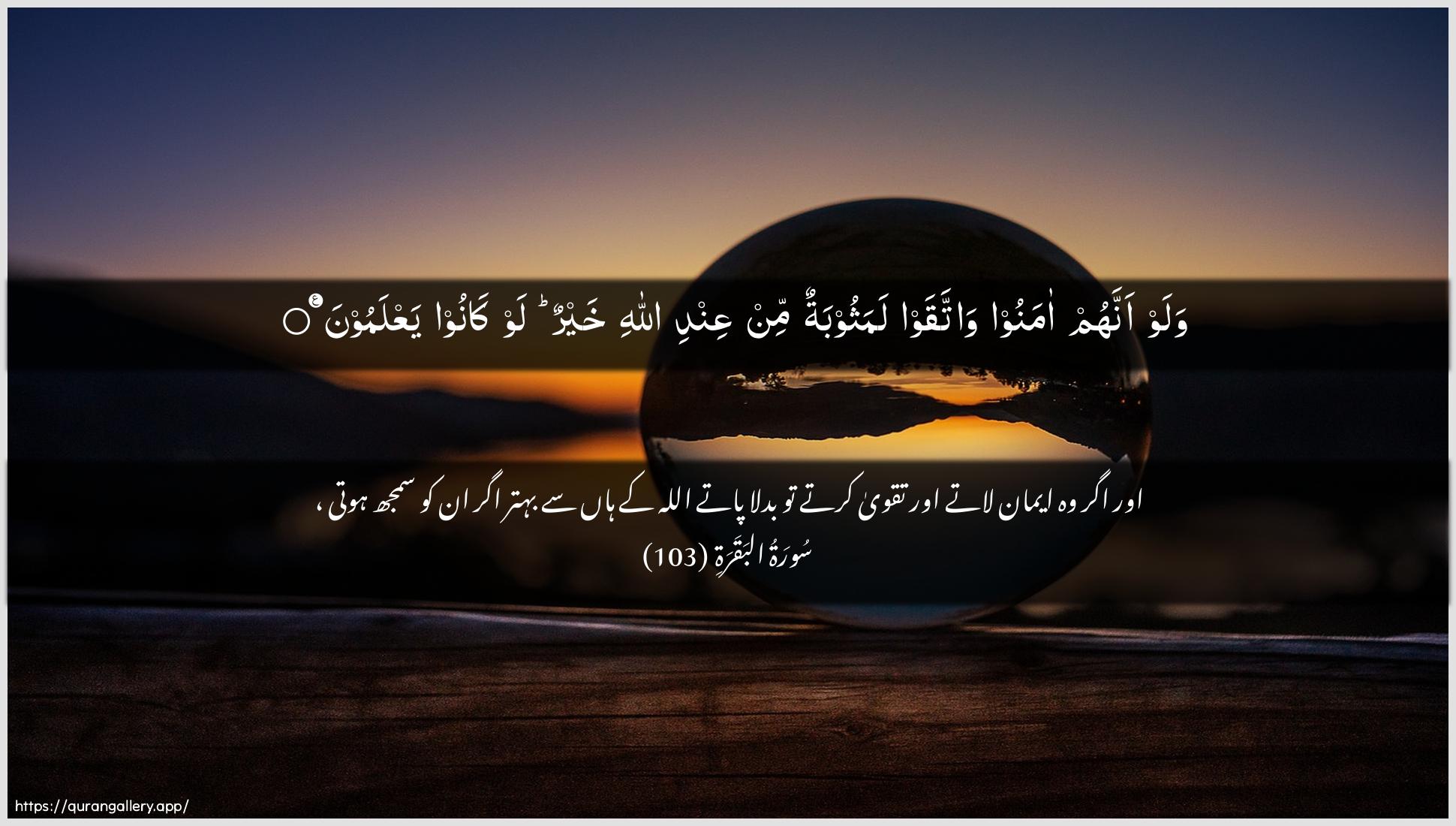
Arabic + Urdu
Free for personal & educational use with attribution
Quick Facts about this Verse
Surah
Al-Baqara
Revealed
Madani
Position
Juz 1,2,3
Explore this Verse
Verse Meaning
According to the classical exegesis of Al-Tabari, Quran 2:103 serves as a profound concluding statement to the preceding narrative about magic and the Children of Israel. It presents a divine ultimatum: the path of faith (Iman) and God-consciousness (Taqwa) yields a reward—'mathubah'—from Allah that is unequivocally superior to the fleeting power and illusions offered by sorcery. Ibn Kathir reinforces this, explaining that had they believed in Allah and His messengers and avoided the prohibitions, the recompense would be their ultimate good. The synthesis of scholarly thought reveals a crucial divine principle: true, lasting benefit is intrinsically linked to belief and piety. The phrase 'if they only knew' is not merely a statement of their ignorance, but a divine expression of regret over their poor choice, highlighting that their lack of profound knowledge led them to trade an eternal, superior reward for a temporary, harmful delusion. This verse thus frames the choice not as one between two equal options, but between ultimate good and self-inflicted loss.
Questions for Reflection
personal
Reflect on the phrase 'if they only knew.' What specific knowledge do I lack or ignore that leads me to prioritize lesser, worldly goals over the 'better' reward from Allah? How can I actively seek the kind of knowledge that reorients my heart towards the Akhirah?
relational
The preceding verse discusses magic used to separate people. How does my pursuit of worldly status, wealth, or influence (my 'magic') affect my relationships? In what ways would prioritizing faith and Taqwa lead to 'better' and more blessed connections with others?
cosmic
Contemplate the word 'mathubah' (recompense/reward) 'from Allah.' How does the source of a reward change its essential nature and value? What does it mean for a reward to come directly from the Creator of all value, and how does this reality render all other 'rewards' insignificant?
Practical Applications
In moments of decision, consciously ask: 'Does this action align with my faith and fear of Allah, and does it contribute to my eternal reward?'
Applicable in career choices, financial decisions, and interpersonal relationships where ethical compromises may offer short-term advantages.
Cultivate 'Taqwa' by actively avoiding actions that, while not explicitly forbidden, exist in gray areas and could displease Allah.
Relevant to media consumption, social interactions, and business ethics where the lines between permissible and doubtful can be blurred.
Hidden Gem
The verse subtly implies that true knowledge ('ilm) is not the accumulation of facts but the ability to perceive true value. The Children of Israel were knowledgeable in religious law but lacked the wisdom to apply it. The gem here is that Iman and Taqwa are themselves the highest forms of knowledge, as they illuminate the path to what is truly 'better'.
Scroll to see more verses or use the dropdown in the breadcrumb to jump to any verse