
Yusuf - Joseph
Arabic Name: يُوْسُف
Urdu Name: یوسف
Type: Makki
Serial Number: 12
Revelation Order: 53
Total Verses: 111
Parah: 12,13
Rukus: 12
Sajda: None
Share Verse Art
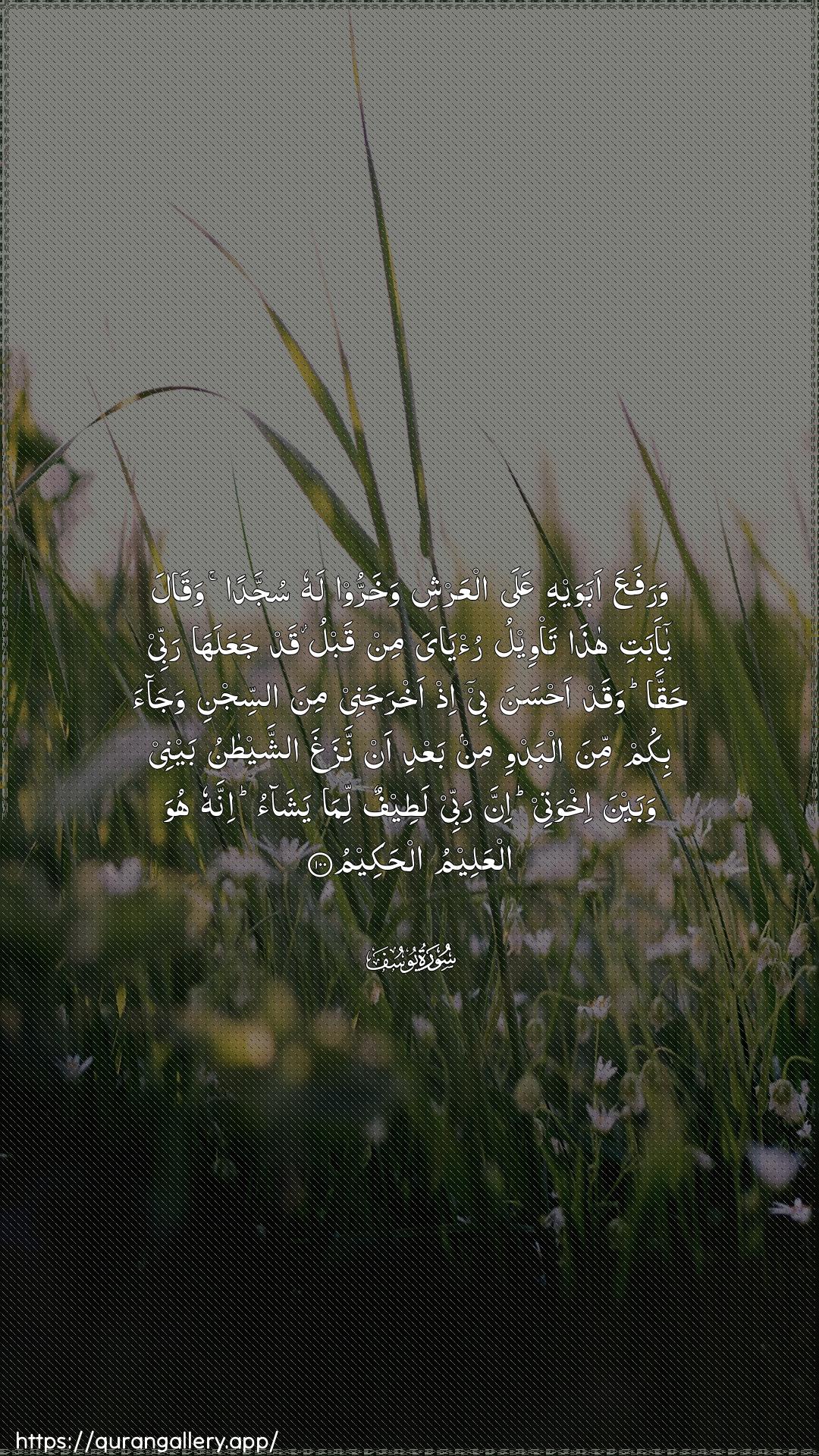
Arabic

Arabic + English

Arabic (Wide)
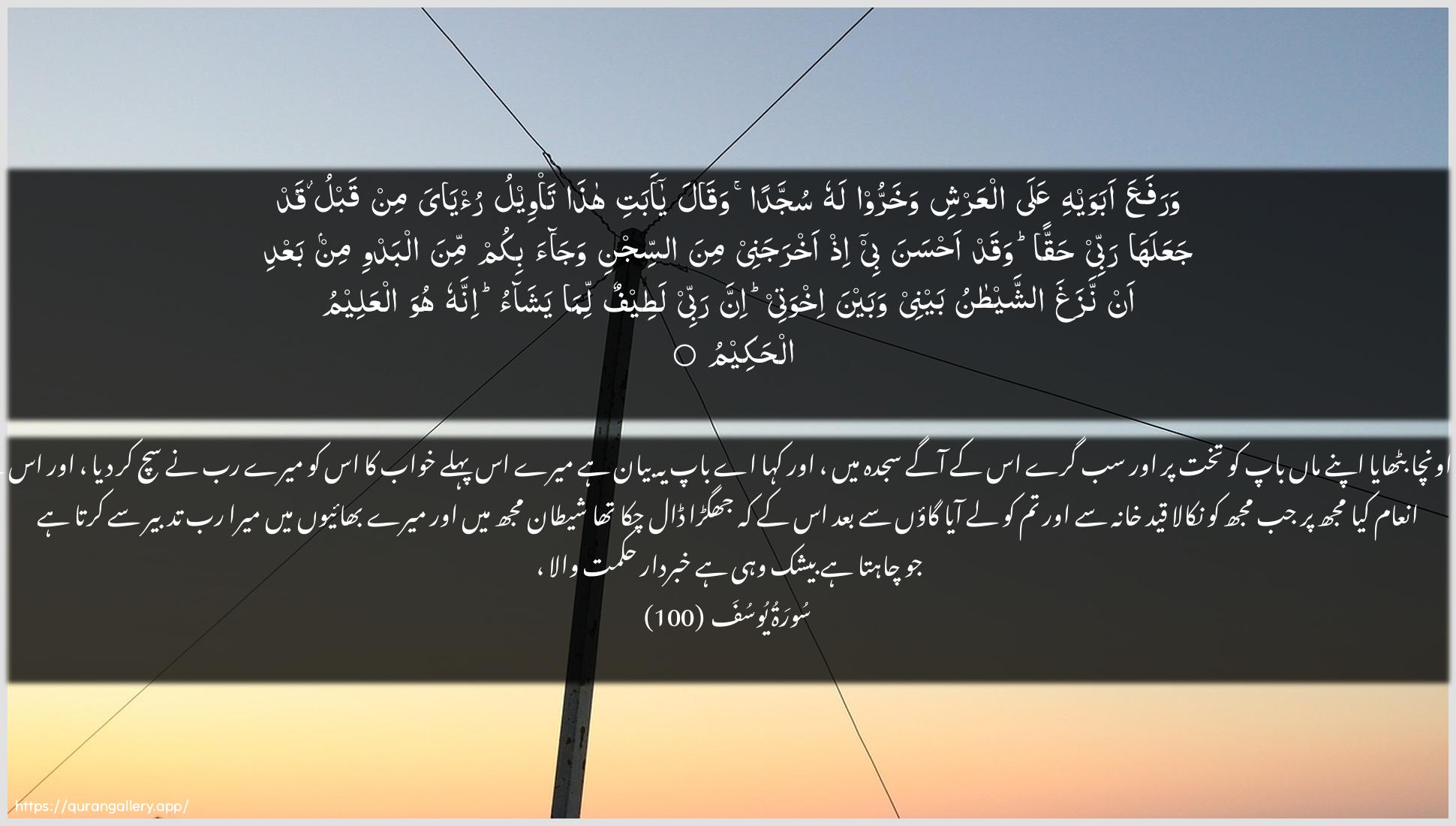
Arabic + Urdu
Free for personal & educational use with attribution
Quick Facts about this Verse
Surah
Yusuf
Revealed
Makki
Position
Juz 12,13
Explore this Verse
Verse Meaning
According to a consensus of classical scholars like Ibn Kathir, Al-Tabari, and Al-Qurtubi, Quran 12:100 represents the magnificent climax of Prophet Yusuf's story, marking the fulfillment of his childhood dream and the culmination of Allah's subtle and wise plan. The verse captures the emotional reunion where Yusuf raises his parents to the throne and they, along with his eleven brothers, fall prostrate before him. This prostration, as Ibn Kathir clarifies, was a greeting of honor and respect permissible in previous religious laws, not an act of worship, which is due only to Allah. The moment prompts Yusuf (peace be upon him) to declare to his father, 'O my father, this is the interpretation of my dream of old!' The profound character of Prophet Yusuf shines as he recounts Allah's favors. With immense grace, as noted by Al-Qurtubi, he mentions being freed from prison but omits his ordeal in the well, so as not to embarrass his brothers. He attributes the family's journey from the desert life and the past conflict with his brothers to the incitement of Satan, completely absolving his siblings. The verse concludes with Yusuf's deep theological insight: 'Indeed, my Lord is Subtle in what He wills. Indeed, it is He who is the Knowing, the Wise,' a powerful testament to Allah's intricate and merciful planning that turns trials into triumph.
Questions for Reflection
Personal Transformation
Yusuf (as) saw his release from prison as an act of Allah's goodness. Reflect on a past difficulty in your life. How can you, following Al-Qurtubi's insights on sabr, reframe that event not as a moment of suffering, but as a necessary step in Allah's subtle plan for your growth?
Relational Wisdom
Ibn Kathir highlights Yusuf's tact in not mentioning the well. Contemplate a relationship where forgiveness is needed. How can you apply this prophetic wisdom to communicate forgiveness in a way that completely preserves the other person's dignity and paves the way for a true reconciliation?
Theological Deepening
The verse concludes, 'Indeed, my Lord is Subtle (Latif) in what He wills.' Drawing from As-Sa'di's tafsir, contemplate the concept of Allah's 'Lutf'. Where in your own life have you seen His plan unfold through unexpected or even seemingly negative events, leading to a good outcome you could never have planned yourself?
Practical Applications
Practice 'Graceful Forgiveness' by focusing on reconciliation without recounting the specifics of the hurt caused, just as Yusuf mentioned the prison but not the well.
Apply in family disputes or when reconciling with friends, choosing to highlight shared positive outcomes rather than dwelling on past mistakes.
Reframe past trials as part of Allah's favor. Yusuf framed his release from prison as an act of Allah's goodness ('He was indeed good to me').
When reflecting on personal history, consciously identify how overcoming past challenges led to current strengths or blessings.
Attribute interpersonal conflict to external instigation (Satan) to facilitate reconciliation, as Yusuf did by saying 'after Satan had sown enmity between me and my brothers.'
In mediation or personal apologies, one can say, 'Misunderstanding and negativity came between us,' which softens the blame and opens the door to forgiveness.
Hidden Gem
The synthesis of tafsirs reveals a profound spiritual insight: the prostration of the family was not just the fulfillment of Yusuf's dream, but the healing of Ya'qub's grief. Ibn Kathir discusses the duration of separation (up to 80 years), while Al-Qurtubi discusses the emotional reunion. Combined, one can see that the physical act of prostration was the final, visual confirmation that shattered decades of sorrow and uncertainty, making it a mercy for the father as much as an honor for the son.
Scroll to see more verses or use the dropdown in the breadcrumb to jump to any verse
Common Questions
2 more questions available in the full page