
Yunus - Jonas
Arabic Name: يُوْنـُس
Urdu Name: یونس
Type: Makki
Serial Number: 10
Revelation Order: 51
Total Verses: 109
Parah: 11
Rukus: 11
Sajda: None
Share Verse Art

Arabic

Arabic + English

Arabic (Wide)
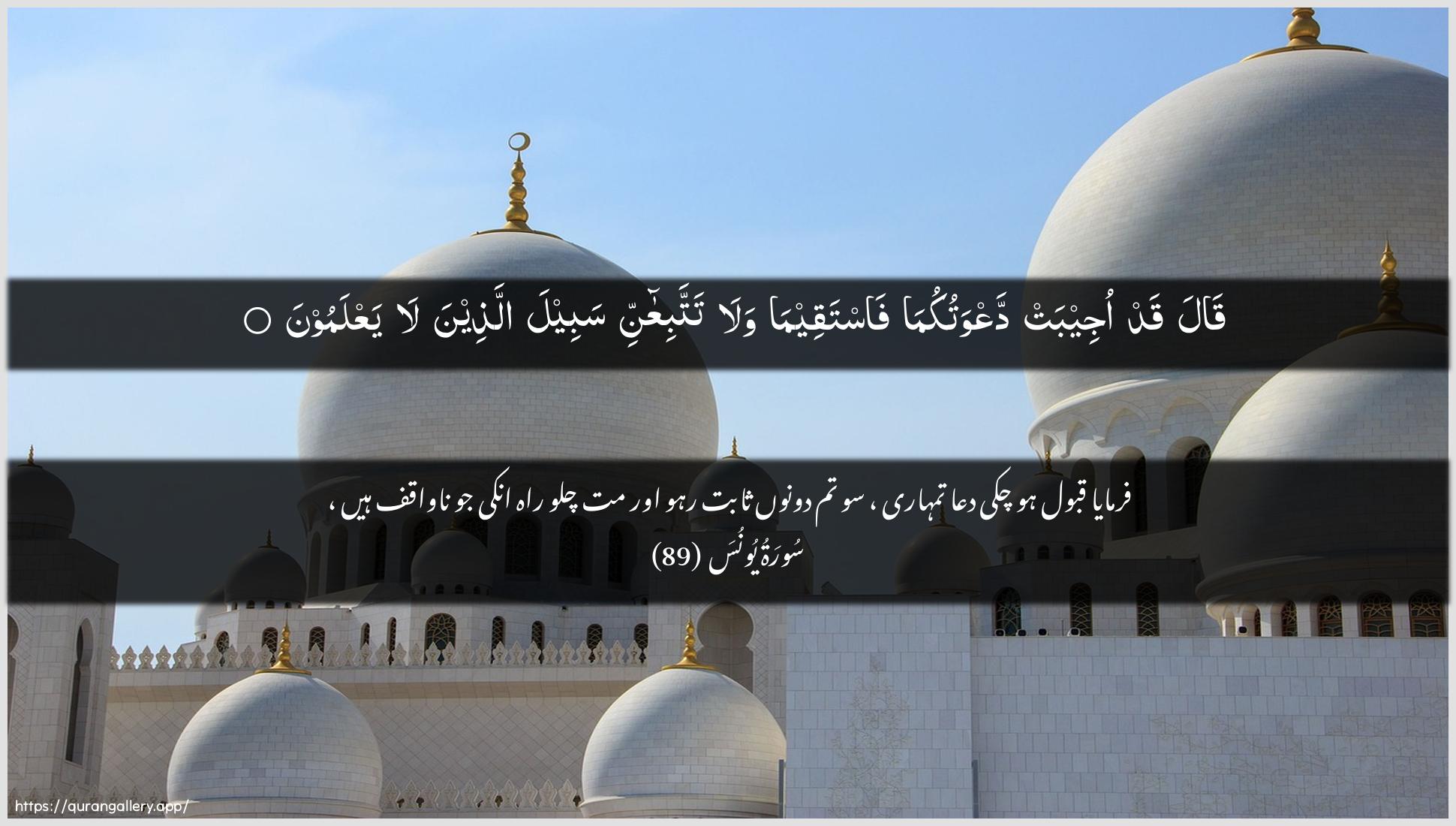
Arabic + Urdu
Free for personal & educational use with attribution
Quick Facts about this Verse
Surah
Yunus
Revealed
Makki
Position
Juz 11
Explore this Verse
Verse Meaning
According to the classical exegete Imam Al-Tabari, Quran 10:89 is Allah's definitive response to the powerful prayer of Prophet Moses against Pharaoh, a prayer in which his brother Aaron participated by saying 'Amen.' A comprehensive review of tafsirs reveals a profound lesson in divine timing and human responsibility. While Moses prayed for destruction, Allah's answer, 'Your prayer has been answered,' was followed by the crucial command, 'So be steadfast' (Fastaqima). Ibn Kathir notes that the fulfillment of this prayer—the drowning of Pharaoh—occurred forty years later. This synthesis reveals that the acceptance of a prayer is not always immediate in its manifestation; it initiates a period requiring unwavering steadfastness and continued adherence to the divine path, a test of faith in itself. The prohibition, 'do not follow the way of those who do not know,' serves as a warning against the impatience and ignorance of those who misunderstand Allah's wisdom and timetable, demanding instant results. This verse, therefore, functions as a masterclass in the etiquette of supplication: pray with conviction, trust in the acceptance, and then embody steadfastness, patience, and wisdom while awaiting the decree of Allah.
Questions for Reflection
Personal Steadfastness
Ibn Kathir mentions the fulfillment of this prayer came 40 years later. Reflect on a long-term goal in your life. How does the command 'Fastaqima' (be steadfast) challenge you to think beyond mere waiting and instead focus on consistent, righteous action and personal growth during this period?
Identifying Ignorance
Al-Qurtubi defines the 'way of those who do not know' as demanding haste and not understanding Allah's wisdom. In what areas of your life (career, family, personal projects) are you influenced by this 'ignorant' desire for instant results? How can you apply the principle of steadfastness to counter this external and internal pressure?
The Power of 'Amen'
Al-Tabari explains that Harun became a partner in the prayer simply by saying 'Amen.' Contemplate the last time you sincerely said 'Amen' to someone else's prayer. How does understanding this partnership principle change your role from a passive listener to an active participant in seeking and spreading divine blessings within your community?
Practical Applications
Implement the 'Dua-and-Steadfastness' principle: After making a heartfelt supplication, immediately pivot your focus to persevering on the right course of action, rather than passively waiting for the outcome.
Apply this after praying for a job, a life partner, or the resolution of a major project. Continue to strive and do your part with excellence.
Develop an 'Ignorance Filter' by consciously rejecting hasty conclusions or despair when divine help seems delayed, recognizing this impatience as the 'way of those who do not know.'
Use this when facing societal pressure, comparing your life's timeline to others, or when a long-term project faces setbacks.
Hidden Gem
The synthesis of 'Ujibat da'watukuma' (Your prayer IS answered) and 'Fastaqima' (SO be steadfast) reveals a profound spiritual equation: Certainty in the result is the very fuel for steadfastness in the process. The command to be steadfast is not given in a state of hope, but in a state of confirmed acceptance. Contemplation on this transforms steadfastness from a struggle of hope into an act of certainty.
Scroll to see more verses or use the dropdown in the breadcrumb to jump to any verse
Common Questions
1 more question available in the full page