
Al-Baqara - The Cow
Arabic Name: الْبَقَرَة
Urdu Name: گائے
Type: Madani
Serial Number: 2
Revelation Order: 87
Total Verses: 286
Parah: 1,2,3
Rukus: 40
Sajda: None
Share Verse Art

Arabic
Arabic + English

Arabic (Wide)

Arabic + Urdu
Free for personal & educational use with attribution
Quick Facts about this Verse
Surah
Al-Baqara
Revealed
Madani
Position
Juz 1,2,3
Explore this Verse
Verse Meaning
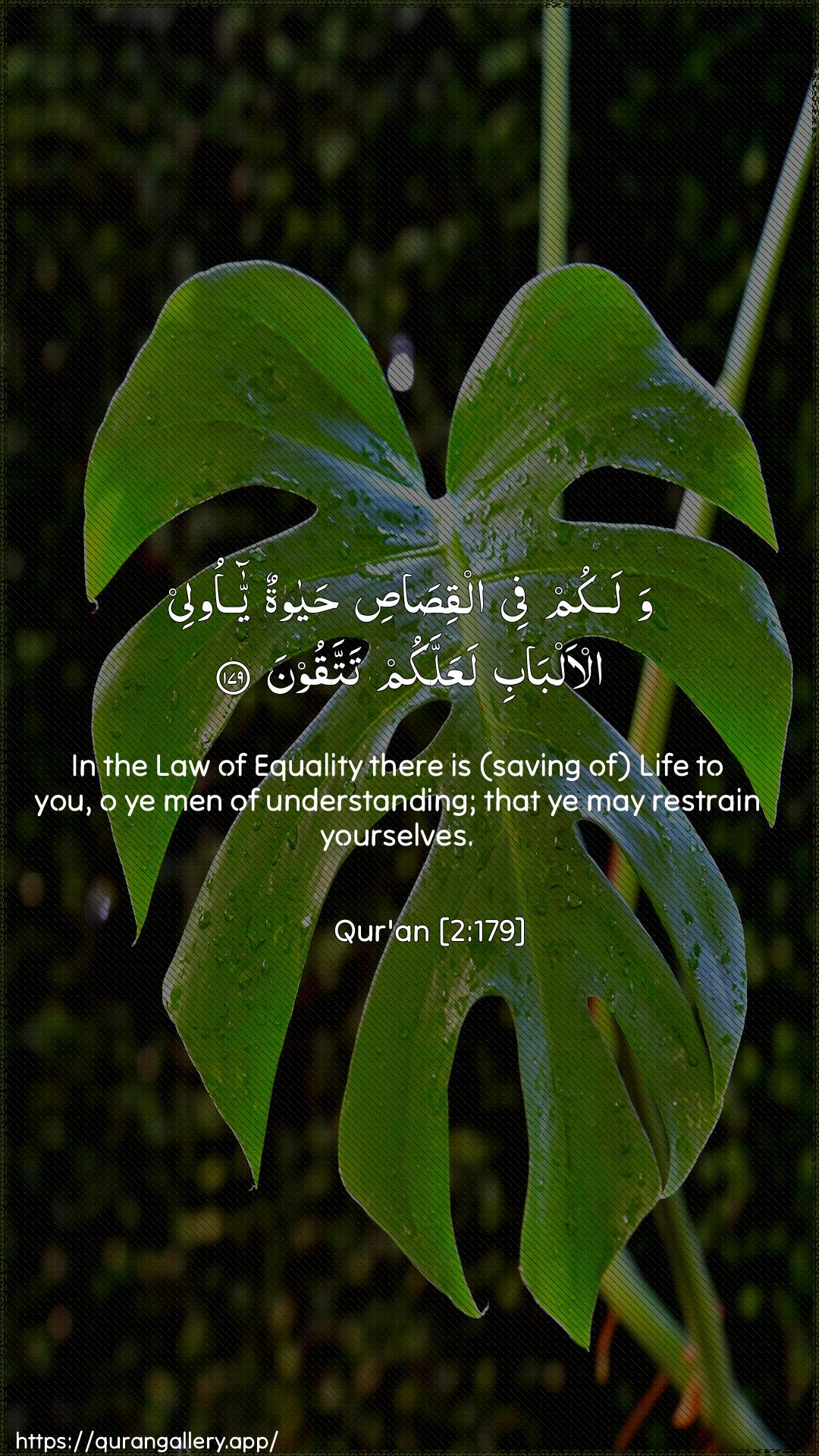
According to the classical exegete Imam Al-Tabari, Quran 2:179 articulates a foundational principle of Islamic jurisprudence: 'And for you in just retaliation there is life, O people of understanding.' This concise statement reveals a profound paradox that in a seemingly life-taking act, the preservation of life for the entire society is achieved. Ibn Kathir elaborates that this 'life' stems from deterrence; when a potential murderer knows they will face an equal consequence, they are restrained from the act, thereby saving both their own life and the life of their intended victim. Al-Qurtubi highlights that the address to 'people of understanding' (uli al-albab) signifies that this wisdom is not superficial but requires deep intellectual and spiritual reflection to grasp its true mercy. The verse synthesizes justice, deterrence, and societal welfare, presenting Islamic law not as mere punishment, but as a sophisticated system designed to protect the sanctity of life and foster a state of God-consciousness (Taqwa).
Questions for Reflection
Theological Contemplation
Allah names Himself The Most Merciful, yet ordains Qisas. How does this verse challenge a simplistic, sentimental understanding of 'mercy' and redefine it to include the profound mercy of establishing justice and security for the entire community, even if it is severe for one individual?
Societal Contemplation
Al-Qurtubi explains that this law ended endless cycles of tribal warfare. In our modern world, what are the 'tribal' mentalities (e.g., political, national, gang-related) that lead to cycles of violence, and how does the principle of impartial, state-administered justice taught here offer a solution?
Personal Contemplation
The verse specifically addresses 'People of Understanding' (Uli al-Albab). What intellectual and spiritual qualities must one cultivate to become a person of 'lubb' (deep intellect) who can perceive the 'life' in this law, rather than just the 'death'? How does this train us to trust Allah's wisdom over our own initial emotional reactions?
Practical Applications
Cultivate respect for the rule of law by understanding its ultimate purpose is protection, not vengeance.
Applicable when discussing criminal justice reform, emphasizing deterrence and societal safety as primary goals over personal retribution.
Appreciate the role of a just and impartial state authority in administering justice to prevent cycles of tribal or family revenge.
Essential for understanding the Islamic basis for a strong, just legal system and the rejection of anarchy or mob justice.
Engage with divine commands intellectually, seeking the underlying wisdom, especially in laws that seem difficult or counter-intuitive.
A powerful tool against extremist interpretations by encouraging deep reflection over literalist or emotional reactions to Islamic law.
Hidden Gem
The ultimate goal stated is 'la'allakum tattaqun' (so that you may attain Taqwa). The deepest contemplation is realizing that the law isn't just for societal order; it's a tool for spiritual development. By submitting to a just law that curbs our most primal instincts for revenge, we are trained in self-restraint and God-consciousness, which is the core of Taqwa.
Scroll to see more verses or use the dropdown in the breadcrumb to jump to any verse