
Al-Baqara - The Cow
Arabic Name: الْبَقَرَة
Urdu Name: گائے
Type: Madani
Serial Number: 2
Revelation Order: 87
Total Verses: 286
Parah: 1,2,3
Rukus: 40
Sajda: None
Share Verse Art

Arabic
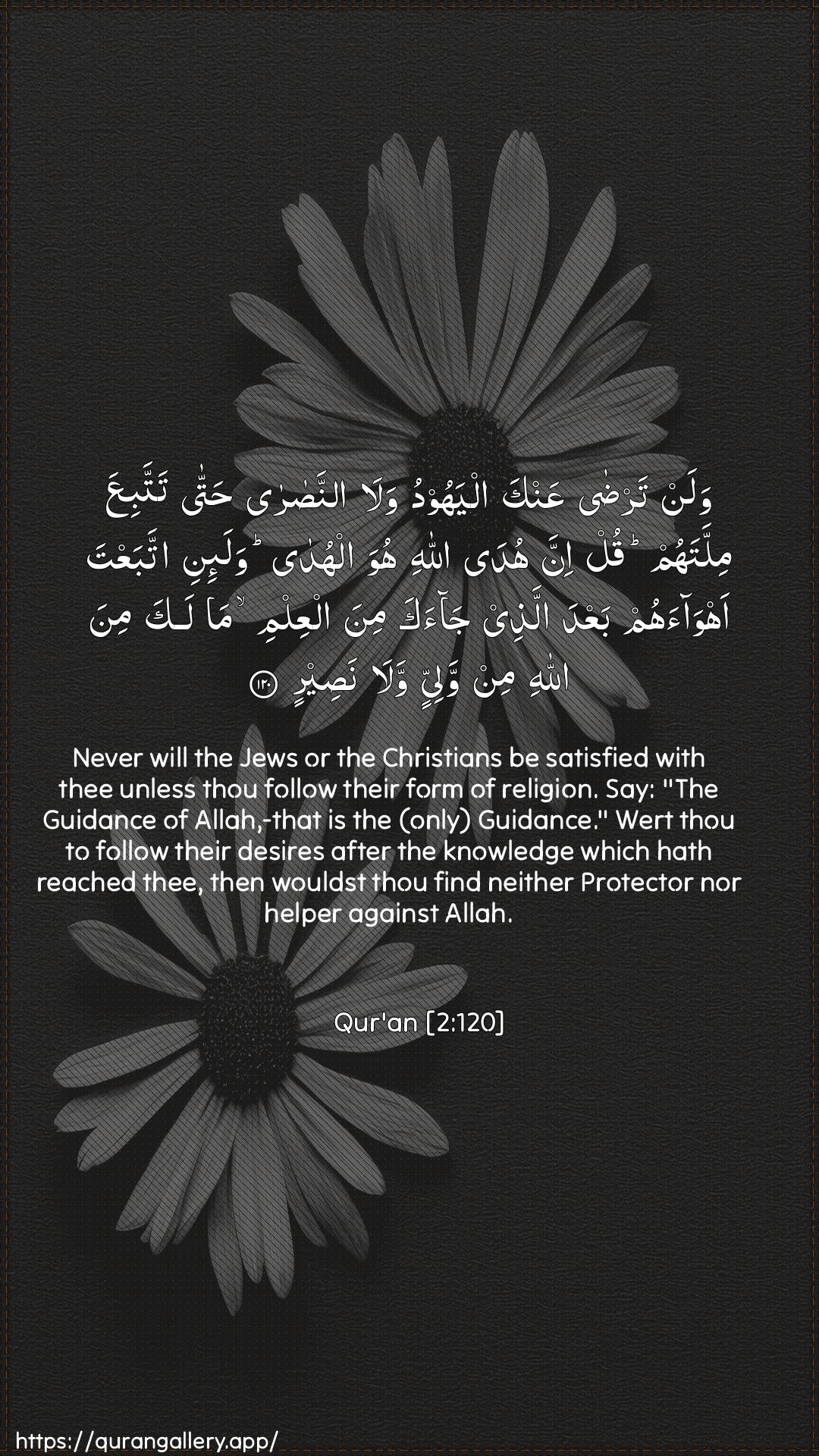
Arabic + English

Arabic (Wide)
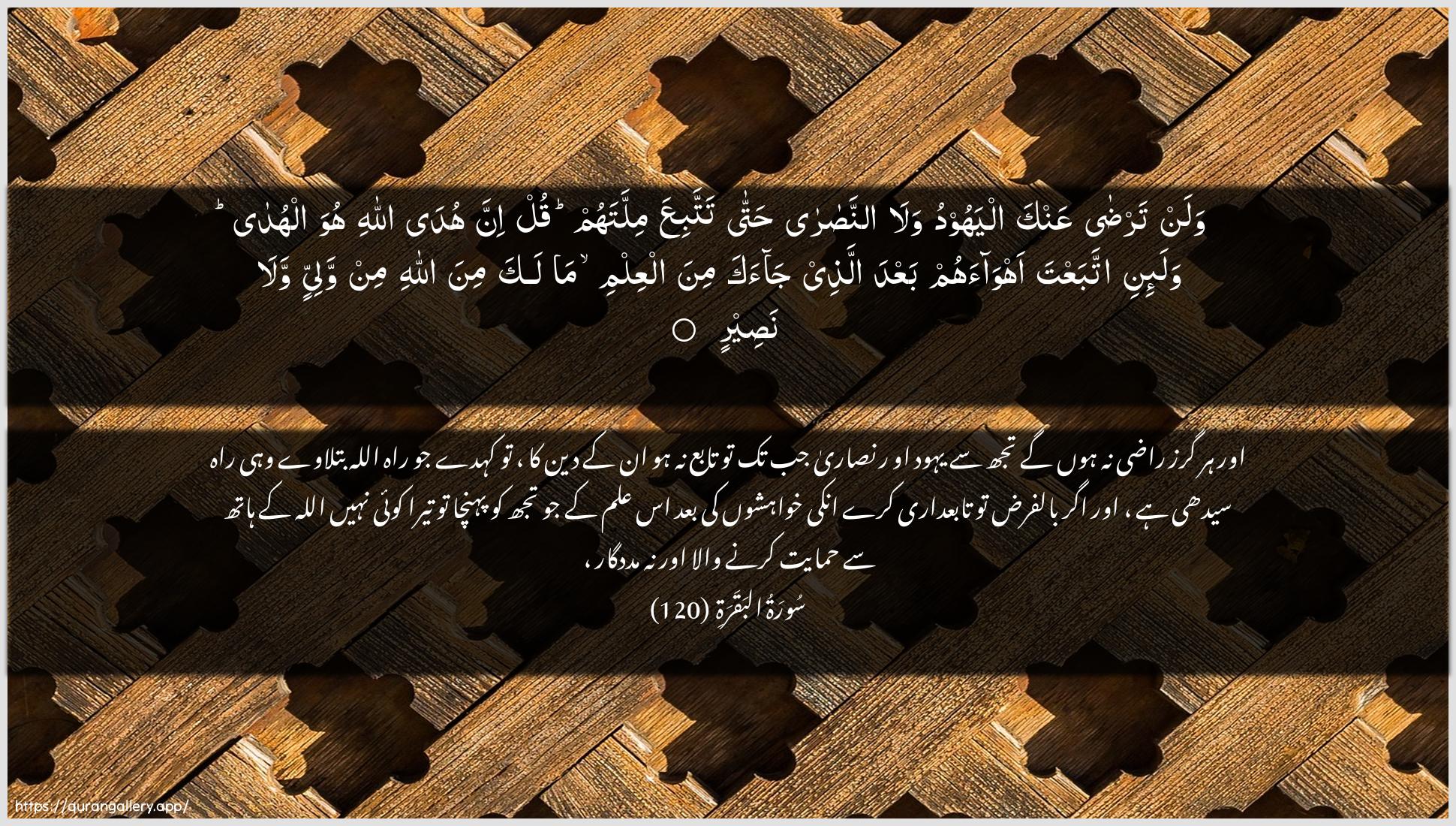
Arabic + Urdu
Free for personal & educational use with attribution
Quick Facts about this Verse
Surah
Al-Baqara
Revealed
Madani
Position
Juz 1,2,3
Explore this Verse
Verse Meaning
According to the classical exegete Al-Tabari, Quran 2:120 is a decisive declaration from Allah to Prophet Muhammad ﷺ, revealing the ultimate futility of seeking the absolute approval of the Jewish and Christian communities, as their contentment is conditional upon abandoning Islam entirely and adopting their specific creed ('millah'). This verse serves to redirect the Prophet's focus from appeasing others to pleasing Allah alone. The synthesis of classical tafsirs reveals a profound insight: as Ibn Kathir notes, the address is a gentle yet firm counsel to cease efforts at compromising core tenets for their sake. Furthermore, Al-Qurtubi extracts a significant legal principle from the singular term 'millah,' arguing that all forms of disbelief (kufr) are fundamentally one religion in their opposition to Islam, a concept with deep implications for Islamic law. This comprehensive analysis shows the verse is not merely a statement about historical relations, but a timeless principle for believers on maintaining spiritual integrity and prioritizing divine guidance ('huda') over the ever-shifting desires ('ahwaa') of mankind.
Questions for Reflection
Personal Integrity
As-Sa'di's tafsir highlights the internal conflict between 'ahwaa' (their desires) and 'al-ilm' (the knowledge that has come to you). Reflect on a time your desire for acceptance or approval from a person or group conflicted with a clear Islamic principle you knew to be true. How did you navigate that moment, and what does this verse teach you about preparing your heart for future tests of conviction?
Social Dynamics
Al-Tabari explains that pleasing both the Jews and Christians is impossible because their own 'millahs' are mutually opposed. Contemplate how this principle applies to seeking approval from any ideologically opposed groups in the modern world. How does trying to satisfy everyone lead to the loss of one's own principles and identity, and how is the clarity of this verse a mercy that protects the believer's focus?
Theological Conviction
The verse commands, 'Say: Indeed, the guidance of Allah is the [only] Guidance.' Contemplate the certainty and confidence this statement demands. What does 'huda-Allah' (the Guidance of Allah) mean to you personally? How does it manifest as a tangible, sufficient, and complete guide in your life, making all other 'millahs' and 'ahwaas' secondary?
Practical Applications
Prioritize Divine Guidance over Social Acceptance in decision-making by consciously asking, 'Is this for Allah's pleasure or for the approval of others?'
Applicable in professional environments, social media interactions, and interfaith dialogues where pressure to conform is high.
Recognize that the root of some external displeasure is not a lack of your effort, but a fundamental disagreement on core principles ('millah').
Helps in understanding criticism in media, politics, or academia that stems from ideological differences, not personal failings.
Fortify your 'Ilm (Knowledge) as a shield against external desires and ideologies by dedicating time to study the Quran and Sunnah.
Essential for navigating a world saturated with information, misinformation, and competing worldviews.
Hidden Gem
The subtle gem for contemplation comes from Al-Qurtubi's legal insight. Reflect on how Allah's singular use of 'millah' unifies all opposition to truth. This means the believer's struggle is not against a thousand different foes, but against one fundamental state: the deviation from divine guidance. This simplifies the spiritual battlefield, making the path to victory clearer: steadfast adherence to the one true 'Huda'.
Scroll to see more verses or use the dropdown in the breadcrumb to jump to any verse