
Yusuf - Joseph
Arabic Name: يُوْسُف
Urdu Name: یوسف
Type: Makki
Serial Number: 12
Revelation Order: 53
Total Verses: 111
Parah: 12,13
Rukus: 12
Sajda: None
Share Verse Art

Arabic

Arabic + English

Arabic (Wide)
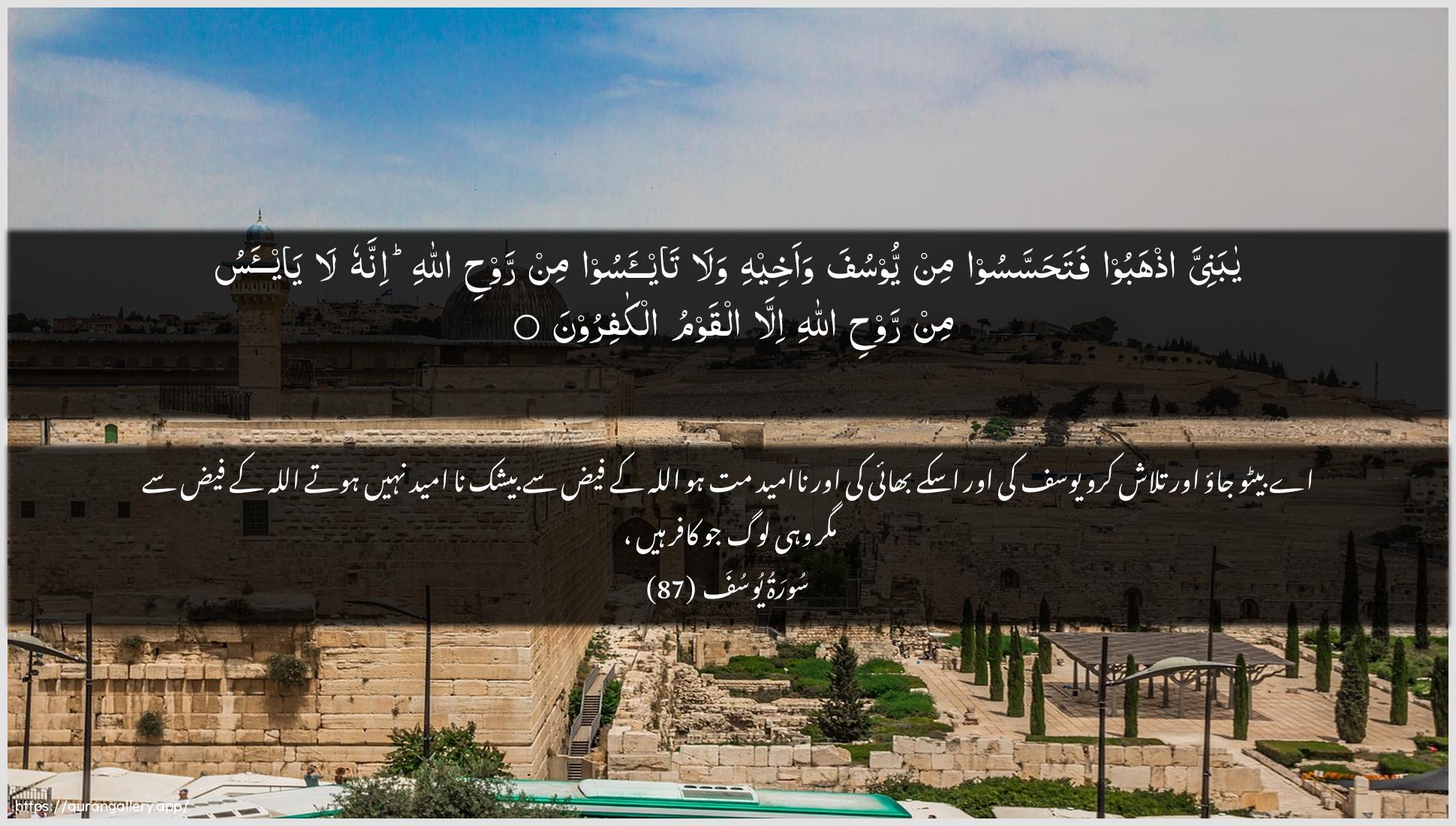
Arabic + Urdu
Free for personal & educational use with attribution
Quick Facts about this Verse
Surah
Yusuf
Revealed
Makki
Position
Juz 12,13
Explore this Verse
Verse Meaning
According to the classical scholar Ibn Kathir, this verse captures a moment of profound and active faith from Prophet Ya'qub (Jacob), who, despite decades of grief, commands his sons to proactively seek out Yusuf and his brother. The term used, 'tahassasū' (search out), specifically implies seeking good news, distinguishing it from 'tajassus' (spying for evil). Al-Tabari and Qatadah explain that 'Rawh Allah' signifies the relief, mercy, andفرج (opening) that Allah provides. The synthesis of scholarly opinion reveals a crucial theological principle: hope in Islam is not passive waiting but an active, persistent search for Allah's mercy, rooted in unwavering certainty. The verse culminates in a stark warning, as explained by Al-Qurtubi and As-Sa'di: to despair of Allah's relief is a characteristic exclusive to those who deny His power and mercy (the disbelievers). Thus, the verse establishes hope as a fundamental pillar of faith (iman) and despair as a symptom of disbelief (kufr).
Questions for Reflection
Theological Contemplation
Al-Qurtubi states that despair of Allah's relief is a major sin and characteristic of disbelievers. Reflect on a moment you felt true despair. In that moment, what did you implicitly believe about Allah's power, mercy, or knowledge that contradicted His true attributes?
Personal Transformation
Prophet Ya'qub maintained this level of hope after decades of separation and grief. How does his example challenge the limits of your own patience and hope? What personal trial feels 'too long' or 'too difficult,' and how can Ya'qub's certainty in 'Rawh Allah' reframe your perspective?
Practical Application
The command is not just 'hope,' but 'Go and search diligently.' How does this verse challenge the idea of hope as a passive emotion? What is one active, physical step you can take today in a situation where you feel stuck, as a direct application of this verse's command?
Practical Applications
When facing a prolonged trial, convert passive worry into 'Tahassus' by identifying and taking the next small, practical step towards a solution, trusting that the action itself is an expression of faith.
Apply this to job searches, recovering from illness, mending relationships, or overcoming financial hardship.
Diagnose feelings of despair as a spiritual warning sign. When you feel hopeless, ask: 'Which of Allah's attributes (e.g., Al-Fattah - The Opener, Al-Qadeer - The All-Powerful) am I currently disbelieving in?'
Use this self-inquiry during moments of depression, anxiety, or when feeling overwhelmed by global or personal crises.
Hidden Gem
The synthesis reveals that Ya'qub's command was not just for his sons, but for himself. By commanding them to act on hope, he was actively renewing his own, demonstrating that teaching and advising others about hope is a powerful way to reinforce it within one's own heart. The command to 'search for Yusuf' was also a command to 'search for Allah's mercy.'
Scroll to see more verses or use the dropdown in the breadcrumb to jump to any verse
Common Questions
3 more questions available in the full page