
Yunus - Jonas
Arabic Name: يُوْنـُس
Urdu Name: یونس
Type: Makki
Serial Number: 10
Revelation Order: 51
Total Verses: 109
Parah: 11
Rukus: 11
Sajda: None
Related Hadith
"When the believer commits a sin, a black spot appears on his heart. If he repents, his heart is polished. If he sins more, it increases until it covers his heart. That is the 'Ran'..."
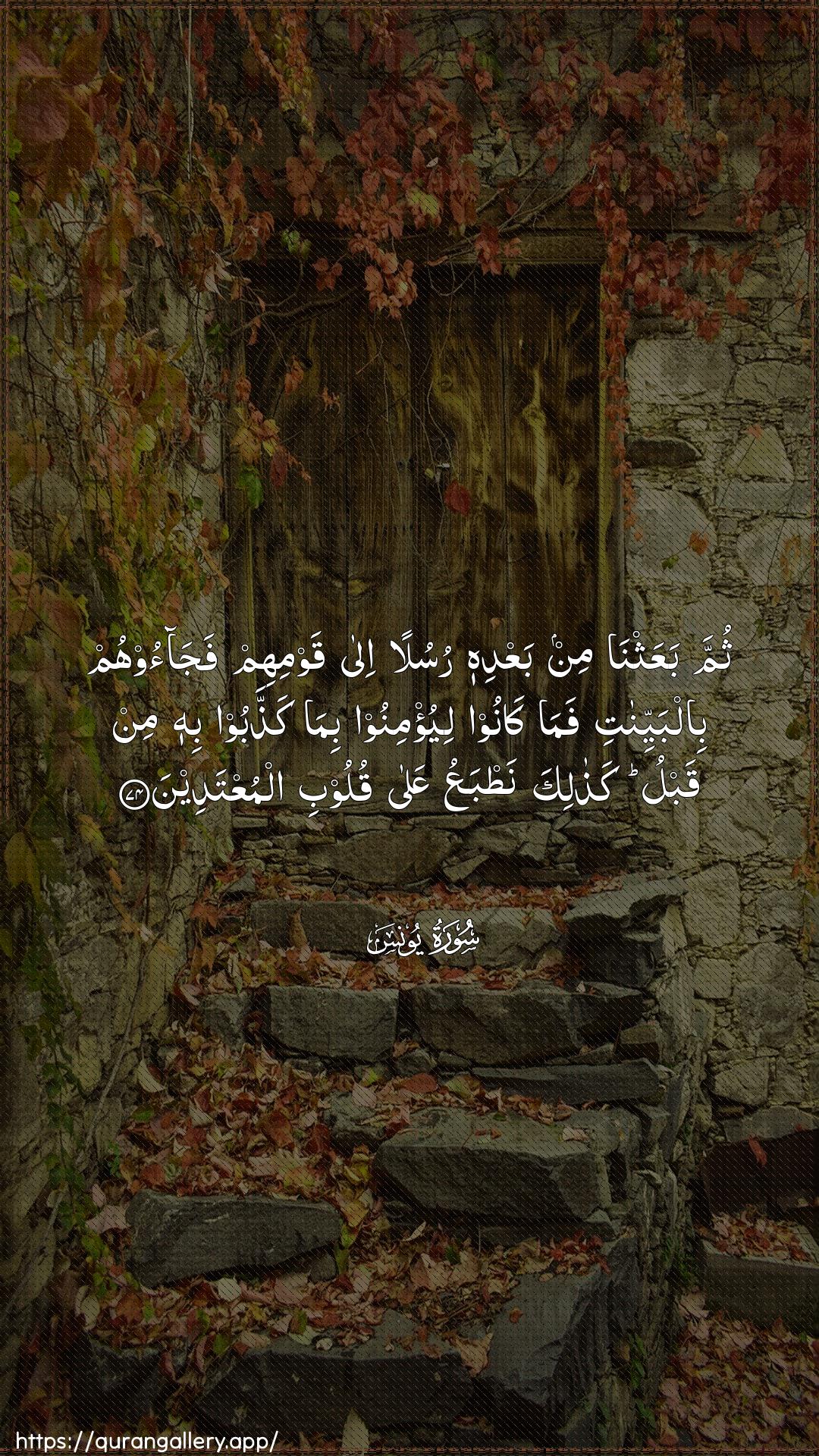
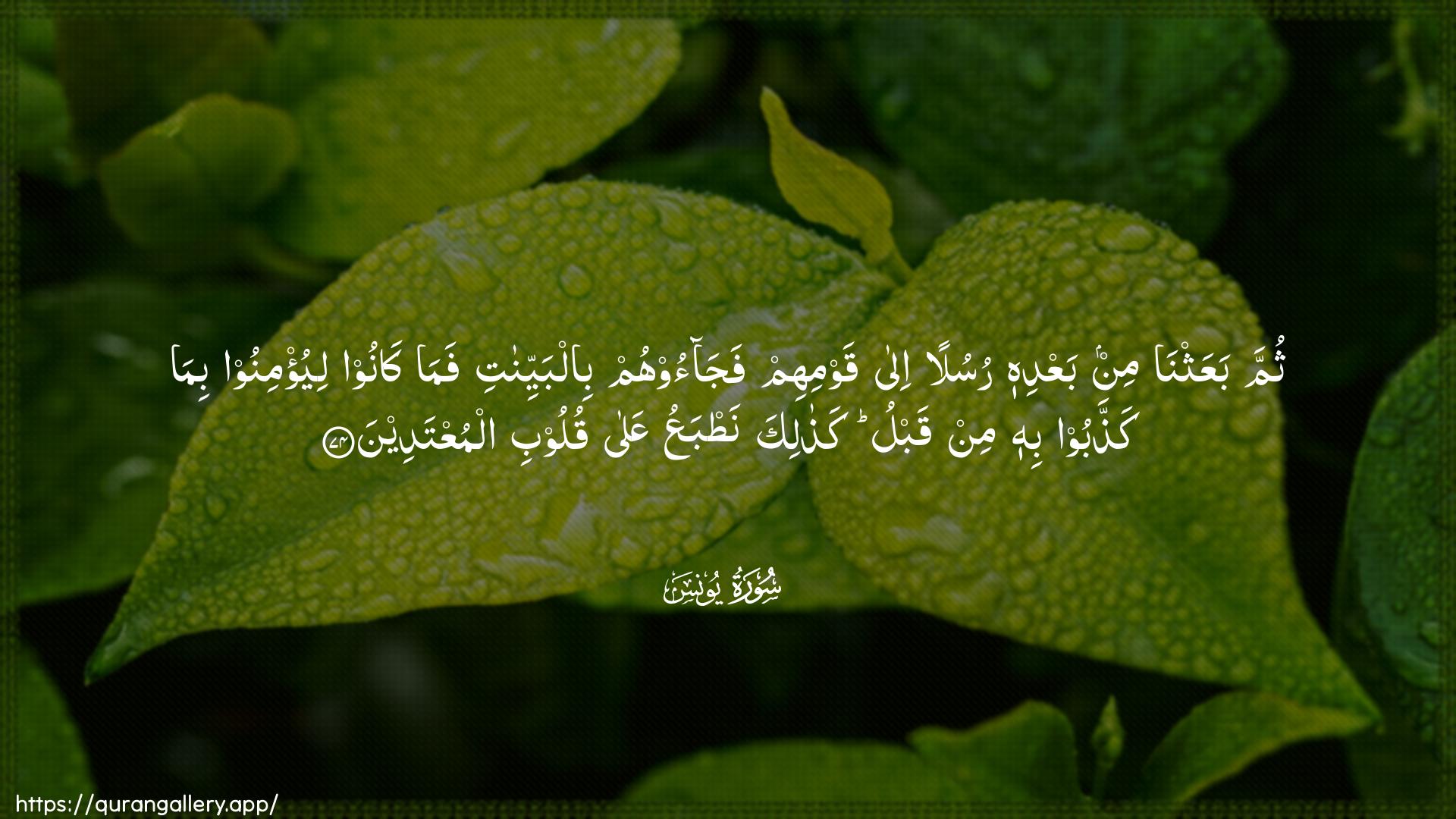
Explains the gradual process by which sin and transgression can lead to a state where the heart is covered or 'sealed' from guidance, as mentioned in verse 10:74.
Share Verse Art
Arabic

Arabic + English
Arabic (Wide)

Arabic + Urdu
Free for personal & educational use with attribution
Quick Facts about this Verse
Surah
Yunus
Revealed
Makki
Position
Juz 11
Explore this Verse
Verse Meaning
According to the classical exegete Ibn Kathir, Quran 10:74 articulates a significant divine principle regarding the consequences of disbelief. After mentioning the history of Noah, Allah states that subsequent messengers also brought clear proofs to their people, yet they refused to believe. The critical phrase, 'they would not believe in what they had already rejected beforehand,' signifies that their initial, obstinate rejection became a barrier to future faith. This is not arbitrary; rather, as Imam al-Sa'di clarifies, it is a just punishment for their transgression. When people are presented with truth and they actively choose to deny it, Allah may seal their hearts as a consequence. This 'sealing' (`natba'u`) is a divine act that prevents guidance from entering, a state brought upon by the individuals themselves through their persistent transgression (`al-mu'tadin`). Al-Tabari connects this pattern back to the people of Noah, establishing it as a recurring theme in the history of prophets and their nations. Thus, the verse serves as a solemn warning that the initial response to divine guidance has profound and lasting spiritual consequences.
Questions for Reflection
Personal Accountability
The verse states they wouldn't believe 'what they had already rejected beforehand.' Reflect on an opinion or belief you hold strongly. Following Ibn Kathir's principle, honestly ask yourself: Is my current certainty based on continuous re-evaluation of evidence, or is it an echo of my initial, perhaps emotional, rejection of an alternative?
Identifying Transgression (I'tida)
Al-Qurtubi and Al-Sa'di highlight that the sealing is upon 'the transgressors.' Contemplate the subtle ways one can transgress. Is it only in major sins, or can it be in dismissing someone's advice out of pride, refusing to admit a mistake, or insisting on one's own understanding against clear evidence? Where in my life am I exceeding my proper bounds?
The State of the Heart (Qalb)
The sealing is upon the 'hearts.' In Islamic tradition, the heart is the seat of understanding. Is my heart today softer or harder than it was a year ago? What actions, habits, or attachments might be contributing to a hardening, and what practices (like dhikr, charity, reading Quran) can soften it and protect it from being 'sealed'?
Practical Applications
Practice 'Intellectual Humility' by suspending judgment when encountering new or challenging truths, especially in matters of faith.
Apply this when reading different scholarly opinions, engaging in interfaith dialogue, or studying complex scientific or philosophical ideas.
Conduct a regular 'Spiritual Audit' to identify and repent from acts of 'transgression' (I'tida), whether in action, speech, or thought.
Reflect daily or weekly on moments of anger, injustice, arrogance, or heedlessness and seek sincere forgiveness.
Hidden Gem
The synthesis of tafsirs reveals a profound spiritual insight: the 'sealing' is not a sudden event, but the final stage of a gradual process initiated by the individual. It is the culmination of small, repeated acts of transgression and rejection. Contemplation on this verse is therefore a preventative spiritual practice, an early-warning system that allows us to catch the subtle hardening of the heart long before it becomes an irreversible seal.
Scroll to see more verses or use the dropdown in the breadcrumb to jump to any verse
Common Questions
2 more questions available in the full page