
Yusuf - Joseph
Arabic Name: يُوْسُف
Urdu Name: یوسف
Type: Makki
Serial Number: 12
Revelation Order: 53
Total Verses: 111
Parah: 12,13
Rukus: 12
Sajda: None
Share Verse Art

Arabic
Arabic + English

Arabic (Wide)

Arabic + Urdu
Free for personal & educational use with attribution
Quick Facts about this Verse
Surah
Yusuf
Revealed
Makki
Position
Juz 12,13
Explore this Verse
Verse Meaning
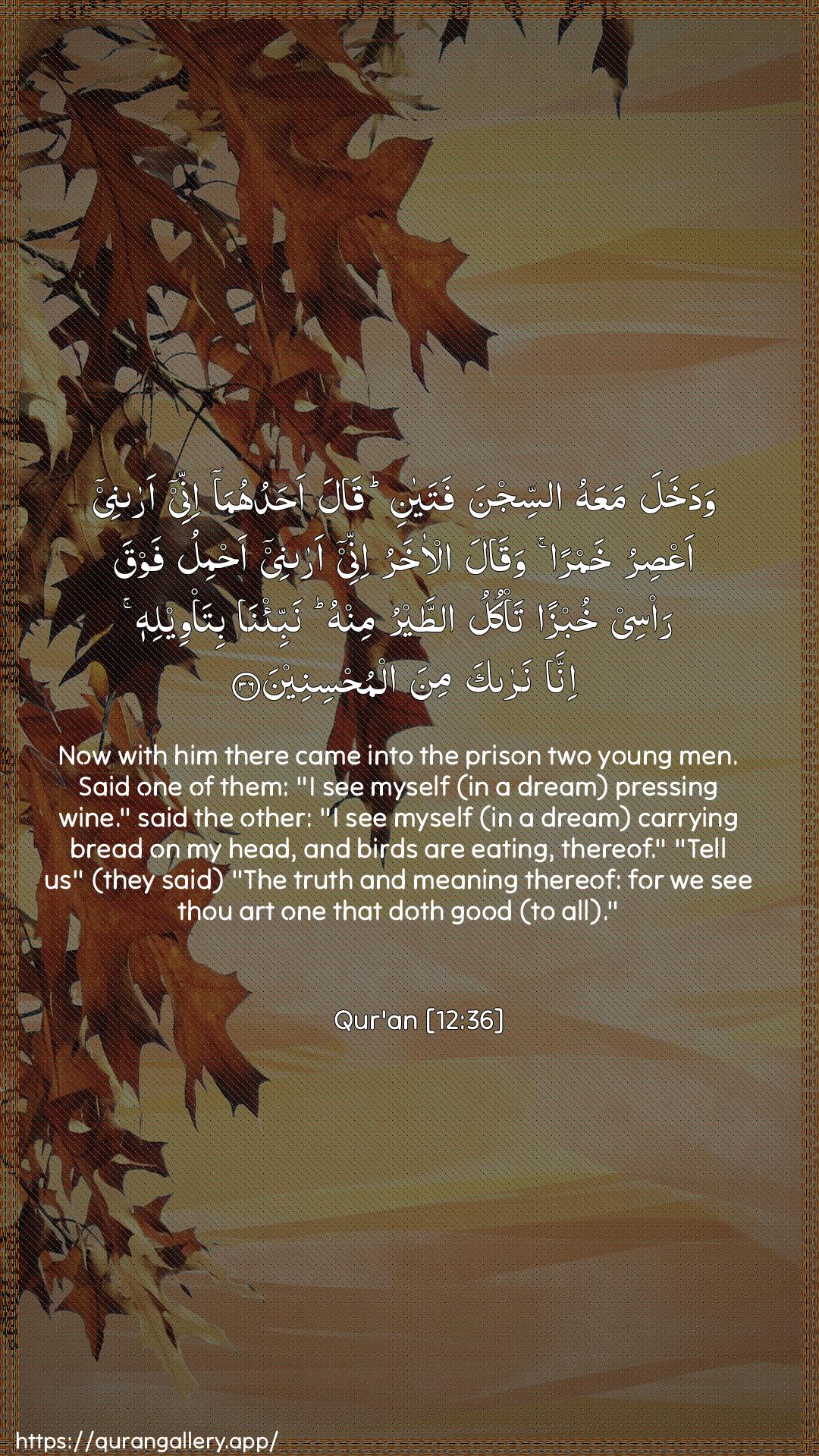
A comprehensive review of classical tafsirs for Quran 12:36 reveals a pivotal moment in Prophet Yusuf's story, where his divine gift and impeccable character converge. According to Ibn Kathir, this verse marks the start of Yusuf's mission within the prison, as two of the king's servants—a cupbearer and a baker imprisoned on suspicion of treason—approach him. Al-Tabari adds that their recognition of him as one of the 'Muhsinin' (good-doers) was not arbitrary; it stemmed from his established reputation for piety, compassion, and helping other inmates. This synthesis across scholarly works shows that Yusuf's spiritual authority was built on tangible acts of goodness, which in turn opened the door for him to share his prophetic knowledge. The most profound insight from this comprehensive analysis is that Yusuf's Dawah (call to God) began with his actions, not just his words. The prisoners' statement, 'Indeed, we see you are of the Muhsinin,' was a testimony to the character he cultivated even in the harshest conditions. Al-Qurtubi's commentary highlights that this 'Ihsan' (excellence/good-doing) included visiting the sick and aiding the needy within the prison. This verse thus provides a masterclass in leadership and influence: trust is earned through consistent, selfless service. Only after establishing this foundation of trust did the prisoners feel comfortable sharing their deeply personal dreams—one of pressing grapes (wine) and the other of carrying bread on his head from which birds were eating—and seeking his divine insight.
Questions for Reflection
Personal Character (Ihsan)
The prisoners recognized Yusuf as a 'Muhsin' before knowing his skills. Al-Qurtubi and Ad-Dahhak detail his actions: visiting the sick, helping the needy. Reflect on your own state during your most recent trial. Was your character a source of comfort and goodness to others, or did your hardship cause you to turn inward? How can I cultivate a state of 'Ihsan' that is independent of my external circumstances?
Divine Planning (Qadr)
Ibn Kathir notes that these two men were servants of the king. Contemplate the divine precision: of all the people who could have been imprisoned with Yusuf, Allah sent two with a direct line to the palace. How does this strengthen your certainty that even in your darkest moments, Allah is arranging the means for your eventual relief and vindication?
Relational Trust
The prisoners felt safe enough to share their vulnerabilities (their dreams and anxieties) with Yusuf. As Al-Tabari's tafsir implies, this was due to the trust his character inspired. Who in your life feels safe sharing their vulnerabilities with you? What aspects of your character, mirroring the 'Ihsan' of Yusuf, foster that trust?
Practical Applications
Become the 'Muhsin' in Your Environment, Regardless of Your Title or Position.
In the workplace, be the colleague who helps without being asked. In your community, be the neighbor who checks on the elderly. This builds a foundation of trust that is more powerful than any formal authority.
Let Your Actions Be Your Primary Introduction.
Before launching a new project or asking for a promotion, spend months building a reputation for excellence and reliability. Your established character will make your request a natural conclusion for others.
Hidden Gem
The synthesis reveals that the prisoners' request was a divine test for Yusuf as much as it was a means of relief for them. By responding with Dawah first (as seen in the next verses), he proved his priority was Allah, not his own freedom. Contemplate: when people approach you for your worldly skills, is your first instinct to serve your own interests or to guide them towards what is most beneficial for their soul?
Scroll to see more verses or use the dropdown in the breadcrumb to jump to any verse
Common Questions
3 more questions available in the full page