
Hud - Hud
Arabic Name: هُوْد
Urdu Name: حود
Type: Makki
Serial Number: 11
Revelation Order: 52
Total Verses: 123
Parah: 12,11
Rukus: 10
Sajda: None
Share Verse Art

Arabic
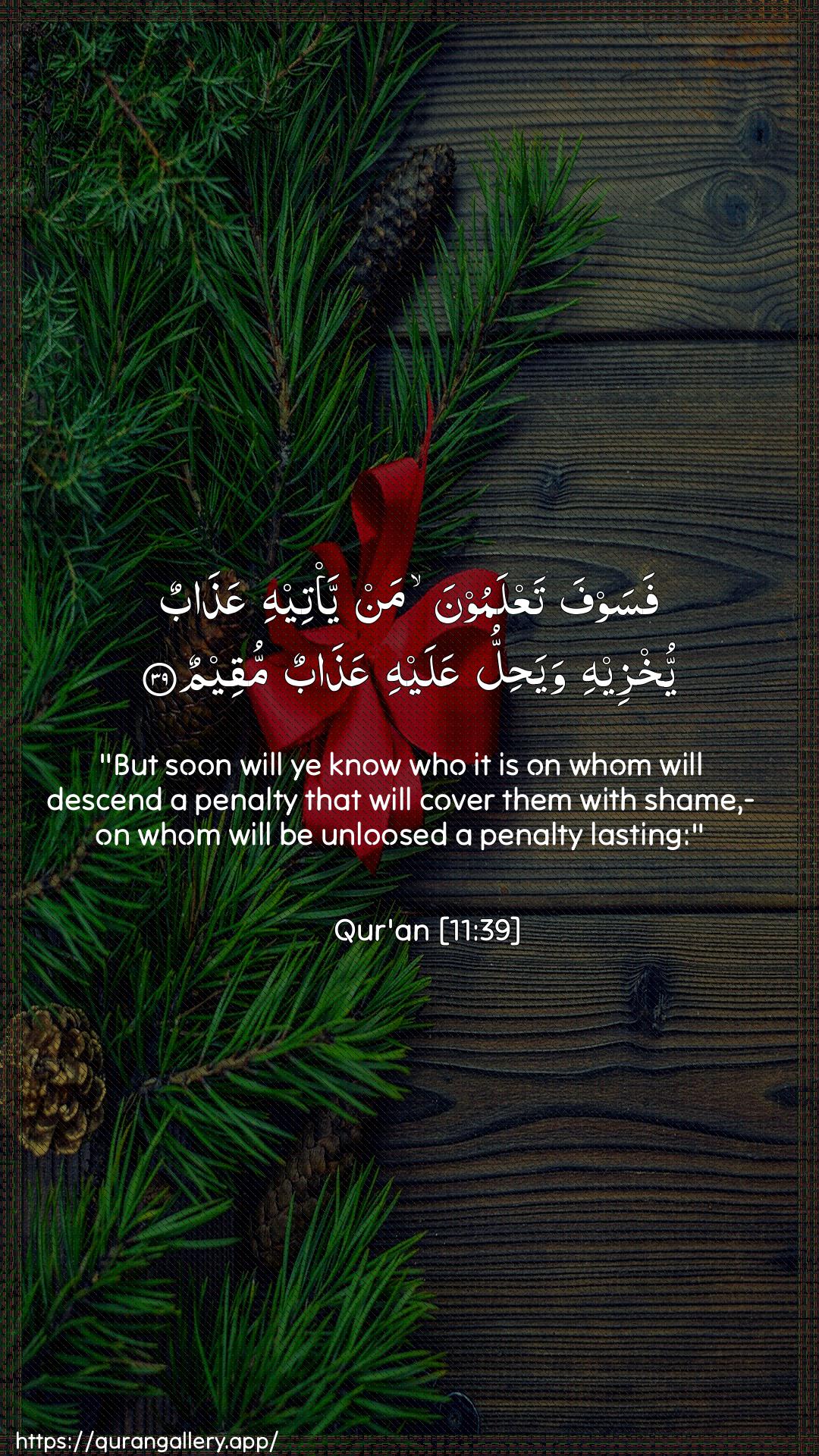
Arabic + English
Arabic (Wide)
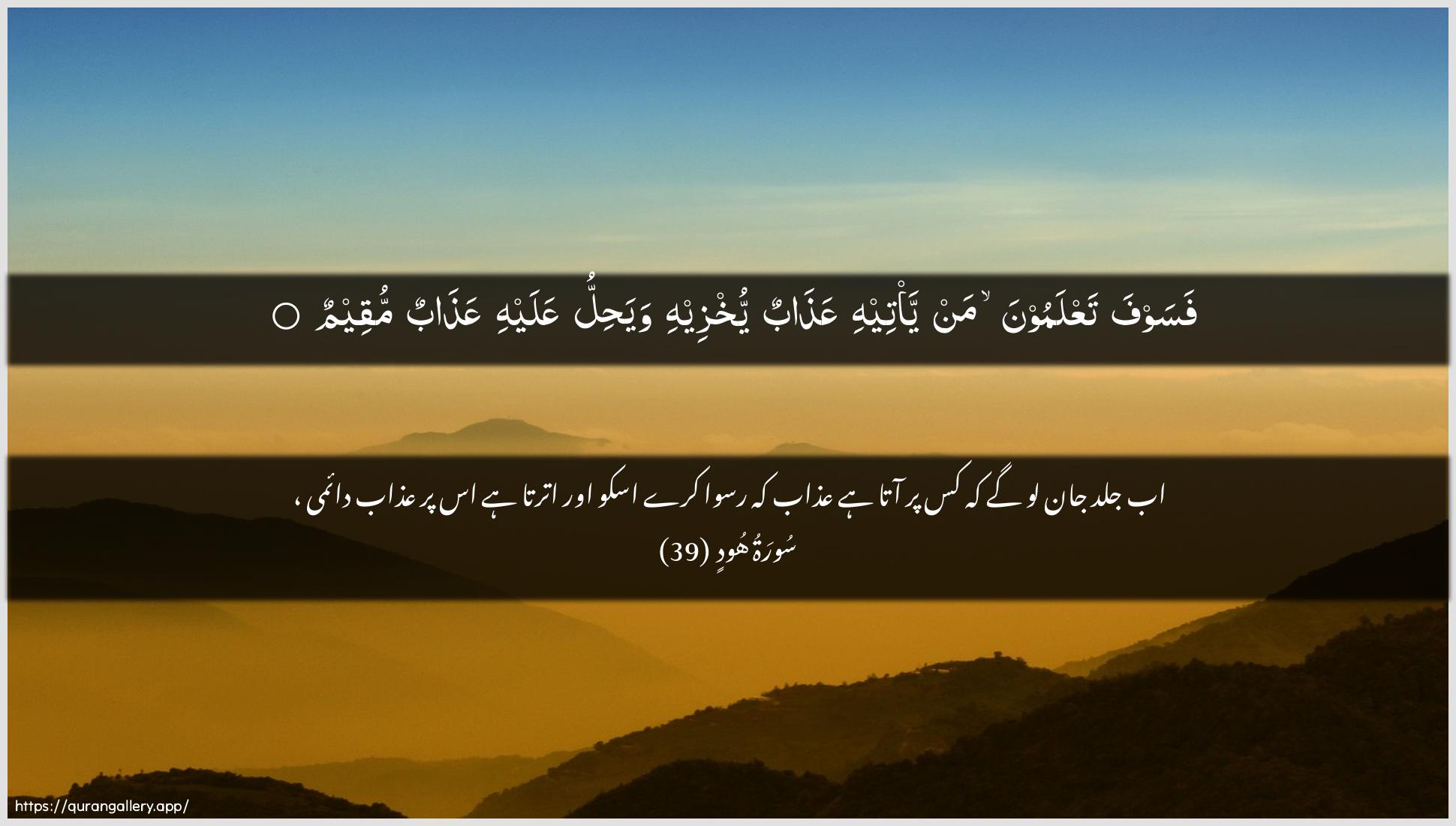
Arabic + Urdu
Free for personal & educational use with attribution
Quick Facts about this Verse
Surah
Hud
Revealed
Makki
Position
Juz 12,11
Explore this Verse
Verse Meaning
According to the classical exegete Al-Tabari, Quran 11:39 delivers a powerful and dual-faceted warning from Prophet Nuh (Noah) to his mocking people. It distinguishes between two distinct forms of divine retribution. The first, a 'punishment that disgraces' (`adhabun yukhzihi`), is a torment that brings humiliation and shame in this world. Scholars like Ibn Kathir clarify this refers to the impending flood that would serve as a public disgrace for the disbelievers. The second, a 'lasting punishment' (`adhabun muqim`), is one that 'settles upon' (`yahillu alayhi`) them permanently. This refers to the unending torment of the Hereafter. The synthesis of scholarly opinion reveals that this verse encapsulates a core tenet of divine justice: accountability is both immediate and ultimate, a system of recompense that addresses transgression in both the temporal world and the eternal one.
Questions for Reflection
Personal Accountability
The verse mentions a punishment that 'disgraces' (`yukhzihi`). In what subtle ways does deviation from a righteous path lead to a loss of honor or inner peace in our own lives, even before the Hereafter?
Conviction in the Face of Mockery
Prophet Nuh spoke with absolute certainty while being mocked. How can the distinction between temporary disgrace and lasting punishment strengthen our conviction when our principles are ridiculed by others?
Understanding Divine Justice
Reflect on the words 'lasting' or 'permanent' (`muqim`). How does the concept of an eternal, unchanging consequence for injustice shape your understanding of the importance and perfection of Allah's ultimate justice?
Practical Applications
Reflect on the immediate consequences of wrongdoing as a form of 'disgracing punishment' in daily life.
Apply this to professional ethics, personal relationships, and online conduct, understanding that loss of reputation is a modern form of this disgrace.
Cultivate patience and trust when facing mockery by focusing on the certainty of 'lasting punishment' for oppressors.
Use this perspective when facing ridicule for one's beliefs, during workplace injustice, or when observing global events where justice seems absent.
Hidden Gem
The synthesis of tafsirs reveals that Nuh's certainty was not based on seeing the punishment, but on the truth of Allah's promise. The verse is a powerful lesson in seeing with the 'eye of faith.' The mockers saw only the 'absurdity' of a boat in the desert; Nuh saw the 'reality' of Allah's justice. Contemplation on this verse is an exercise in shifting our perception from the visible to the real.
Scroll to see more verses or use the dropdown in the breadcrumb to jump to any verse
Common Questions
1 more question available in the full page