
Al-Baqara - The Cow
Arabic Name: الْبَقَرَة
Urdu Name: گائے
Type: Madani
Serial Number: 2
Revelation Order: 87
Total Verses: 286
Parah: 1,2,3
Rukus: 40
Sajda: None
Share Verse Art

Arabic

Arabic + English
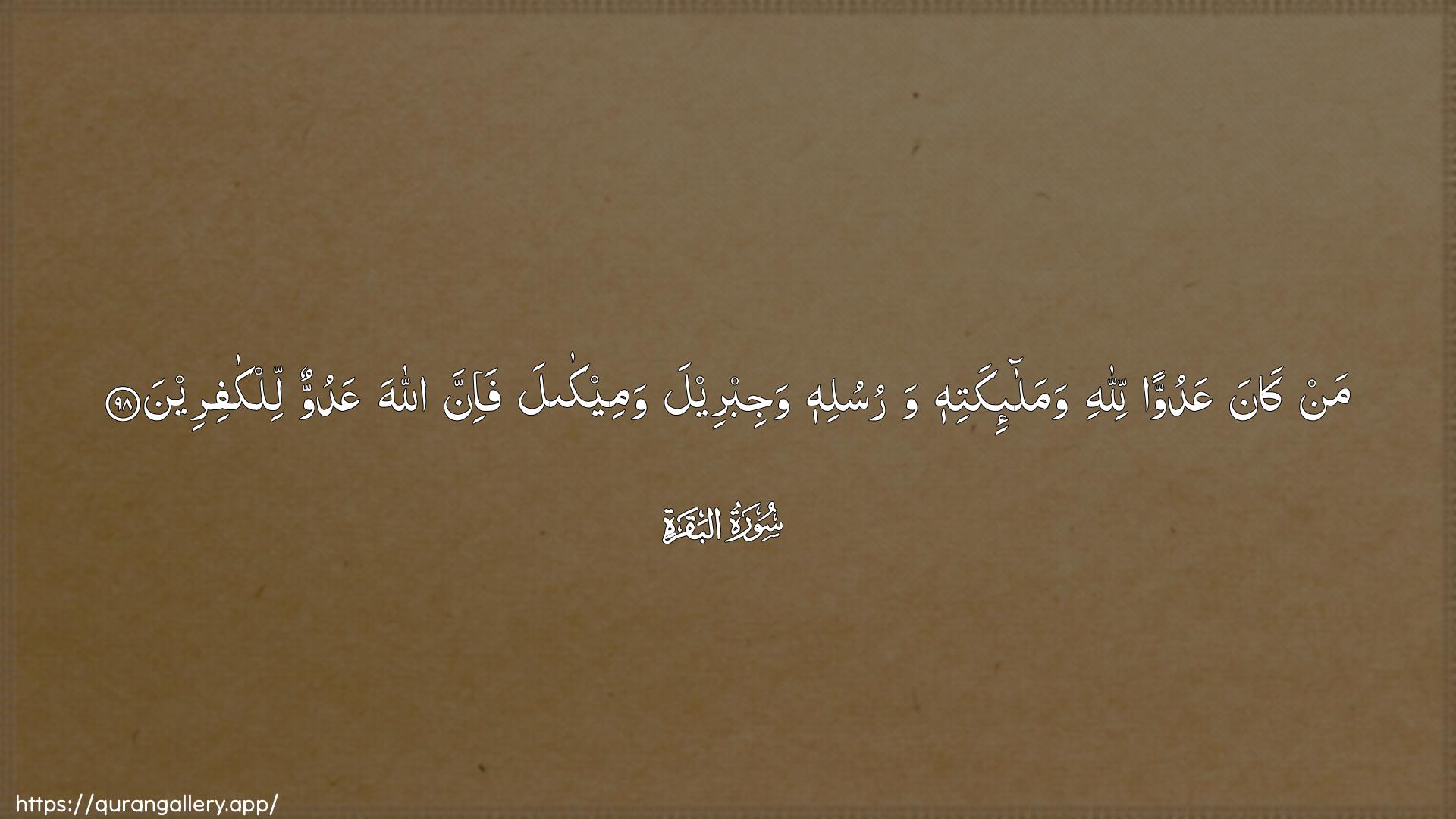
Arabic (Wide)
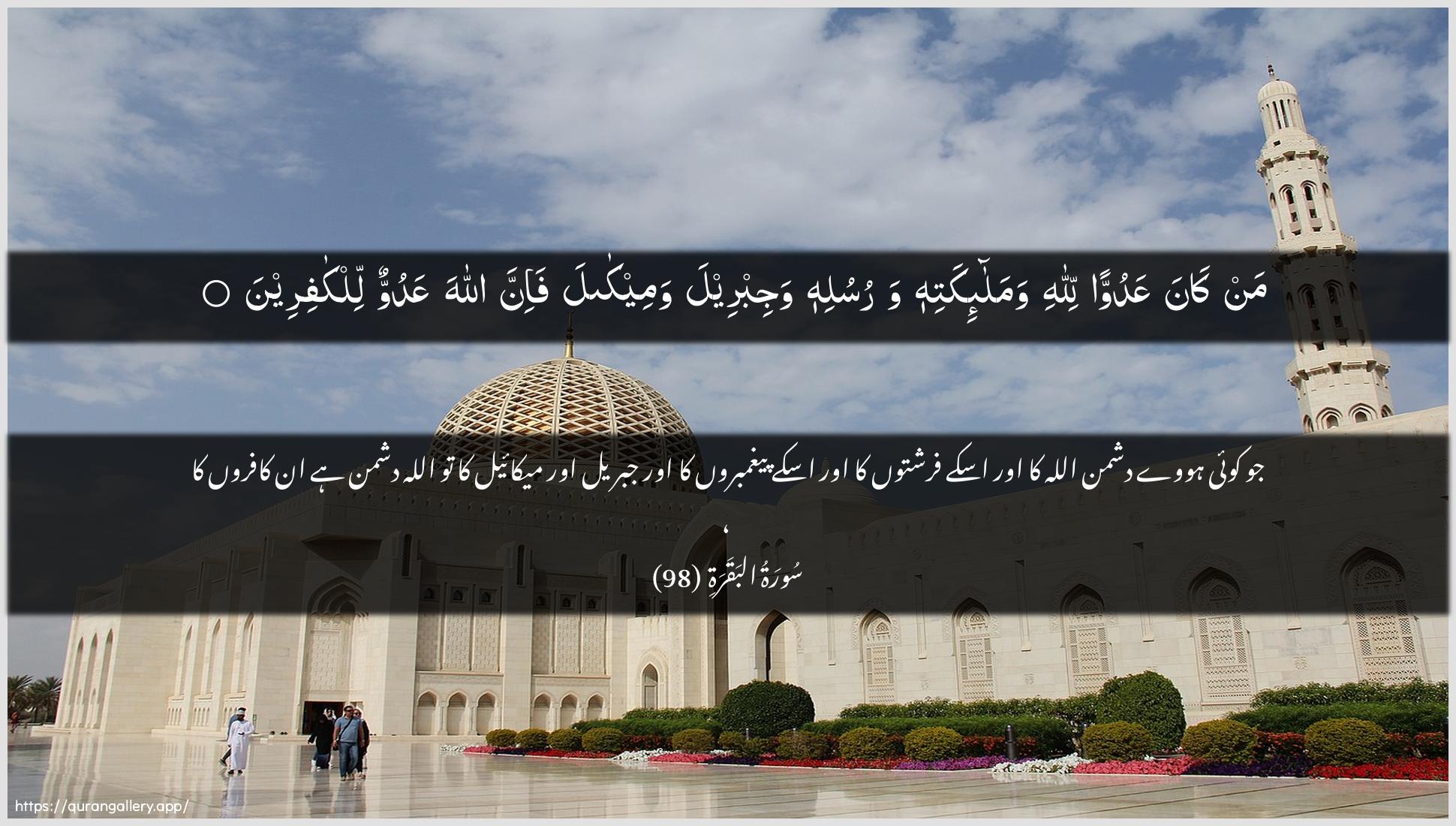
Arabic + Urdu
Free for personal & educational use with attribution
Quick Facts about this Verse
Surah
Al-Baqara
Revealed
Madani
Position
Juz 1,2,3
Explore this Verse
Verse Meaning
According to Imam Al-Tabari, Quran 2:98 serves as a divine declaration that enmity towards any of Allah's chosen messengers, whether angelic or human, constitutes enmity towards Allah Himself. This verse was revealed in response to the claims of some Jewish tribes who professed animosity towards the archangel Gabriel (Jibril), whom they associated with punishment, while claiming friendship with Michael (Mikal), whom they associated with mercy and sustenance. Ibn Kathir clarifies that this distinction is invalid, as both angels act solely on Allah's command. The verse strategically singles out Gabriel and Michael by name, after mentioning 'angels' and 'messengers' generally, to directly refute the Jews' specific claim and to prevent any attempt to exclude them from the general category. This rhetorical device, as noted by classical commentators, solidifies the principle that faith is indivisible; to reject one of God's messengers is to reject the entire system of divine guidance. By concluding with 'Allah is an enemy to the disbelievers,' the verse equates this selective animosity with outright disbelief (kufr), making it clear that such a stance places one in direct opposition to God.
Questions for Reflection
Theological Integrity
The verse equates enmity to Gabriel with enmity to Allah. Contemplate why the rejection of a single divine messenger demolishes the entire foundation of faith. How does this verse teach that Allah's system of guidance is a perfectly unified and interconnected whole?
Personal cherry-picking
The Jews claimed to like Michael but not Gabriel. In what subtle ways might I 'cherry-pick' parts of Islam that are appealing (like mercy and blessings) while feeling aversion to parts that involve discipline, law, or warnings? How is my personal preference a test of my submission?
The Nature of Disbelief
Allah concludes by calling such people 'disbelievers' (al-Kafirin). Contemplate how this verse defines disbelief not just as denial, but as active enmity and selective acceptance. How does this broaden the understanding of 'kufr' from simple rejection to a form of spiritual arrogance and rebellion?
Practical Applications
Cultivate respect for all aspects of divine revelation and its messengers, both seen and unseen.
Applicable in an age where people may be tempted to accept spiritual concepts but reject religious laws or specific divine messengers.
Recognize that the roles of divine agents, like Gabriel (knowledge) and Michael (sustenance), are integrated and from a single source.
Helps in balancing spiritual pursuits with material responsibilities, seeing both as blessings from Allah.
Hidden Gem
A deep insight from Al-Tabari's tafsir is that Allah makes His name, 'Allah', explicit in the conclusion ('Allah is an enemy...') instead of using a pronoun ('He is an enemy...'). Contemplate the power of this choice. It is as if Allah is stepping forward personally and unequivocally to declare His position, removing all ambiguity and making the confrontation direct and absolute.
Scroll to see more verses or use the dropdown in the breadcrumb to jump to any verse