
Hud - Hud
Arabic Name: هُوْد
Urdu Name: حود
Type: Makki
Serial Number: 11
Revelation Order: 52
Total Verses: 123
Parah: 12,11
Rukus: 10
Sajda: None
Share Verse Art

Arabic
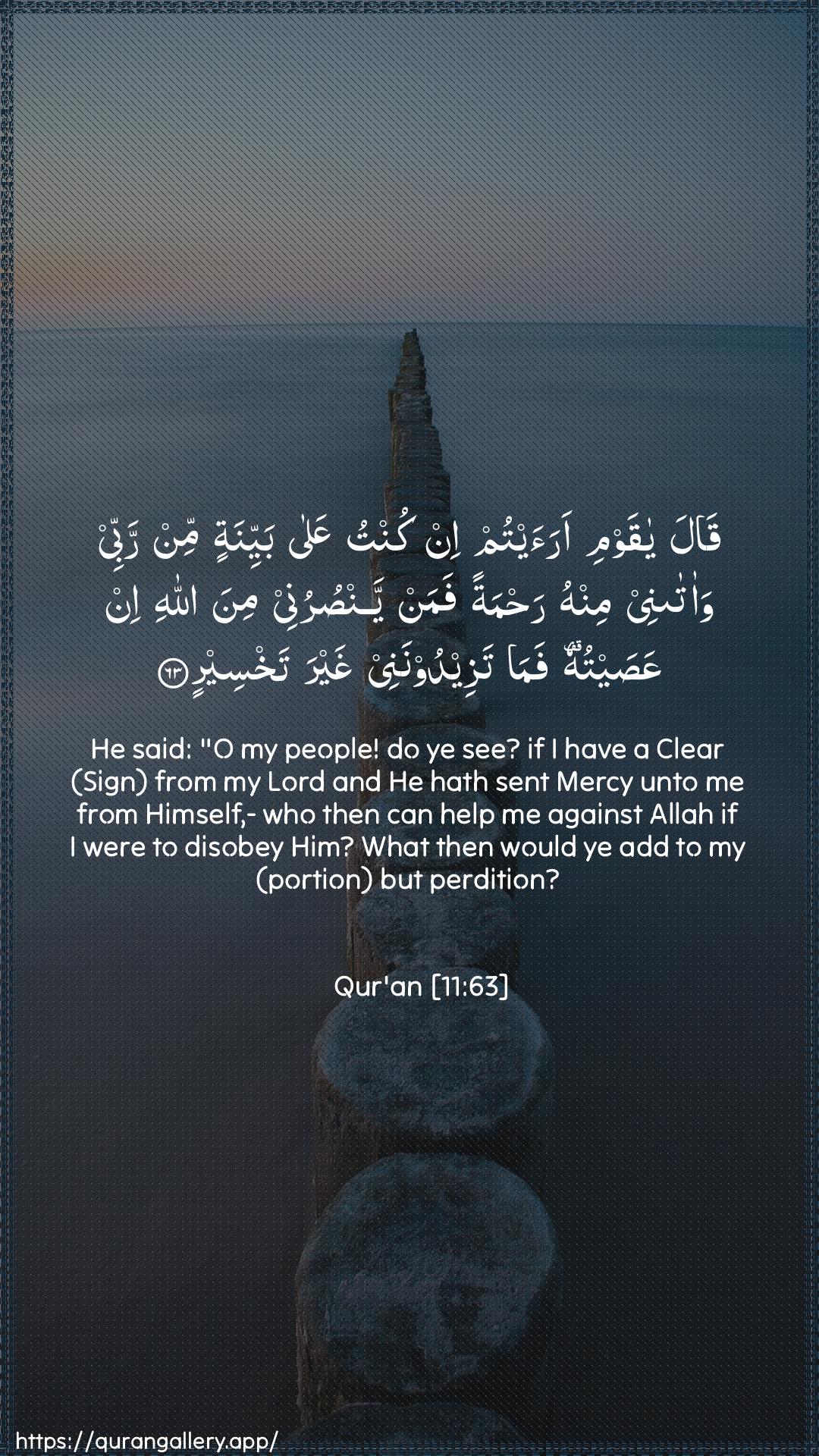
Arabic + English

Arabic (Wide)
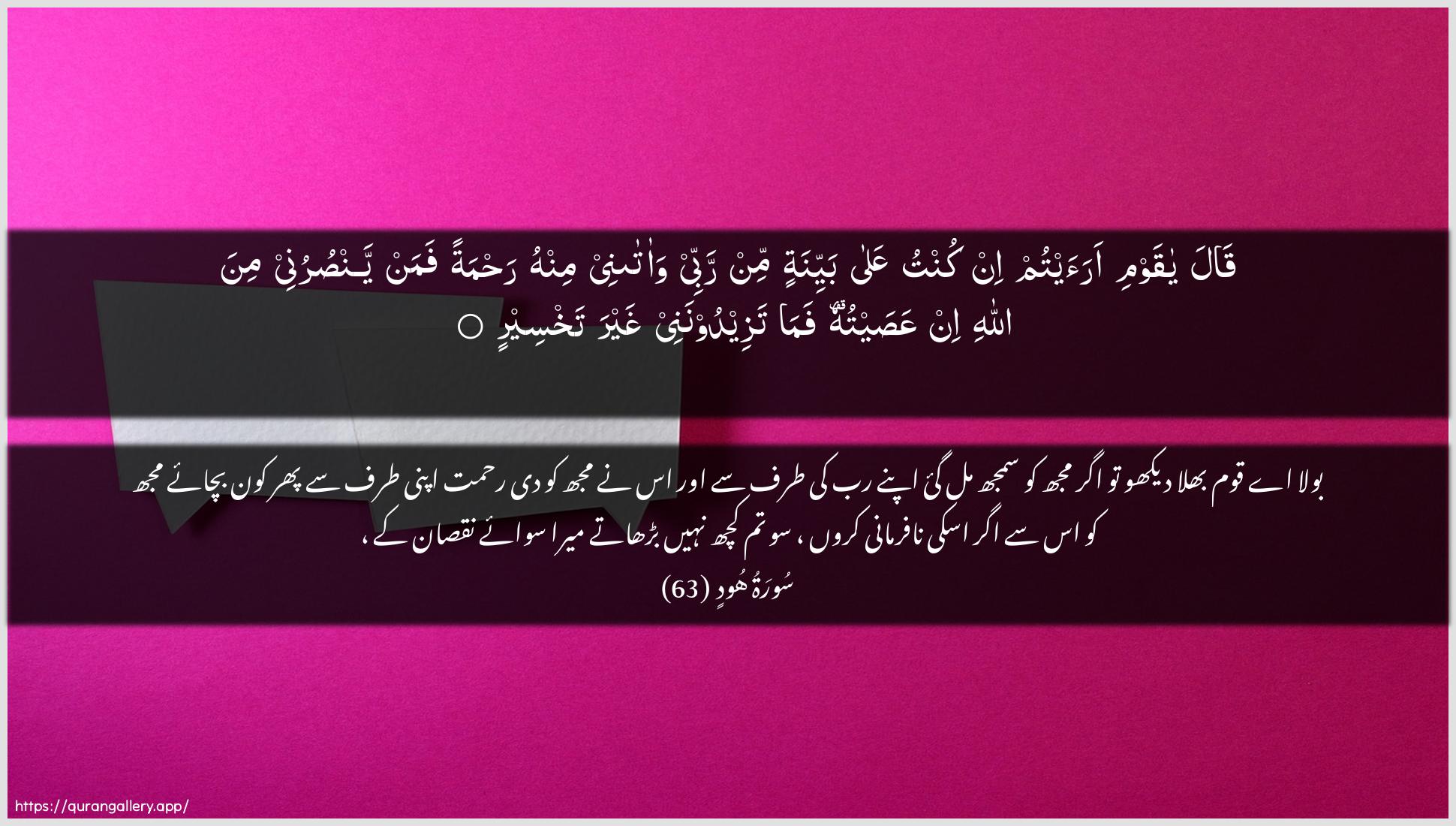
Arabic + Urdu
Free for personal & educational use with attribution
Quick Facts about this Verse
Surah
Hud
Revealed
Makki
Position
Juz 12,11
Explore this Verse
Verse Meaning
According to classical exegetes like Al-Tabari and Ibn Kathir, Quran 11:63 presents Prophet Salih's powerful rhetorical counter-argument to his people. Faced with their demand to abandon his monotheistic call, Salih shifts the burden of proof back onto them. He asks them to consider his position: he is acting on a 'bayyinah'—a clear proof, certainty, and manifest evidence from his Lord. Furthermore, as Ibn Kathir explains, he has been given a special 'rahmah' (mercy), which the scholars interpret as prophethood and wisdom. [1] Given this divine mandate, Salih poses the critical question: if he were to disobey Allah to please them, who could possibly save him from God's inevitable consequence? This query is not one of ignorance but, as Al-Qurtubi notes, a statement of fact framed as a question, implying that no one could. Salih concludes by exposing the truth of their proposition: following their way would 'add to him nothing but loss' ('takhsir'). Al-Baghawi clarifies this means they would only succeed in attributing loss and ruin to him, highlighting the futility and destructive nature of their request.
Questions for Reflection
Textual Contemplation
Ibn Kathir and Al-Tabari explain 'bayyinah' as a clear proof and certainty from Allah. Contemplate the nature of your own faith. Is it based on clear evidence you have reflected upon, or inherited tradition? What are the core proofs that anchor your belief system?
Personal Accountability
Salih poses the question, 'Who will help me against Allah if I disobey Him?' As Al-Qurtubi notes, this is a question with a clear answer: no one. Reflect on a time you were tempted to disobey a core principle to please someone. In that moment, whose help or approval felt more important? How does this verse recalibrate your understanding of ultimate authority and support?
Relational Assessment
Salih tells his people, 'You would add to me nothing but loss (takhsir).' Examine your key relationships—friends, colleagues, family. Which of these, if you were to follow their advice against your conscience, would lead you toward spiritual, moral, or ethical 'loss'? Conversely, which relationships support your stand on 'bayyinah'?
Practical Applications
Anchor your stance on 'Bayyinah' (Clear Proof).
Use this in professional settings when asked to compromise ethical standards, or in personal life when pressured to abandon your moral values for social acceptance.
Recognize Your Guidance as a 'Rahmah' (Mercy) to be Protected.
When feeling isolated for your beliefs, reframe it not as a burden but as a mercy from God that you are being entrusted to protect.
Calculate the True 'Takhsir' (Loss) in Any Compromise.
Before making a difficult ethical choice, ask yourself: 'What does this path add to me other than spiritual loss?' This clarifies priorities instantly.
Hidden Gem
A synthesis of the tafsirs reveals that Salih's argument is not defensive, but offensive in its spiritual logic. He isn't just saying 'I can't,' he's saying 'Your way is bankrupt.' Contemplate how shifting from defending your principles to calmly questioning the viability of the opposing path can change the entire dynamic of a difficult conversation.
Scroll to see more verses or use the dropdown in the breadcrumb to jump to any verse