
Al-Baqara - The Cow
Arabic Name: الْبَقَرَة
Urdu Name: گائے
Type: Madani
Serial Number: 2
Revelation Order: 87
Total Verses: 286
Parah: 1,2,3
Rukus: 40
Sajda: None
Share Verse Art

Arabic
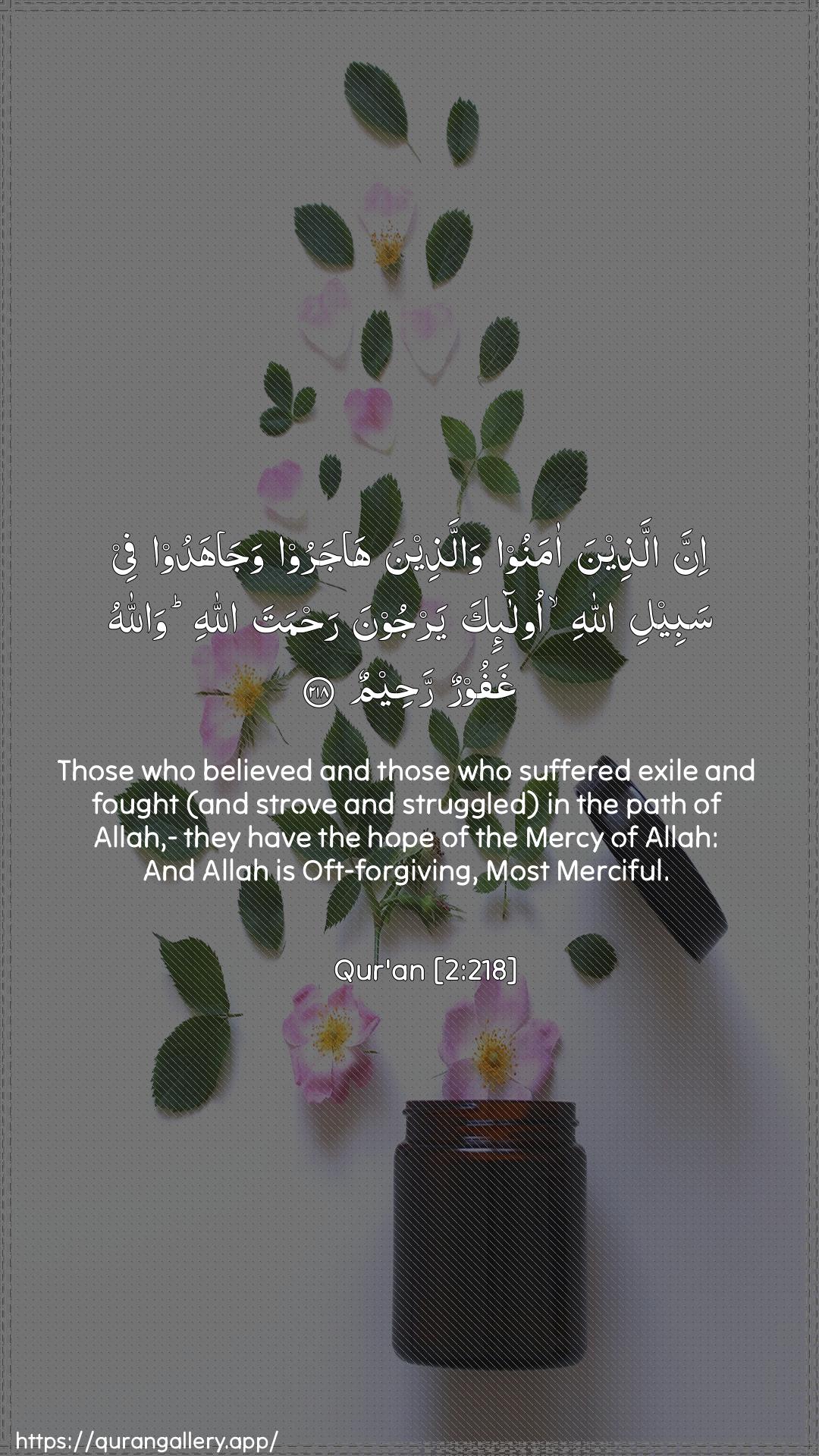
Arabic + English
Arabic (Wide)
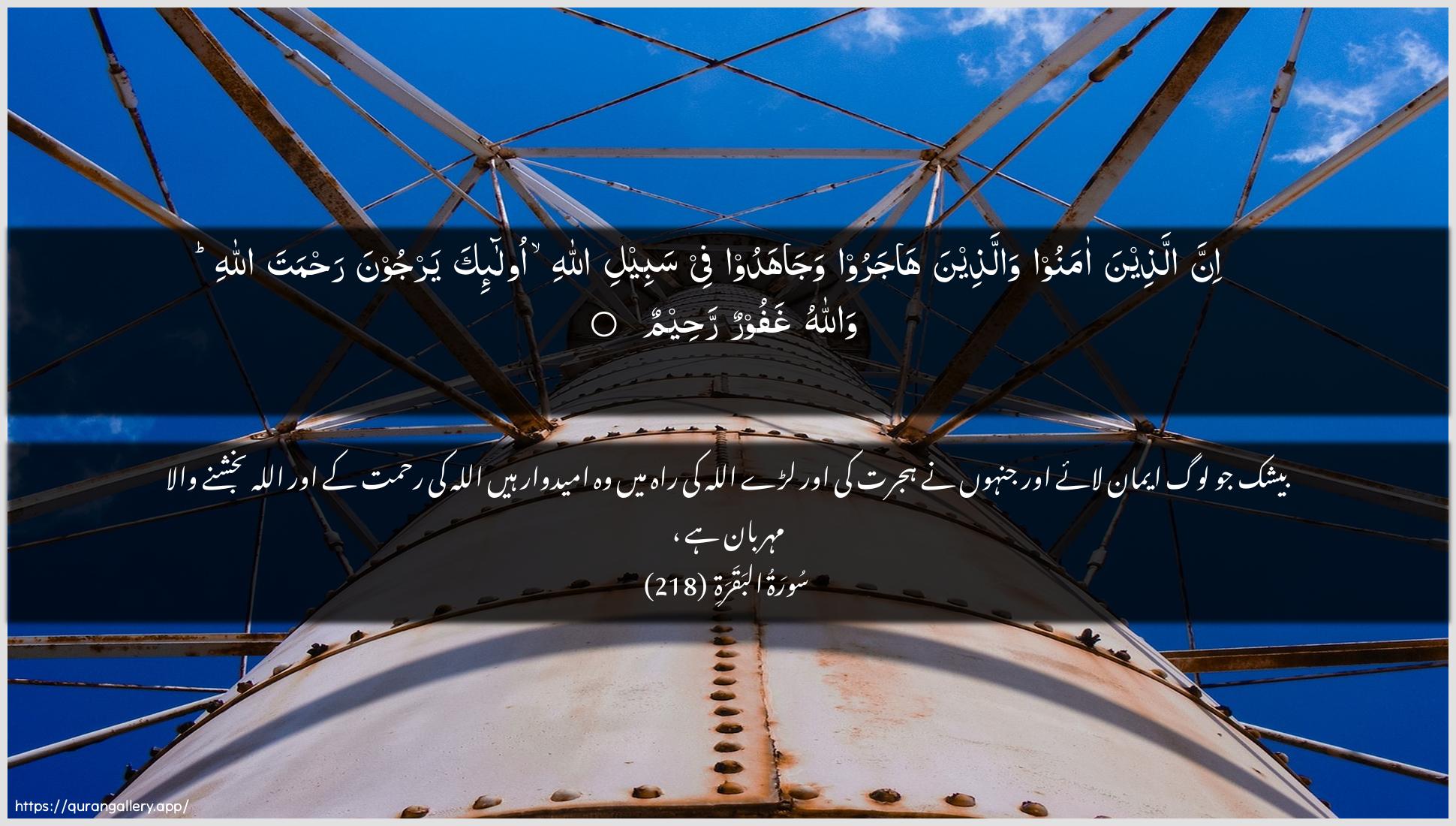
Arabic + Urdu
Free for personal & educational use with attribution
Quick Facts about this Verse
Surah
Al-Baqara
Revealed
Madani
Position
Juz 1,2,3
Explore this Verse
Verse Meaning
According to the classical tafsir of Imam Al-Tabari, Quran 2:218 is a foundational verse that establishes the divine formula for authentic hope, linking it inextricably to three pillars of action: unwavering faith (iman), selfless migration (hijrah), and sincere struggle (jihad). While the historical context, as detailed by Ibn Kathir, reveals this verse was sent down to reassure the companions of Abdullah ibn Jahsh after their controversial expedition, its wisdom transcends that moment. The great exegete As-Sa'di illuminates a universal principle: true hope (Raja') is not passive wishing but an active pursuit, earned through sacrifice and effort. The synthesis of the specific historical event with this timeless theological principle provides a profound insight: this verse is a divine roadmap, teaching that the path to Allah’s mercy is paved not with idle daydreams, but with the concrete actions of a heart committed to faith, a body willing to sacrifice comfort, and a soul striving for His cause. It distinguishes legitimate hope from mere delusion, affirming that those who truly exert themselves are the ones who can genuinely expect Allah's forgiveness and mercy.
Questions for Reflection
personal
As-Sa'di explains that hope without action is 'laziness, wishful thinking, and delusion.' Reflect honestly on your own hope for Allah’s mercy. Is it an active 'Raja' backed by daily struggles (Jihad) and conscious choices to abandon sin (Hijrah)? Or is it a passive 'Tamanni' (wishful thinking)? Identify one area where your hope is passive and what single action could make it active.
existential
Ibn Kathir and Al-Tabari detail how the companions feared their sincere efforts might have been in vain due to a mistake. Contemplate the nature of sincerity and reliance on Allah. Even with their immense sacrifices, they didn't rely on their deeds but sought a sign of hope from Allah. How does this profound humility challenge the modern tendency to feel entitled to reward for minimal effort? Reflect on how you can cultivate a spirit of striving while maintaining ultimate reliance on Allah's mercy alone.
relational
The verse speaks of believers in the plural ('those who...'). Their anxiety was shared, and their hope was granted collectively. Contemplate the role of community in your spiritual journey. How does your 'Hijrah' (e.g., leaving a bad crowd) and 'Jihad' (e.g., striving for community welfare) impact the collective hope of those around you? Reflect on how strengthening your brothers and sisters in their faith and struggles is an integral part of your own path to Allah's mercy.
Practical Applications
Conduct a 'Hijrah Audit': Identify one significant negative habit or environment in your life and make a concrete plan to migrate away from it towards a better alternative.
Applicable to leaving toxic relationships, quitting harmful addictions, or changing a spiritually detrimental career path.
Define Your 'Personal Jihad': Identify the primary internal or external struggle that hinders your spiritual growth and dedicate consistent effort to overcome it.
Striving to be more patient, seeking knowledge, speaking out against injustice, or dedicating time to community service.
Anchor Your Hope in Action, Not Emotion: When you feel hopeful for Allah's mercy, immediately follow it with a relevant good deed (Iman, Hijrah, or Jihad-related) to solidify that hope.
Feeling hopeful for forgiveness? Give charity (action). Hoping for guidance? Open the Quran (action). Hoping for strength? Help someone in need (action).
Hidden Gem
A synthesis of scholarly thought reveals a subtle psychological insight: the verse is structured as a divine validation. The companions *already* had faith, had migrated, and had struggled. Allah is not commanding them, but describing them and then stating that such people ('ulaa'ika' - 'it is they') are the ones who hope. This teaches that when you feel lost, the way to find hope is not to look forward into the unknown, but to look back at the sincere efforts you have already made for His sake and trust that they form the foundation of your plea for mercy.
Scroll to see more verses or use the dropdown in the breadcrumb to jump to any verse
Common Questions
3 more questions available in the full page