
Ar-Ra"d - The Thunder
Arabic Name: الرَّعْد
Urdu Name: گرج
Type: Madani
Serial Number: 13
Revelation Order: 96
Total Verses: 43
Parah: 13
Rukus: 6
Sajda: 15
Share Verse Art
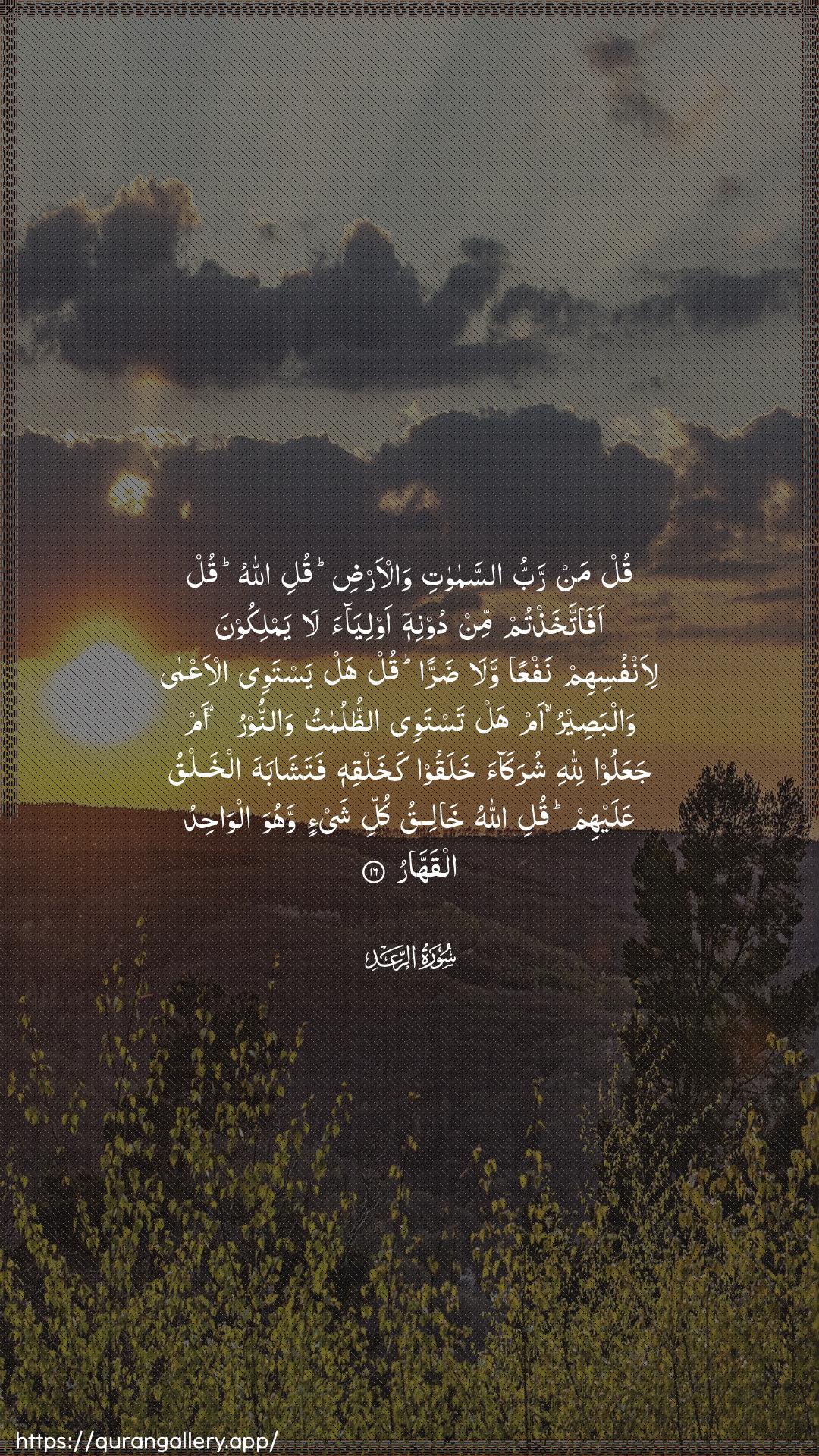
Arabic
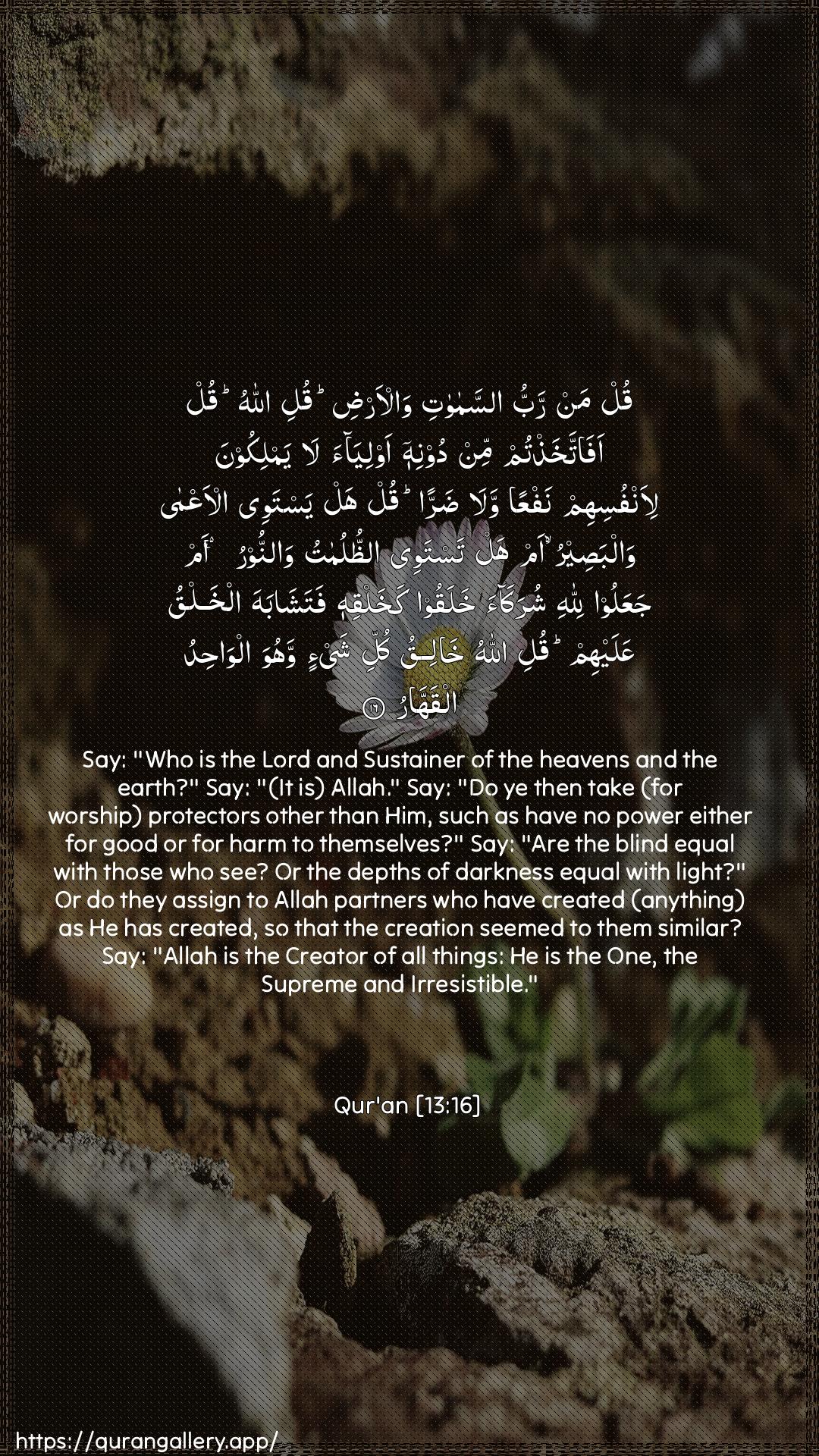
Arabic + English
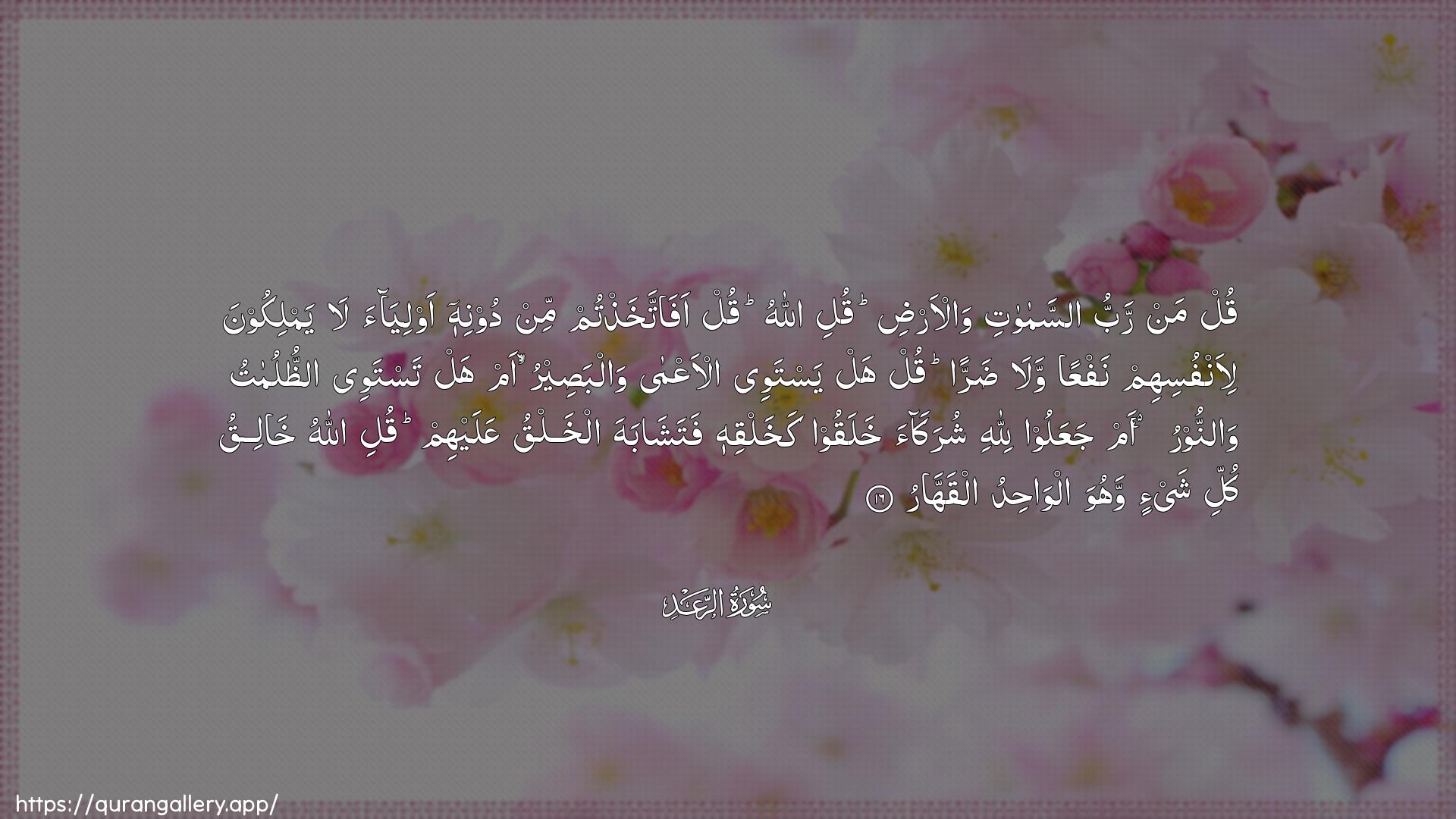
Arabic (Wide)
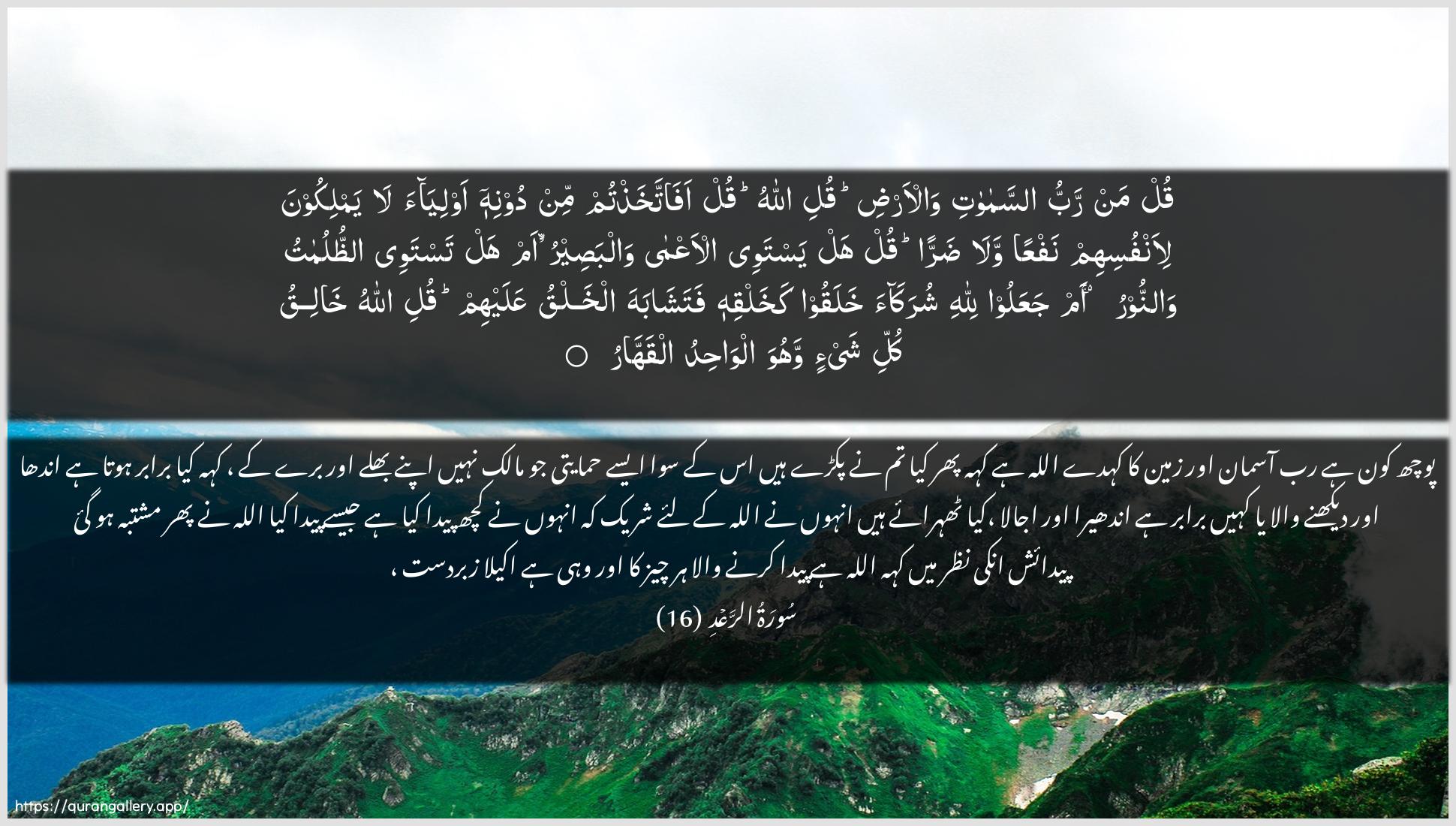
Arabic + Urdu
Free for personal & educational use with attribution
Quick Facts about this Verse
Surah
Ar-Ra"d
Revealed
Madani
Position
Juz 13
Explore this Verse
Verse Meaning
According to the classical scholar Ibn Kathir, Quran 13:16 delivers a decisive argument for Tawheed (the Oneness of Allah) by exposing the powerlessness of false deities. The verse commands the Prophet to challenge the polytheists with a question they cannot deny: 'Who is the Lord of the heavens and the earth?' The inevitable answer is 'Allah.' This admission becomes the foundation for a series of powerful rhetorical questions that dismantle the logic of shirk (polytheism). As Al-Qurtubi explains, the verse then masterfully employs metaphors to contrast belief with disbelief, asking if the spiritually 'blind' can be equal to the 'sighted,' or 'darkness' equal to 'light.' This illustrates that the believer, guided by the light of revelation, is fundamentally different from the disbeliever, who is lost in the darkness of ignorance. The synthesis of classical tafsirs reveals a profound insight: the verse systematically eliminates any justification for polytheism. It first establishes the idol's impotence—they cannot even benefit or harm themselves. It then moves to a logical challenge: have these partners created anything like Allah's creation, causing confusion? The answer is a resounding no. This comprehensive refutation culminates in the ultimate declaration of divine authority: 'Say, Allah is the Creator of all things, and He is the One (Al-Wahid), the All-Prevailing (Al-Qahhar).' As As-Saddi clarifies, this final statement leaves no room for doubt, affirming that the sole Creator is the only one worthy of worship, and His power is absolute and irresistible over all creation.
Questions for Reflection
Personal Transformation
The verse asks, 'Are the blind equal with those who see?' As Al-Qurtubi suggests, this refers to the spiritually blind versus the sighted. In which specific areas of my life am I choosing to be 'blind' to the truth for convenience or desire? What is the 'light' of guidance available in the Quran and Sunnah that I am ignoring in that area?
Relational Wisdom
The verse critiques taking 'protectors' (awliya) besides Allah who 'have no power either for good or for harm to themselves.' Ibn Kathir explains this refers to false deities and idols. Beyond literal idols, what intangible things—wealth, status, people's opinions—have I taken as 'protectors' that have no real power to benefit or harm me in the ultimate sense?
Cosmic Perspective
The verse concludes, 'Allah is the Creator of all things, and He is the One, the All-Prevailing (Al-Qahhar).' Reflect on one magnificent aspect of creation (a galaxy, a cell, an ocean). Now, contemplate that the One (Al-Wahid) who created it is also Al-Qahhar, the One with irresistible, prevailing force over it and everything else. How does this resize your personal worries and fears?
Practical Applications
Develop 'Spiritual Sight' by actively contrasting light and darkness in daily choices, asking if an action leads to the clarity of faith or the confusion of disbelief.
Apply when choosing entertainment, making business deals, or engaging in online discussions.
Construct a 'Tawheed Ladder' in your mind. Start with the agreed-upon premise (Allah is the Creator) and logically ascend, step-by-step, to the conclusion (only He is worthy of worship), just as the verse does.
Use this mental model when confronted with atheistic arguments or when explaining the core of Islamic belief to others.
Internalize the attributes 'Al-Wahid' and 'Al-Qahhar' to overcome feelings of helplessness. Remind yourself that the 'One' who created everything is also the 'All-Prevailing' who has ultimate control over your situation.
Recite and reflect upon 'Ya Wahid, Ya Qahhar' during times of personal trial, career uncertainty, or when feeling overwhelmed by world events.
Hidden Gem
The synthesis reveals a hidden contemplation: the verse itself is the 'light' (nur) it speaks of. By engaging with its logical progression, as analyzed by Al-Tabari, the darkness of confusion (shirk) is dispelled. Contemplating the *structure* of the argument itself—from the undeniable premise to the irrefutable conclusion—is an act of moving from the 'darkness' of doubt to the 'light' of certainty, a spiritual exercise embedded in the verse's very design.
Scroll to see more verses or use the dropdown in the breadcrumb to jump to any verse
Common Questions
2 more questions available in the full page