
Yusuf - Joseph
Arabic Name: يُوْسُف
Urdu Name: یوسف
Type: Makki
Serial Number: 12
Revelation Order: 53
Total Verses: 111
Parah: 12,13
Rukus: 12
Sajda: None
Share Verse Art

Arabic

Arabic + English

Arabic (Wide)
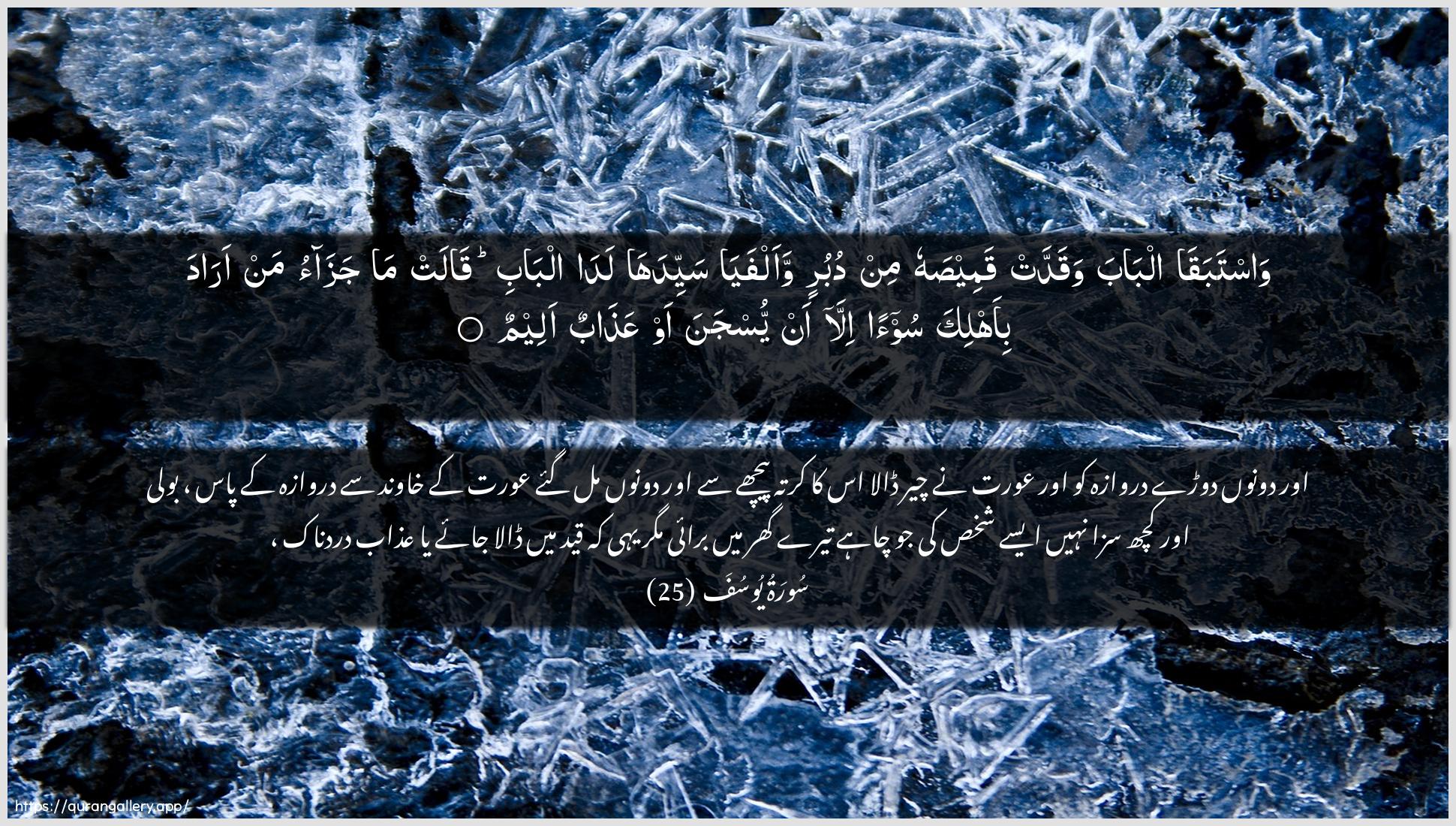
Arabic + Urdu
Free for personal & educational use with attribution
Quick Facts about this Verse
Surah
Yusuf
Revealed
Makki
Position
Juz 12,13
Explore this Verse
Verse Meaning
According to the classical tafsir of Imam Al-Tabari, Quran 12:25 captures the climactic moment of Prophet Yusuf's trial, where his spiritual resolve transforms into physical action. He explains that the phrase 'Wastabaqa al-bab' (They raced to the door) signifies two opposing intentions: Yusuf racing away from sin towards salvation, and the wife of the Aziz racing towards transgression to prevent his escape. This comprehensive analysis, supported by Ibn Kathir, highlights the physical manifestation of a spiritual battle. The tearing of the shirt 'min dubur' (from behind) is not merely a detail but the central piece of evidence, a divine sign of Yusuf's innocence. Al-Qurtubi further elaborates on this point, viewing it as a foundational example of using circumstantial evidence (al-qiyas) in Islamic jurisprudence. The synthesis of these scholarly views reveals the verse as a pivotal narrative point where a private spiritual struggle becomes a public trial, and Allah's plan begins to unfold through tangible proof. Upon being discovered by her husband, the woman's immediate and cunning accusation—'What is the recompense for one who intended evil for your wife?'—is, as Al-Sa'di notes, a masterful deflection, shifting the blame to preserve her honor. This comprehensive scholarly understanding shows the verse's multifaceted layers: a test of faith, a lesson in divine justice, a legal precedent, and a profound psychological study of guilt and innocence.
Questions for Reflection
Personal Integrity
Yusuf raced towards a closed door, not knowing if it would open, but certain he had to flee the sin. Reflect on a time you faced a 'closed door' in your effort to do the right thing. How does Yusuf's certainty in action, despite an uncertain outcome, inspire your own taqwa and tawakkul?
The Nature of Evidence
Al-Qurtubi highlights how a simple torn garment became irrefutable proof. Contemplate the 'small evidences' in your own life that Allah might be using to guide you or reveal a truth. Are you attentive to the subtle signs He places in your path, or do you only look for grand miracles?
Responding to Accusation
The wife immediately crafted a narrative of victimhood and blame. Reflect on your own initial response when your faults are about to be exposed. Do you lean towards deflection and blame like her, or can you cultivate the quiet confidence in the truth that Yusuf demonstrates in the following verse?
Practical Applications
Physically Flee from Fitnah (Temptation): When faced with a compromising situation, do not negotiate or hesitate—actively and immediately move away from it.
Leaving a social gathering where inappropriate behavior is occurring, closing a browser tab with tempting content, or ending a conversation that is heading towards gossip or slander.
Trust in 'Circumstantial Evidence' from Allah: When falsely accused, maintain composure and have faith that Allah will manifest signs of your innocence, even in seemingly small details.
In a workplace dispute, remaining truthful and calm, trusting that emails, records, or the testimony of others will eventually clarify the situation.
Recognize the Accuser's Psychology: Understand that a person quick to make a loud accusation upon being discovered may be deflecting their own guilt.
Navigating personal conflicts or public disputes where the guilty party employs a strategy of 'the best defense is a good offense'.
Hidden Gem
The synthesis of the scholars' views reveals a profound spiritual dynamic: Yusuf's internal spiritual state (taqwa) directly manifested as external physical evidence (the shirt torn from behind). Contemplate how your own internal spiritual states—your sincerity, your fears, your intentions—leave physical traces and evidences in the world around you, even when you are not aware of them.
Scroll to see more verses or use the dropdown in the breadcrumb to jump to any verse
Common Questions
3 more questions available in the full page